Gunnedah, Gulargambone and Coonamble

I have included an map of my travels so far.  The map shows the zig zag journey necessary to pick up the art sites, 2400 Km and not even in Qld yet.


On Monday I stopped at Gunnedah where the old water tower is now a museum.  The artwork commemorates the Australian Army battle at Long Tan in Vietnam.  Two thousand  Viet Cong attacked 108 young and mostly inexperienced Australian and New Zealand soldiers on patrol on a shattered rubber plantation, Long Tan.  For 3-1/2 hours they held off the attackers until support arrived. The Battle of Long Tan is one of the most savage and decisive engagements in ANZAC history, earning many individual gallantry awards.


A couple of close ups of vignettes on the tower:


I stayed at the Top caravan park, the only one in town which was a very nice park but one of the toilets was so small you had to stand beside the pan to open the door to get out!  Another early start, on the road at 7.30 which gets me to the destination by around 1.00 leaving the afternoon for whatever I want to do.  I have averaged 300 Km per day on the days I have travelled which is comfortable for me.  I could do more as I arrive on site not tired, but I enjoy an early finish to the days travel.

Today, Tuesday, I was heading for Coonamble via Gulargambone.  The country I have travelled in NSW is barren except for the gum trees, very dry and most farms are empty of stock and the dams are nearly dry.  For example, Tamworth is down to 22% capacity in their water supply dam.  There has been so little rain that some crops are hardly out of the ground and some are browning off already and will deliver no grain.  But in some areas crops are doing quite well, so they must have had some good rain but in a narrow area.  Mudgee was sad to see, usually green with nice gardens and parks, everything is brown, there is no green grass anywhere and bushes in the gardens are dead.  Only the trees are green, which is typical in most of the towns I travel through.  You really feel for people living in these areas who are trying to make a living.

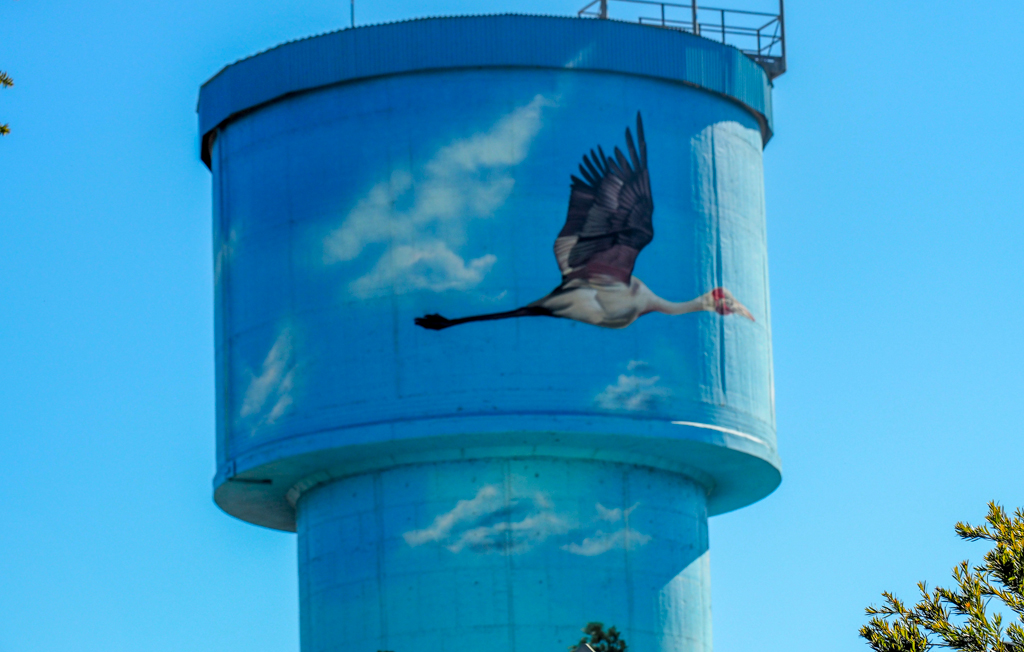
The Gulargambone water tower is a relatively new tower and was painted by Jenny McCracken and she named her Kingfisher artwork “Lucky Dip”.  The detail in the artwork is excellent showing a kingfisher diving under the water to catch a fish.


A closeup of the kingfisher:


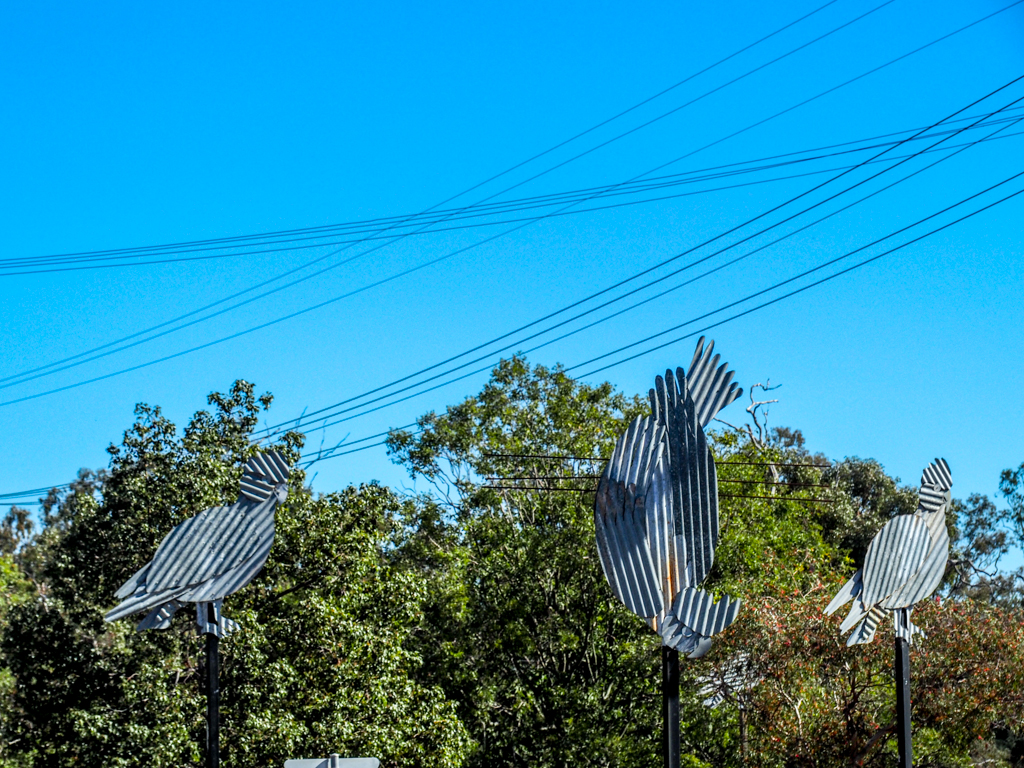
On the approach to Gulargambone there is a series of Cocky artworks and some more in the town.


After Gulargambone it was on to Coonamble where I will spend the night.  Coonamble is near the Pilliga scrub and Timmallallie National Park where I camped in 2017.  The sculptures in the park are wonderful.  The tower in Coonamble is decommissioned and the artist who painted it is John Murray from Lightning Ridge, it is the first mural he has painted.  John included galahs, which he thought represent community, plus fence posts to signify the rural aspect of Coonamble, and the sun, moon and Southern Cross.  The tower art is very well done and impressive.


Galahs are pictured right around the tower and here are a couple of close ups:


Another couple of views of the tower:


Tomorrow (Wednesday) I am off to Queensland but no silos or towers for a couple of days, so maybe no posts for a couple of days.

Posted in 2019 | Leave a comment

Merriwa Tamworth and Barraba

As I crisscross NSW I am finding the GPS ignores minor roads which can significantly extends the journey.  Today I had Google maps on the iPad, the inbuilt GPS and the Tom Tom all programmed to the destination and none was going the way I wanted.  So I had to pick intermediate towns and include them to get the GPS’s going on minor roads, which can be a bit rough with potholes but I find are generally OK.  Today there was a difference of 100 Km between the route I wanted and the one the car GPS chose.

The drive on Sunday was through very hilly country with a couple of long descents where I had to select first gear so I didn’t have to use the brakes all the time.  Into Sofala was very steep with an equally steep climb out.  Marg and I visited Sofala in 2014 and this is what Margie had to say about that visit

“The countryside has been very hilly and we were looking for a place where we could buy a couple of sandwiches for our lunch.  We came down a very steep hill into Sofala and found a little General Store, selling food.  Mrs Mac was the grumpiest little old lady I have ever come across.  After ordering two ham and salad sandwiches, she clicked her tongue when I asked for salt and pepper and when I said that $16.25 was quite expensive, she went on a tirade about the cost she has to incur because of EFTPOS.  She asked me if I wanted to see her telephone bill and see the charges.  Russ took a photo of the old Sofala Hotel on the main street, which is only wide enough for two cars to creep past each other.  The hill into Sofala from the north is the steepest we have encountered on a main road and is about 1.2 Km down all the way.”  So I didn’t call in for a snack this time!


I visited the Merriwa silos on the way and I was disappointed with them compared to others I have seen on the way.  They lacked detail and were missing the extra elements such as trees and birds that the others included.  The buildings in the background are new grain storage sheds.


Another couple of views of the silos:


I am camping tonight at Willow Tree where a power site in the rec ground is $15 a night and there is a water tap to connect to as well.  Monday will see me heading through Toowoomba and Baraba.

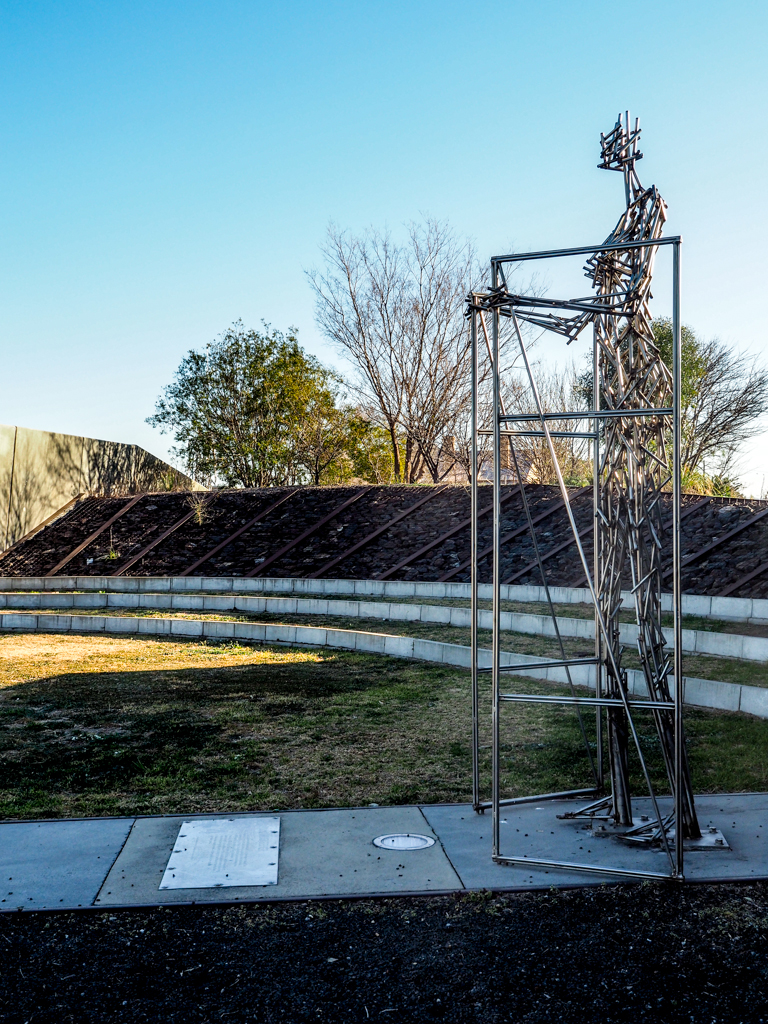
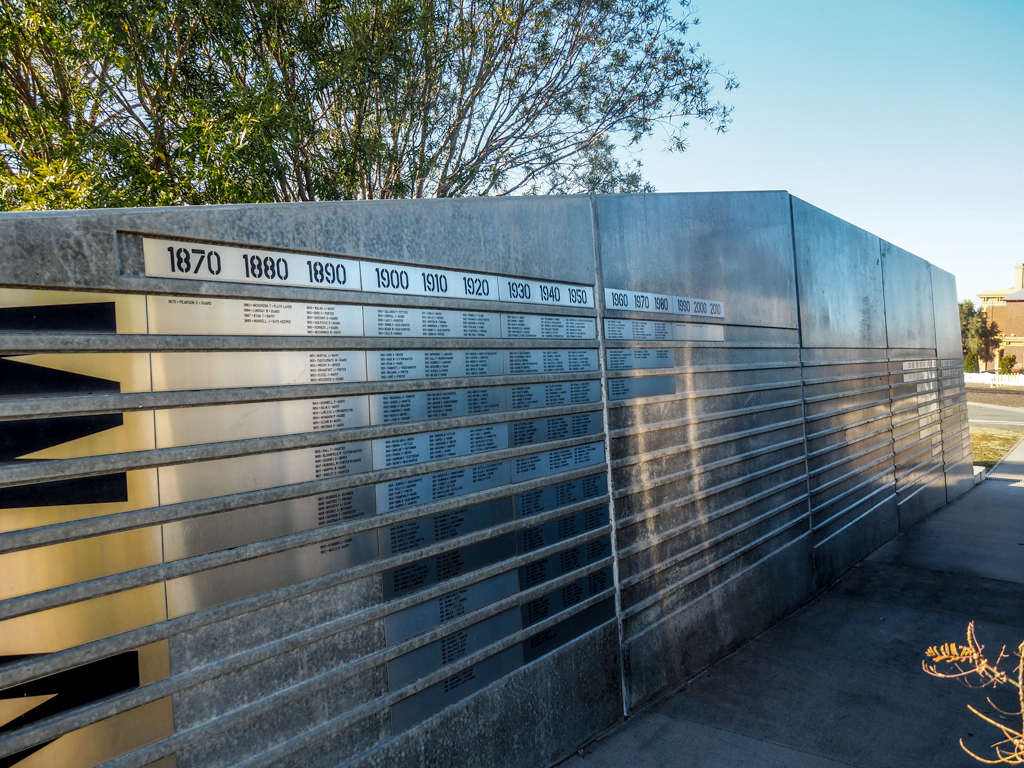
On the way to Toowoomba I visited the railway museum at the Werris Creek railway station, the museum wasn’t open but I could view the statues outside.  They are made of stainless steel tubes welded together and they are set in a landscaped area.  I parked away from the station and approached the station through a memorial wall thaat has the names of all the railway workers killed in Australia, 150 in total, which is quite amazing to me that there were so many.


The statue shown above if of a gatekeeper who opened and closed the railway crossing gates.  They were usually the wives of fettlers or other railway workers and worked a 12 hour day.

At the entrance to the memorial wall is a statue of a fireman:


I wish that person had not parked their van there!  There were two more statues, one of a signal woman on the left, not sure why she is on a diving board, and a station master on the left.


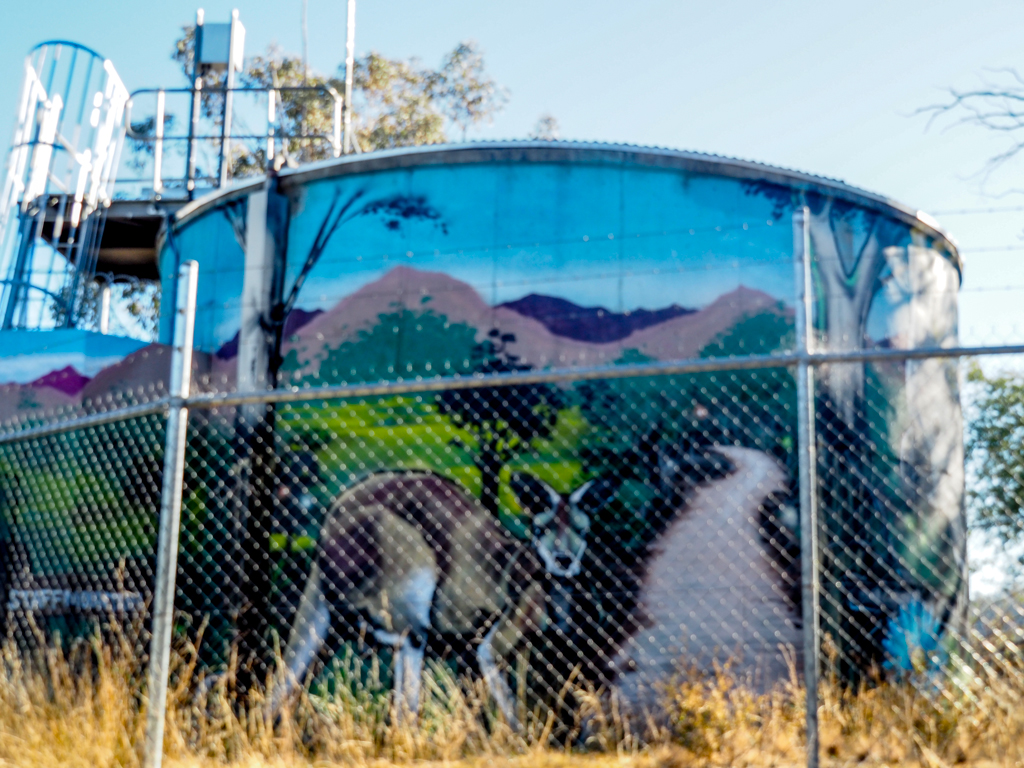
Next stop was Tamworth where the water tower was at the top of a steep climb plus a steep but short walk, had me puffing.  The tower was behind a cyclone fence so it was a bit hard to exclude the wire and in a couple it was not possible.


I particularly liked the Cocky:


But the butterfly and the rainbow lorikeet were also very good.


The descent from the tower was first gear all the way plus regular braking to reduce speed build up.   From Tamworth I went to Barraba where there are three painted silos.  While in the town I bought a caesar salad wrap which was delicious with two chicken fillets, bacon, an egg and salad all for $9.50, what a bargain.  The silos were all painted with the same water diviner on each and painted by Fintan Magee.  The artwork was excellent but I would have preferred a different character on each silo.


From Barraba I headed for Gunnedah where I will spend the night and visit the water tower and the artwork that commemorates the battle of Long Tan that the Australian army fought and won.


Posted in 2019 | 4 Comments

Grenfell and Portland

On Friday I moved on from West Wyalong to Bathurst where I will stay for 2 nights.  It was interesting to see that the crops were quite stunted but still green, in contrast the grazing lands were mainly brown with faint tinges of green.  It would seem the rain in NSW has been quite patchy, with some areas getting little rain.

The only silo on the way to Bathurst was at Grenfell where Margie broke her wrist tripping on a footpath discontinuity on the third day of a 2 month holiday.  She was taken by ambulance, a painful journey, to Orange hospital where they fixed and set her wrist.  I was eventually able to get a good settlement from the insurers for the caravan park.

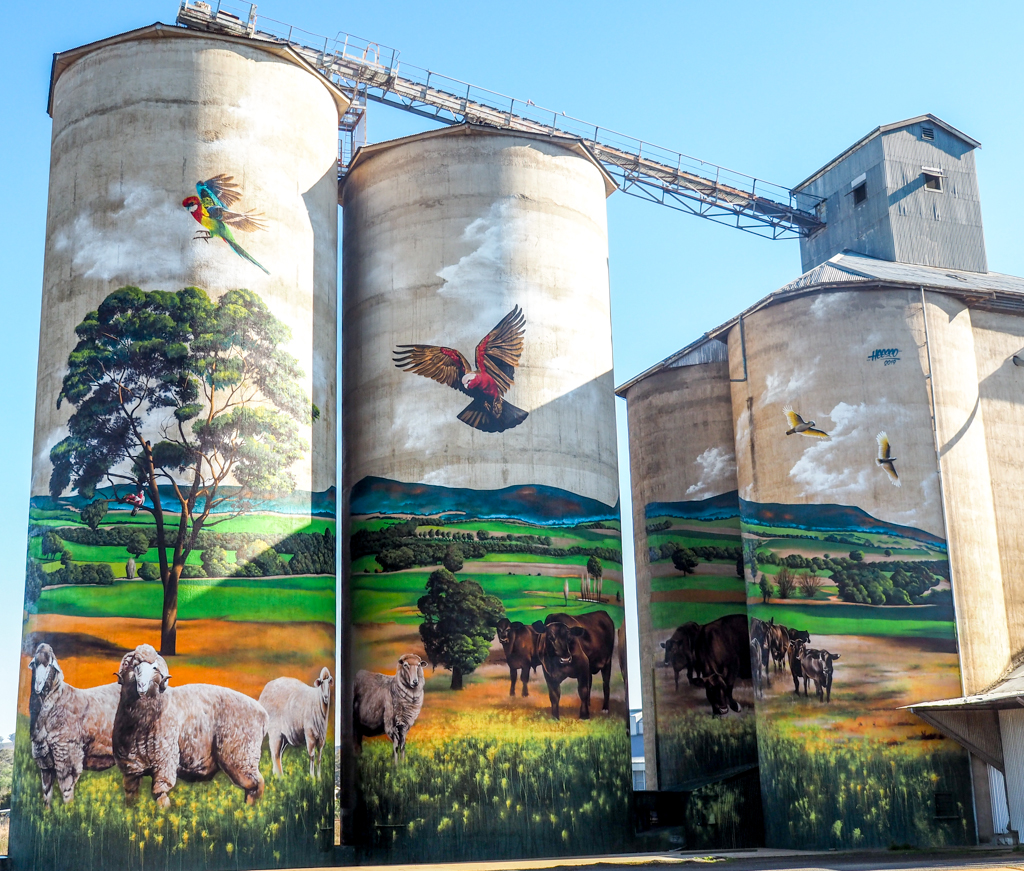
The lady who painted the silo took 5 weeks and used 180 litres of paint plus 800 paint spray cans.  The silos are owned by a company run by locals who financed the painting as a legacy to Grenfell.

The silo art reflects the farming nature of the shire and has the Weddin Mountains National Park in the background.  We had a great day in the national park including the usual picnic lunch, visit to Ben Halls Cave and a visit to an early farm where the dirt floored cottage and farm sheds and equipment were still in place.


The sheep were so realistic you felt you could touch them and feel the wool, the cows were also very real.  In the photo of the cows the lines down the photo are from where one silo meets the next, the middle silo is in shade.


At Bathurst I stayed at the showgrounds where there are no facilities except an old but clean amenities block; but only $25 a night with power and water on the power sites.

I visited the cement silos in Portland on Saturday.  The cement we use today is called Portland Cement but not because it was made in Portland.  The cement name is derived from its similarity to Portland stone, a type of building stone quarried on the Isle of Portland in Dorset, England.  In his 1824 cement patent, Joseph Aspdin called his invention “Portland cement” because of the its resemblance to Portland stone.

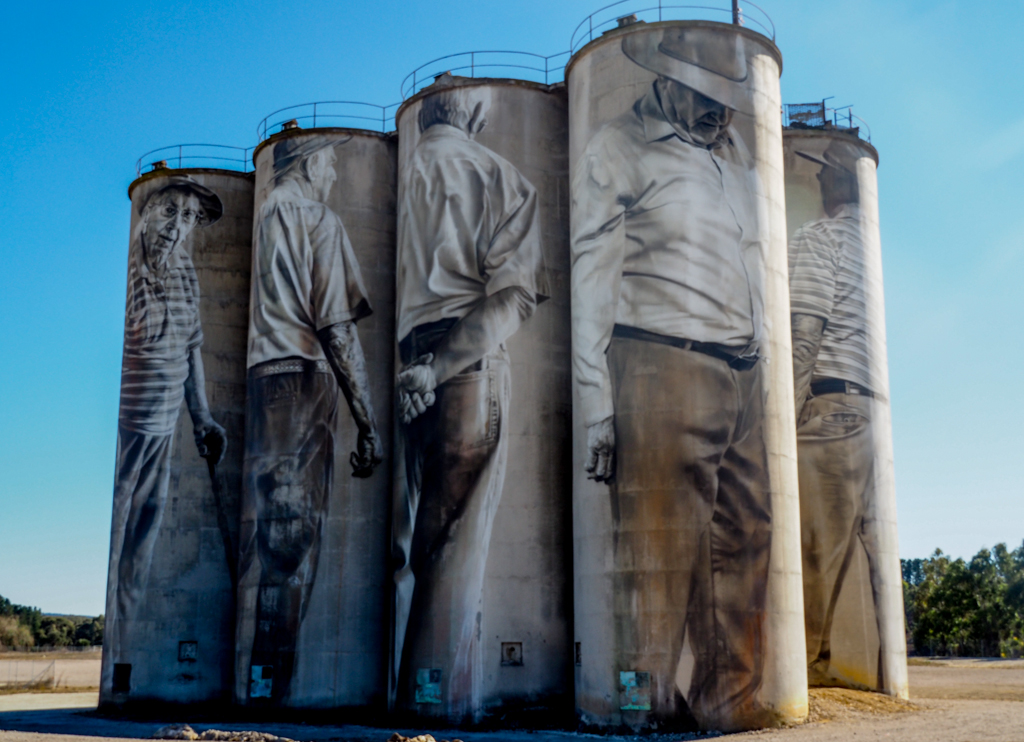
Portland is about 50 Km from Bathurst through hilly scenic country, an easy drive.  There are five silos painted in sepia tones all of workers from the old cement works; they were painted by Guido Van Helten.  They are excellent but I’m not sure why some are painted from a rear view.


The photo below shows the two end silos and part of the old cement works.  The chimney would have been on the kiln because the process of making cement involves roasting crushed limestone, silica, alumina and iron oxide.

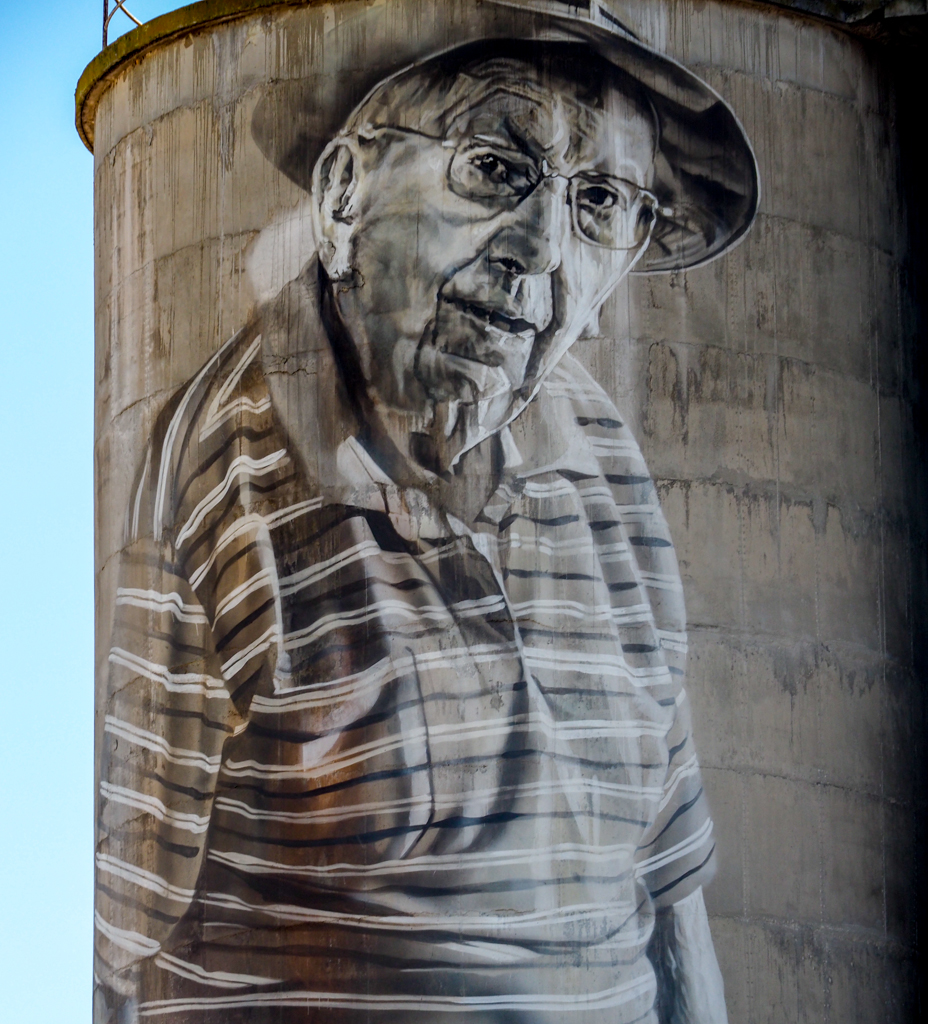
 The next photo is of a woman who worked in the office of the cement works:


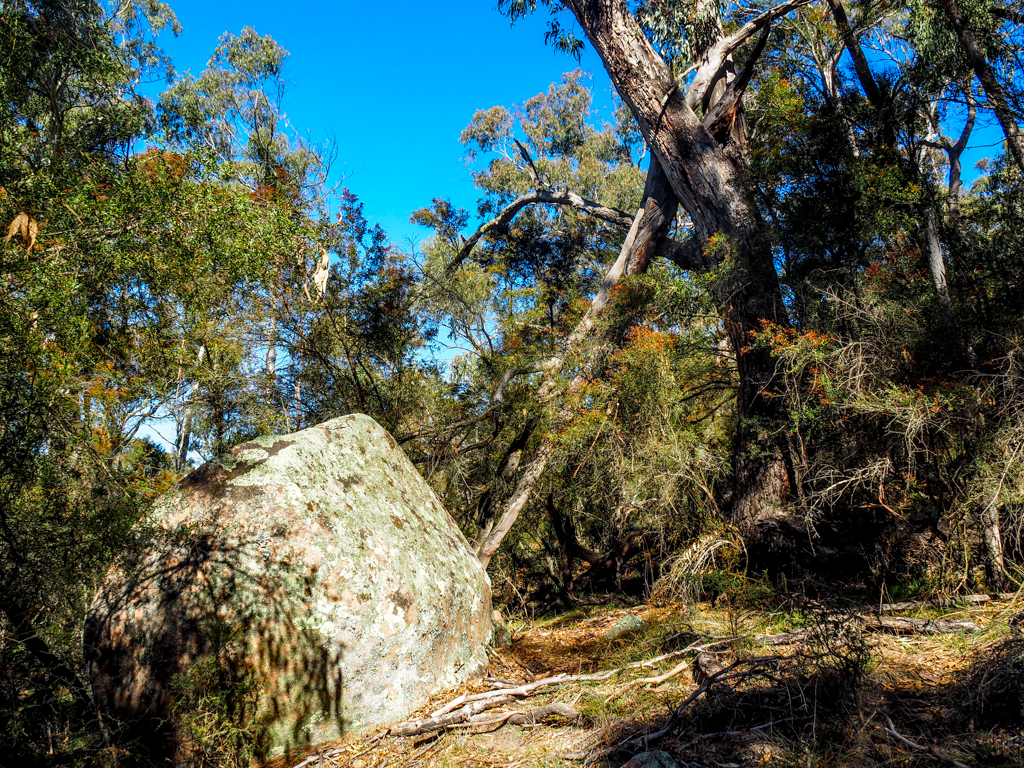
After visiting the silos I travelled to Tarana about 30 Km away and the nearby Evans Crown Nature Reserve which protects 425 hectares of remanent dry eucalypt forest scattered with large granite boulders (Tors).  It was proclaimed in 1975 and named after George Evans who followed Blaxland et al across the blue mountains and went further into the bathurst area.  He did this in 1813.  I started on the climb to the top and got about halfway but after about 150 steps I thought better of it.  It was good to hear a lot of different birds, but there were no wildflowers or orchids.


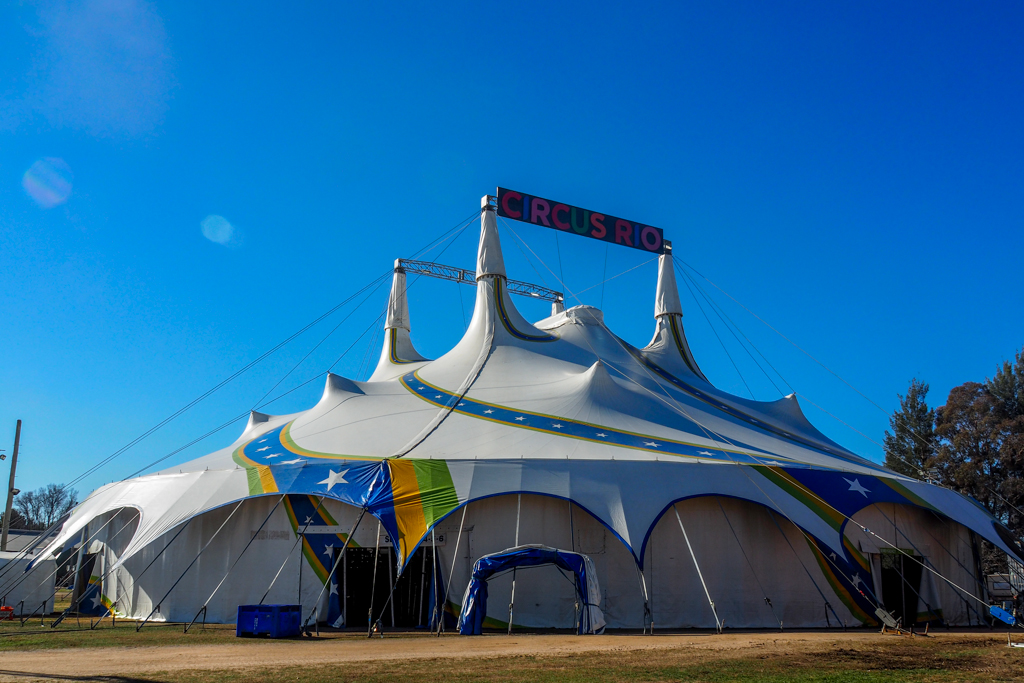
At the showgrounds there was also a circus, Circus Rio, being set up and it had quite a fancy tent shown above.

On Sunday I will travel to generally north to Willow Tree and on the way visit a silo in Merriwa.


Posted in 2019 | 6 Comments

Silo Art Wagga to Weethalle

The weather on Thursday was beautiful, but the start was very chilly; when I set of at 7.45 it was still 0 °C.  The max was 16 °C and sunny blue skies all day.  The water in the hose from the tap to the caravan froze so I had to use the caravan tank water, the first time that has happened to me.  I’m glad the van was coupled up as my hands were freezing just lowering the roof and packing up the power lead and water hose.  I also had to de-ice thick ice from the windscreen.

The drive to Wagga Wagga was though farming country and everything was green and the crops looked good, which was the same on the next phase to Narrandera.  The water tower at Wagga is on top of Willans Hill which overlooks the city.  I’m glad I came in from the southern end of Captain Cook Drive as the descent I exited by would have been a very steep climb with the caravan, I had the car in first gear all the way down.  The view over the city was extensive but it was a bit foggy so no photos.

The theme of the tower was water but there were no information boards to explain the thinking.  This photo shows all the artwork.


I took a couple of other photos of the two boys.


The Narrandera tower was at the top of a hill with a view over the town.  It was interesting to learn that Narrandera is an aboriginal word for “place of many lizards” hence one of the artworks was of a frilled neck lizard.


The Koala was chosen because Koalas were common in the area at settlement, but the Koala population had been wiped out by 1950 through hunting for the fur trade.  Community action in 1972 saw four Koalas put into a reserve and a few more added in the next couple of years.  They are now very well established and have spread up to 100 Km from Narrandera, a real success story.


The blue line weaving around the tower represents the Murrumbidgee river which flows through the town.  The tiger moth is part of the towns history as they were used at the RAAF base in the town in WW2 for initial pilot training.

Next stop was a Weethalle, this time for silos rather than water towers.  On the way I went through Barellan and dropped into the pub for lunch.  The only sign that meals may be available was a chalk board with “Kitchen Open” printed in chalk at the top of the board.  The barmaid didn’t know the cook’s name, she had to ask the owner, on her way to get him to explain what was available – pizza, spag bol, fish and chips and beef schnitzel with chips.  When I asked for salad he explained he had only been there two days so no salad.  Still the fish and chips were good.

The silos at Weethalle had a farming theme and were very well done:


I especially liked the shearer:


I’m off to Bathurst tomorrow where it is forecast to be -2 °C overnight both nights, I’m glad I have a heater and electric blanket, but I may throw another blanket over the doona (I turn the electric blanket off at night).  Tonight in West Wyalong it will be -1 °C, so maybe it will be a late start!  I will have to drain the water hose before I go to bed.


Posted in 2019 | 6 Comments

Deniliquin and Lockhart Water Tower Art

Wednesday now and I’m heading for Lockhart via Deniliquin, a 380 Km trip that would be only 200 Km without the diversion to visit the Deniliquin water tower.  I woke early so I got up, (I thought about a snug shower in bed but decided it wouldn’t work),had a shower and was on the road by 7.30.  It was an easy drive, but the GPS wanted to take me a different way, so at one stage I had the car GPS, the Tom Tom GPS and Google maps giving me directions and they were all different.  I had checked the way I wanted to go the night before so I knew which GPS to follow at each turn.  I was interesting the Google Maps wanted me to go done narrow dirt roads and also through shut gates.  The estimated time on Google maps was about 3 times what it took.

NSW is green like Victoria, but the grass and crops are much lower than in Victoria so cit would seem they have had less rain.  The water tower at Deniliquin was a very good one also painted by Cam Scale who did the Devenish silos in Victoria, which were also very good.


The next stop was at Lockhart where I would stay overnight at a council caravan park, it is well set up with 4 new individual toilet/shower rooms for us to use and flat grassy sites.  Of course there is the necessary power for the heater and electric blanket.  The water tower in Lockhart was decorated in paintings of birds, which were all very well done.  It was painted by Blue Mountain artists, Scott Nagy and Janne Birkner (Krimsone) and has a waterfall in the section where the parrots are painted.


The tower is in a small garden and has some small trees and buildings next to it so as you approach you see a stork painted on the top of the tower and that excites your interest to see the rest.  The next bird you see is a magpie, both birds are in the photos above.


The above photo shows the an Eastern Rosella, a couple of Galahs and a Kookaburra with a waterfall in the middle.  The painting of the Eastern Rosella was excellent, so realistic.


The galahs were not too bad either!


The small garden around the water tower had three sculptures and I especially liked the cocky and the two emus.


Tomorrow, Thursday, I am off on a circuitous journey to Wagga Wagga, Narrandera to then finish overnight at Weethallo where there is also silo art to view.

Posted in 2019 | 4 Comments

Benalla District Silo & Water Tower Art

It is encouraging to see everything nice and green in this part of Victoria and the crops are looking perfect for this time of the year and they just had a good fall of rain.

I started Tuesday by heading off to Winton Wetlands where Lake Mokoan has been drained and they are working on re-establishing the wetlands.  It is a hugh area but at the moment it is mostly covered with dead red gums killed when the wetlands were flooded a long time ago.  The lake was too shallow for its irrigation purpose so killing all those trees and devastating the ecology was for no good purpose.  Anyway the recovery process is in place.

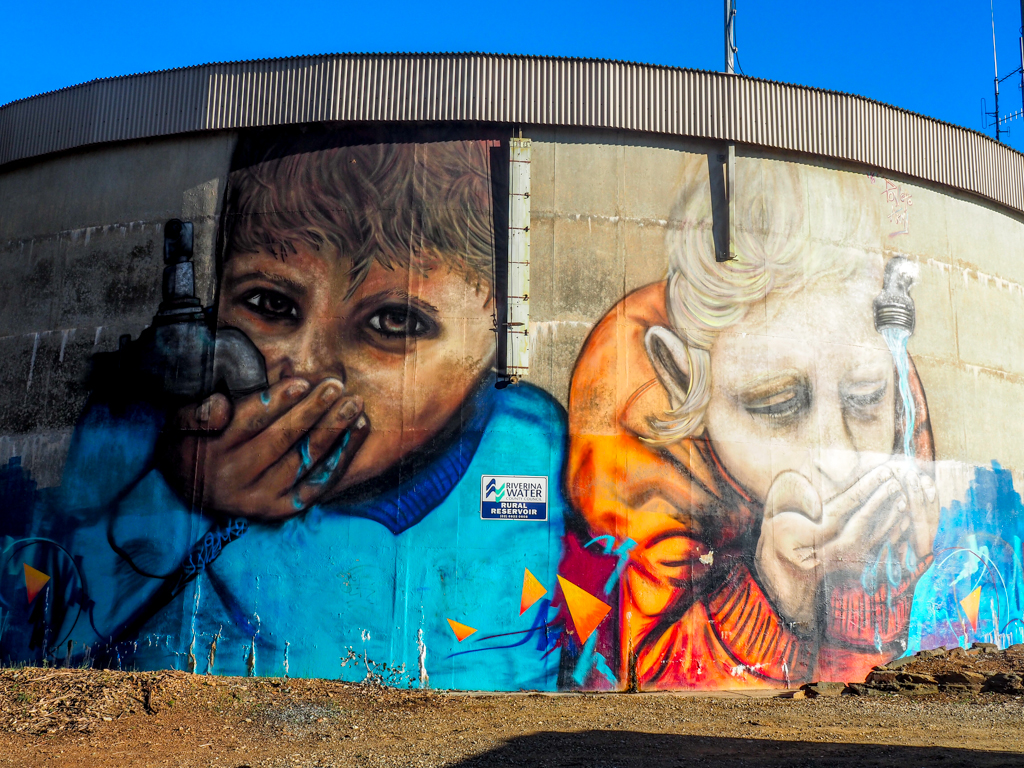
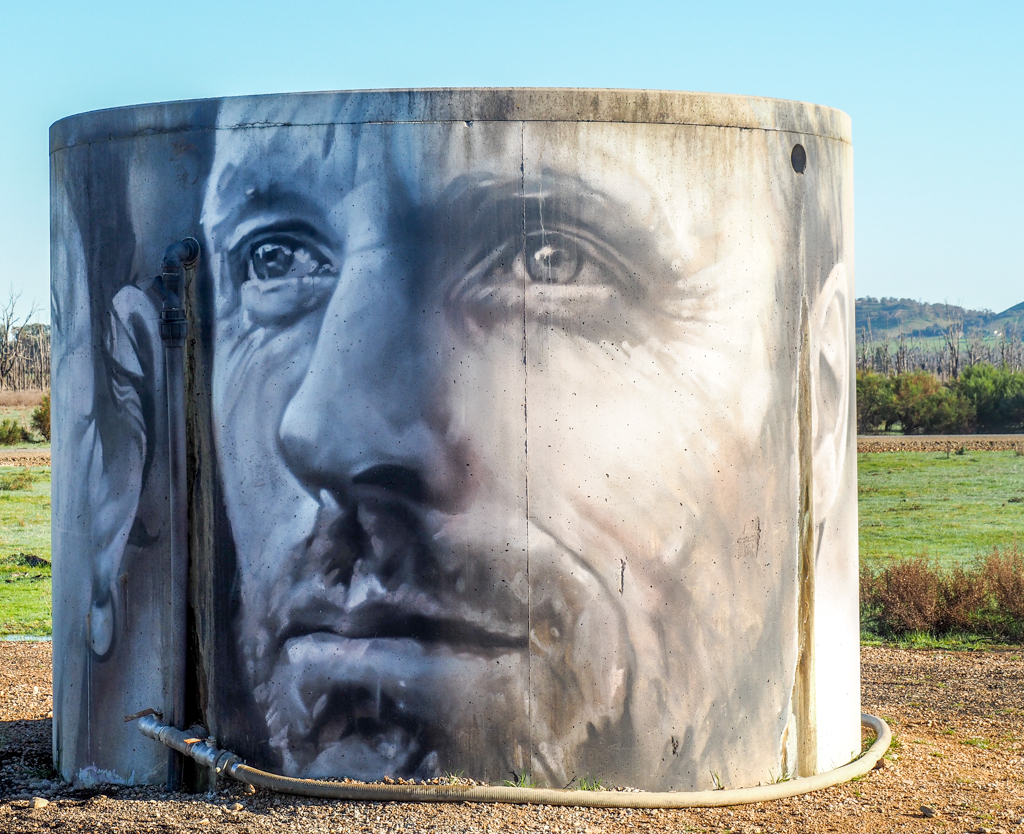
I visited public art on a CFA water tank in the middle of the dry lake, excellent painting of three CFA volunteers, but now two a damaged by water leakage.  Along the dirt road in, you travel on Boggy Bridge Road where there are some painted fish trees.

After this excursion I stopped for a delicious breakfast of fried eggs, bacon, sourdough toast, orange juice and coffee at the Mokoan Cafe on the shores of the old lake, but there are trees around the cafe so it is an attractive location.  From here I traveled 50 odd Km north to Tungamah for the first silo painted in 2018 by Sobrane a female WA artists reputed to be the first woman to paint a silo.

I then turned south to St James to see a group of paintings of country life from the past.  We have two farmers sewing wheat bags and a retailer.

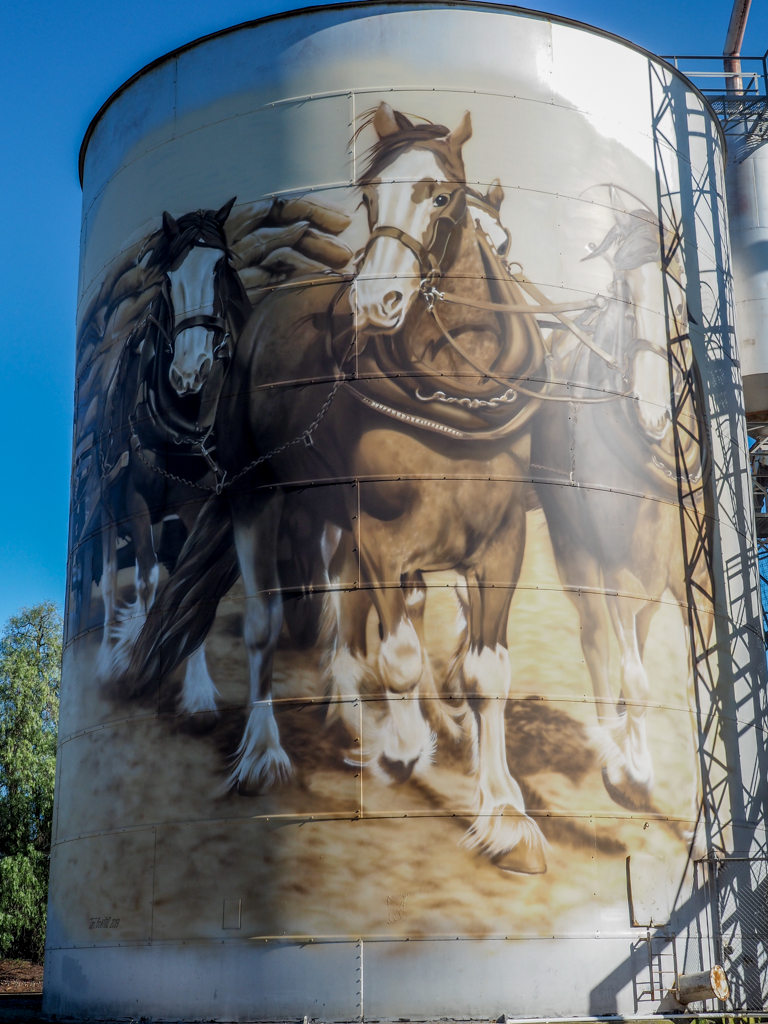
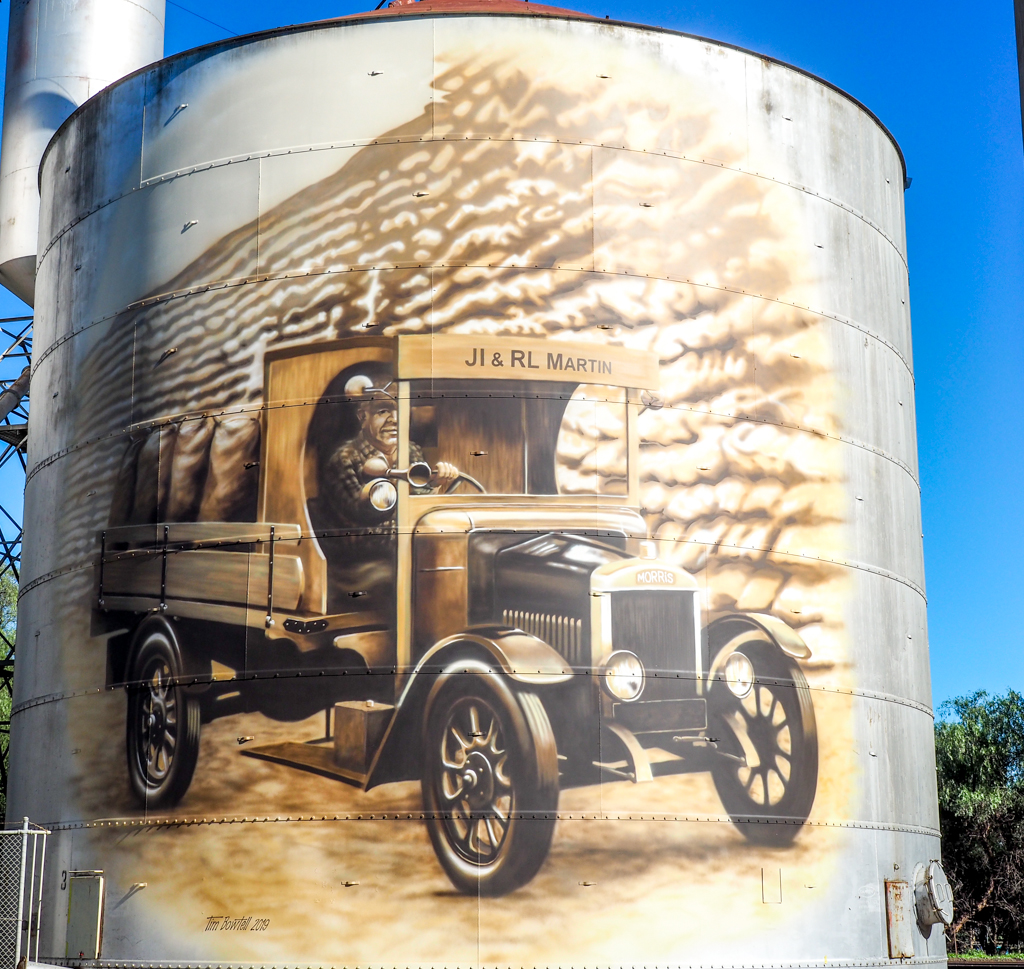
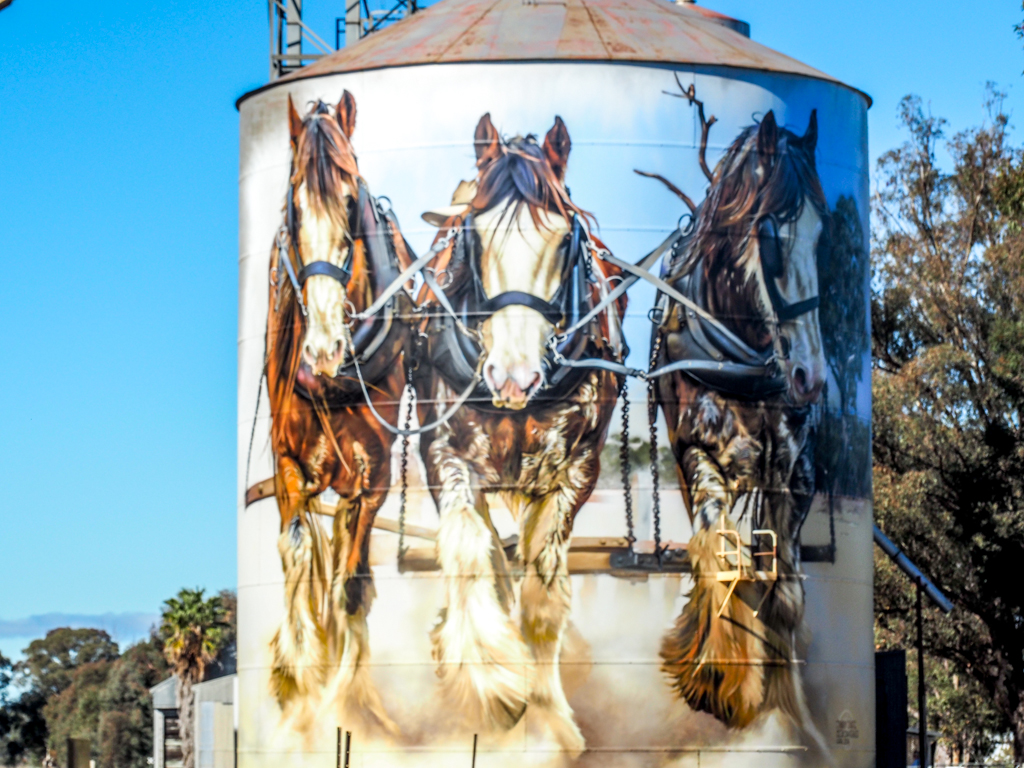
There were two other silos depicting a carrier in an old truck and another carrier with a team of clydesdales.

The photos below show in more detail the face of the retailer, which has excellent detail and one of the farmers.

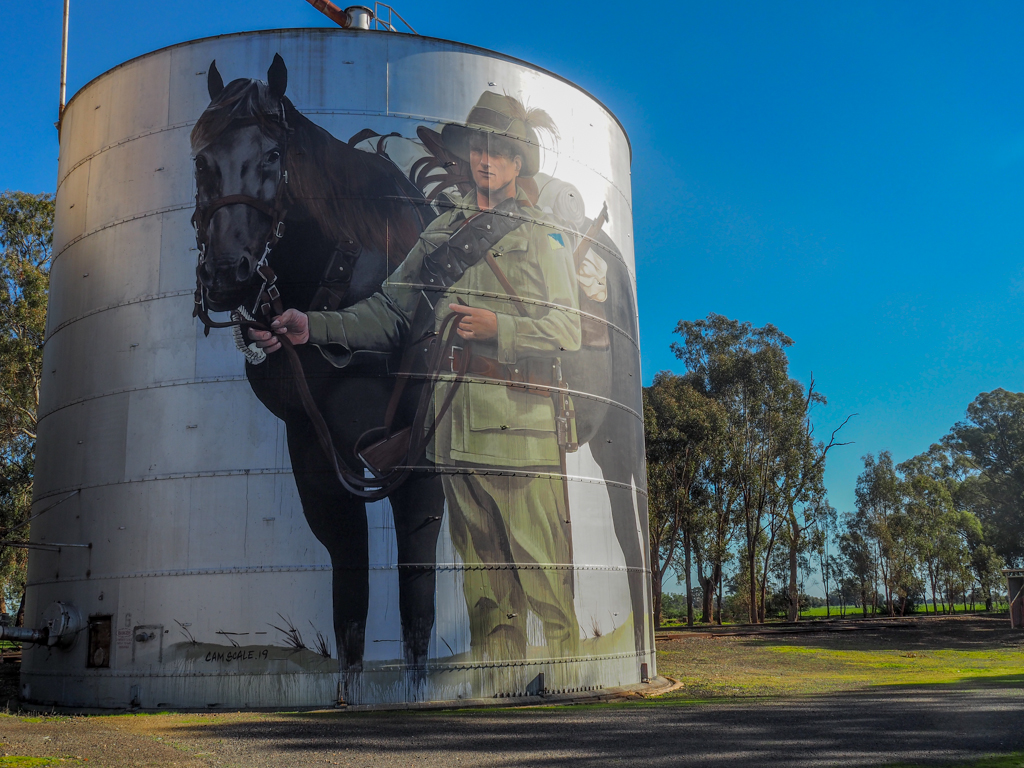
Now off to Devenish where a renowned silo artist Cam Scale has painted three silos depicting army nurses.

From here I travelled to the last silo art site at Goorambat where a female aspect of the holy spirit is represented in ‘Sophia’ is in the Uniting Church in the town, painted by Adnate.

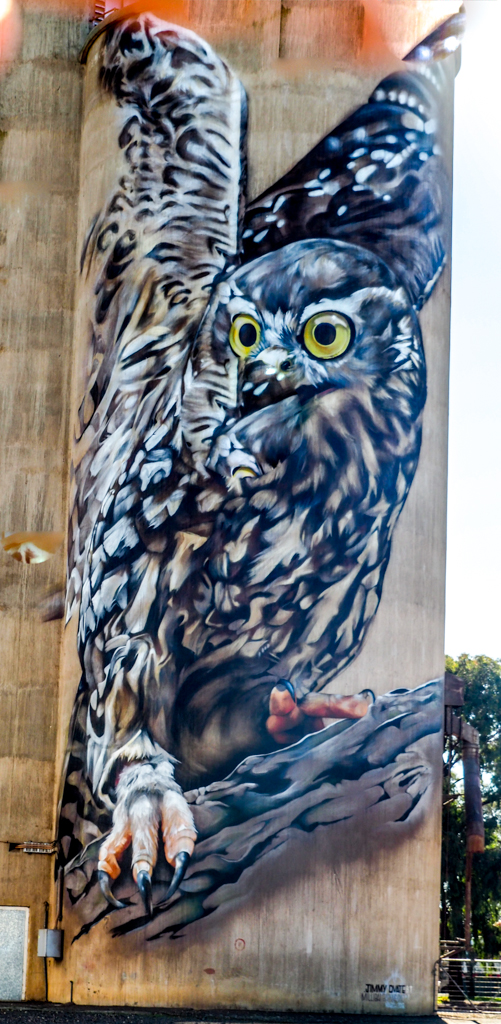
The silos in the town are also excellent painted by Jimmy Dvate and show Clydesdales and the threatened Barking Owl.

The gum tree has a tree hollow that Barking Owls use for nesting and it is the loss of this habitat that is threatening the survival of the owl.  It was a pity that most of the silos are privately owned and fenced off so it is hard to get a good angle for taking photos, especially in the morning with a low sun.

My journey continues through Deniliquin to to visit two more water tower sites with the night spent at Urana Showgrounds.

Posted in 2019 | 4 Comments

Benalla Street Art

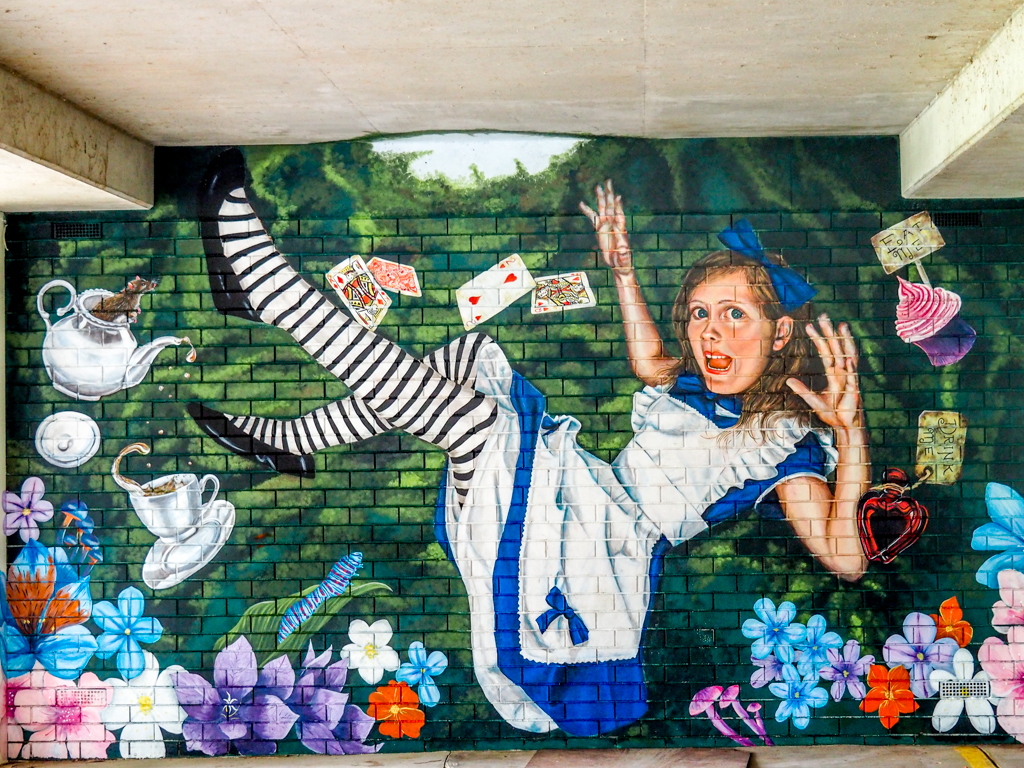
This winter I have decided to visit public art sites in Victoria, N.S.W. and Queensland.  The sites will include street art, silos and water towers.  I started of today in Benalla where there have been street art competitions since 2016, so there is a lot of street art, lots of it very good.

One problem is that quite a few of the sites, while great for painting and viewing, they are in difficult spots to get a good photo, but I tried.  Most of the art is around the city centre so I walked around several streets and then moved the car to a new area and walked that area.  It took me a couple of hours to cover most of the art, by which time I needed sustenance and a Kebab shop magically appeared.  Once you get the idea that you want a Kebab you must have one, so I did.  I didn’t need any dinner!

On the way to Benalla I visited Tatong where a tavern had reportedly been painted up.   While the tavern was quaint it certainly was not public art.

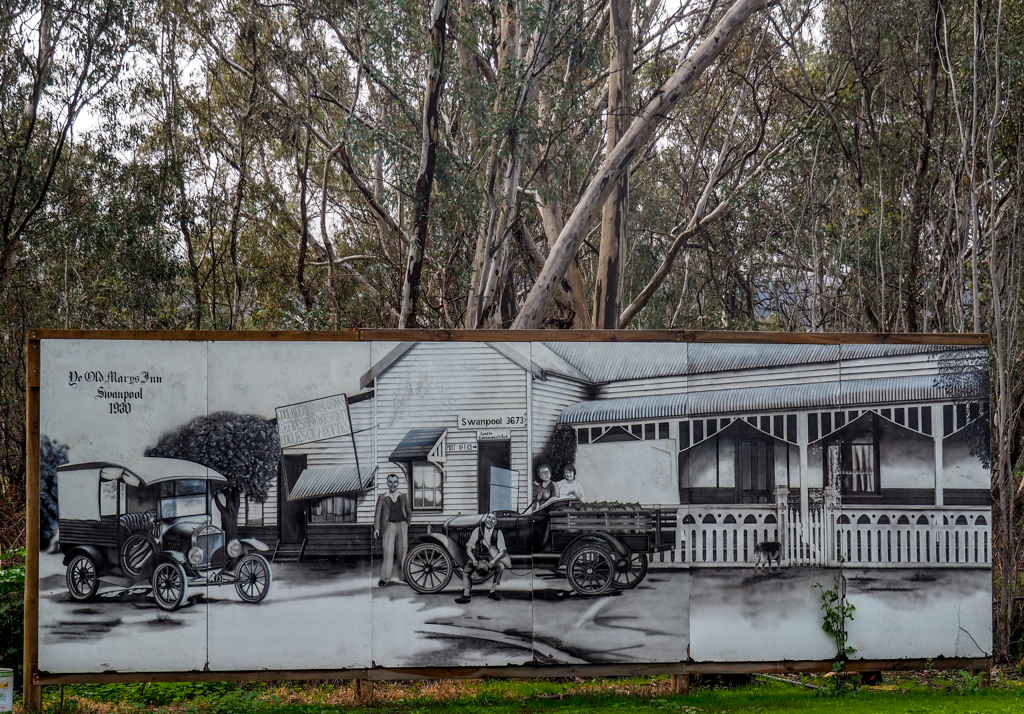
There was a 2000 litre tank painted with a scene and a large billboard painted as well.  Not the best start, but the side trip was not too far off a direct track.


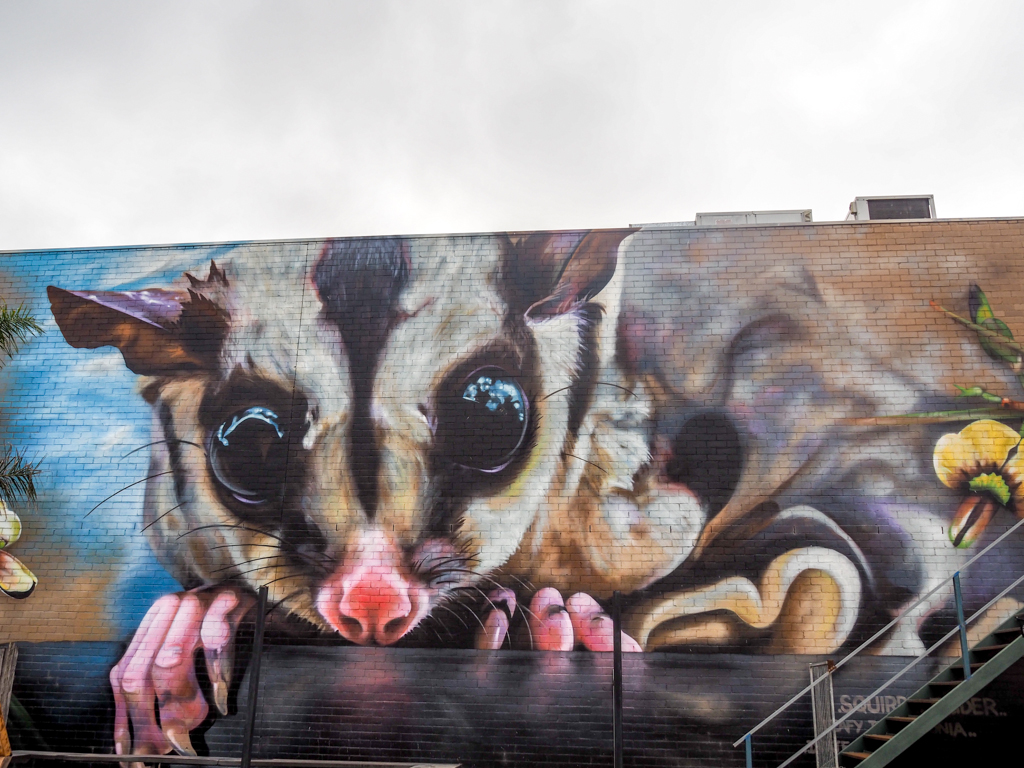
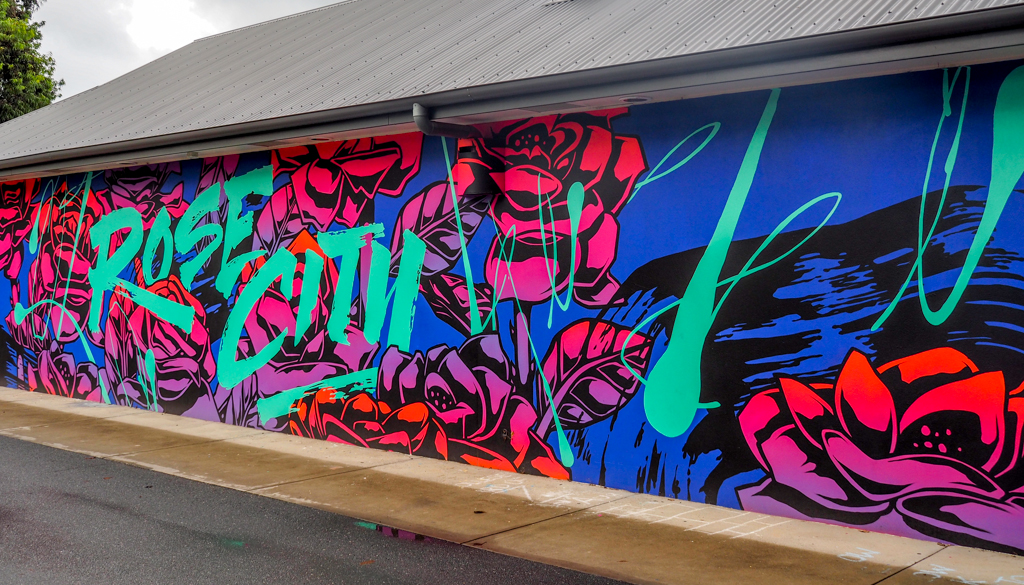
I enjoyed the walk around Benalla looking at the Wall Art and here are some of the images I captured:


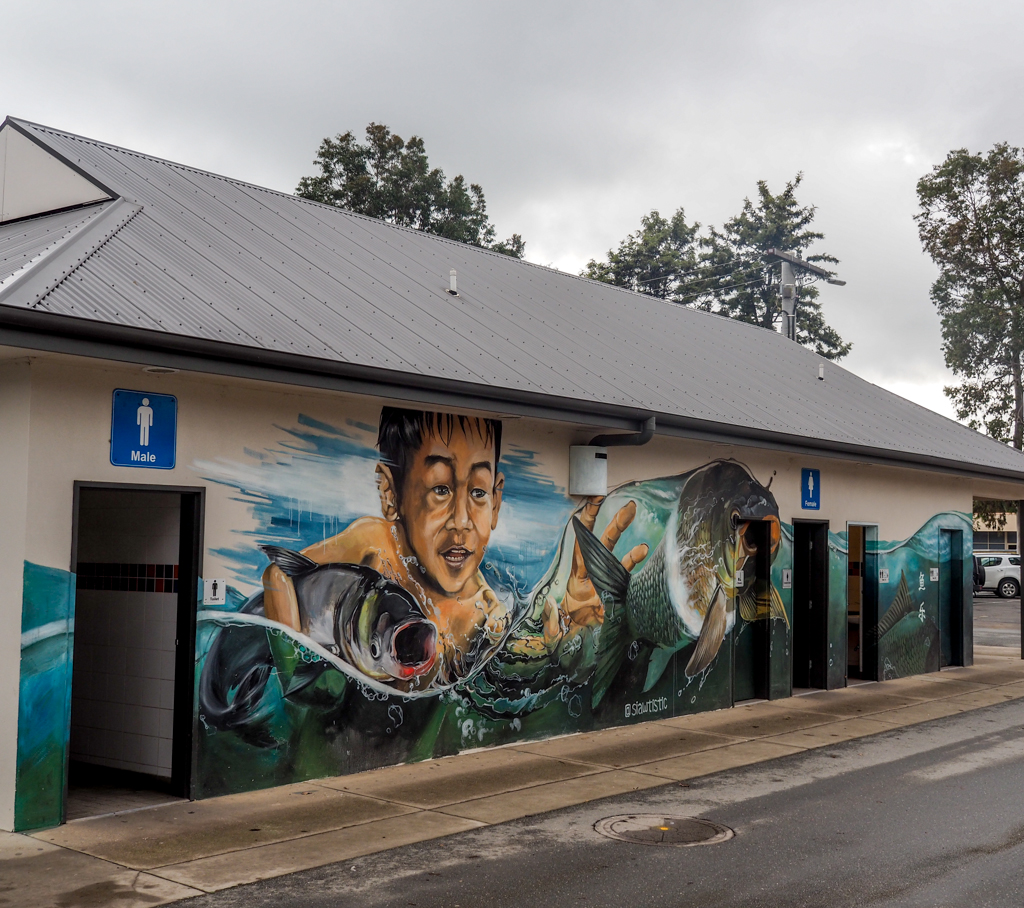
The following images were on various toilet blocks around Benalla:


Benalla is known as the “Rose” City because there are over 1000 rose bushes in the botanic gardens.


The skate park had a couple of paintings in a very scenic setting:


Another couple from around town:


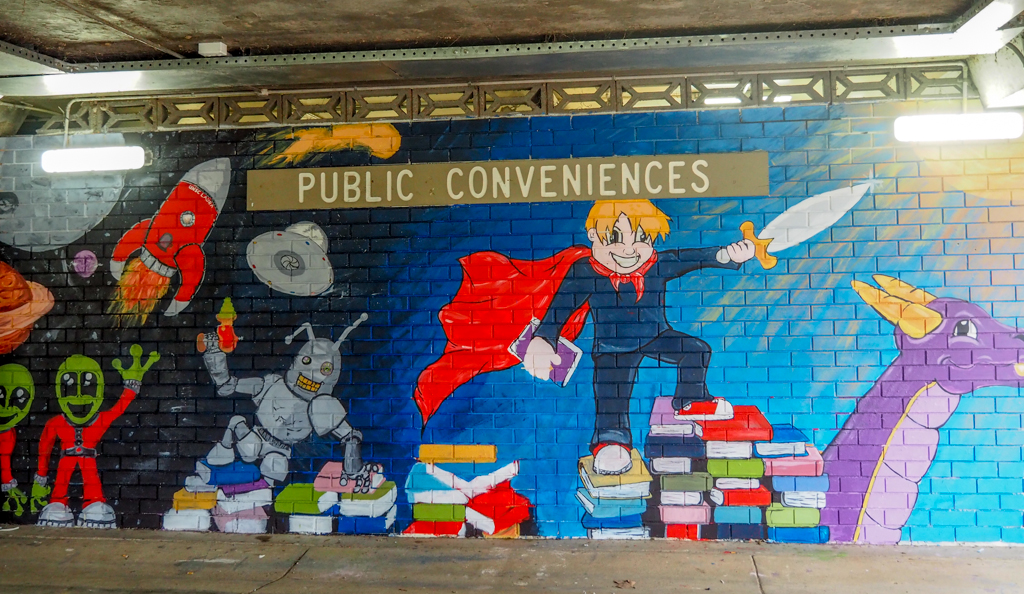
Finally a couple of images from the carpark under the Benalla Library:

There are heaps more but these are the ones I liked best, so it is definitely worth a visit to Benalla.  I will be doing the nearby Silo Art tomorrow.


Posted in 2019 | 2 Comments

Mathoura & Khancoban #2

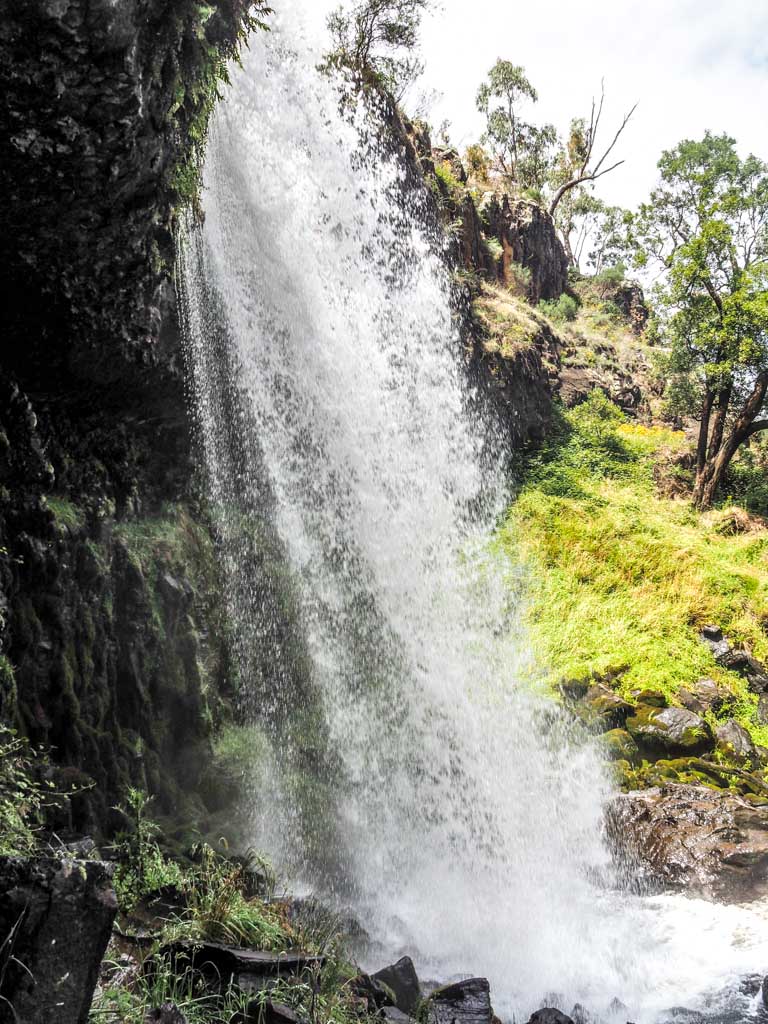
While at Khancoban we drove to Paddy’s River Falls near Tumbarumba.  By Australian standards a lot of water was flowing over the falls and the valley was very pretty and green.  Lots of steps down to the falls, but the walk was worth the effort.


After the falls the river flowed down the very pretty valley.  The falls are 18 metres high and located 15 Km south of Tumbarumba.


After the falls we went to Sugar Pine Walk about 8 Km north of Tumbarumba.  A quiet and peaceful walk among towering Sugar Pine trees planted in 1928.  The forestry people in NSW have preserved 2.5 Hectares for us to enjoy.  The Sugar Pines are an American import that have now been superseded by Radiata Pine, probably because it grows faster.  In the US Sugar Pines have grown to a massive 57 feet in circumference.


After the walk we went to Courabyra Winery for lunch.  The restaurant has a beautiful view over a picturesque valley.  We were seated in a shaded verandah and enjoyed good food and wine.  On another day, we had a counter lunch at Corryong at a pub and visited the grave of Jack Reilly, the man from Snowy River, and saw the statue of him in the town.  Jack was a renowned horseman who met and talked with Banjo Paterson about his experiences and life shortly before the poem was written


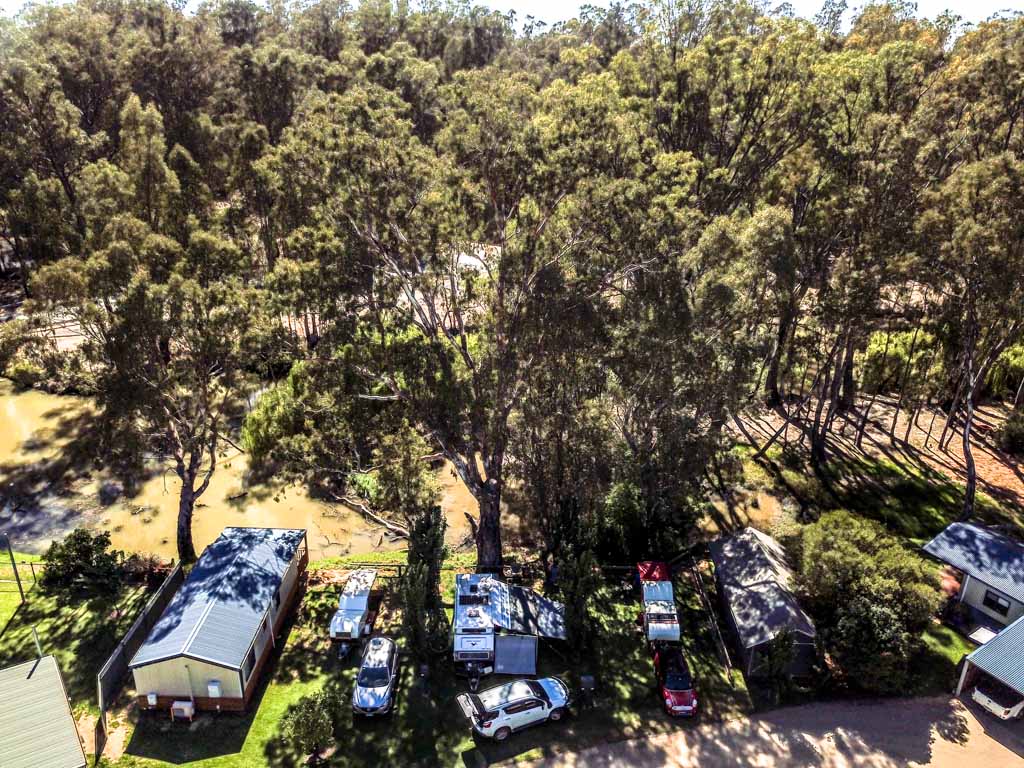
After a week at Khancoban, Cam and the two boys returned to Melbourne, it was great to have them with us and we really enjoyed their company.  The next day Deen and I went to Mathoura in NSW about 40 Km north of Echuca where we met up with Dey, a friend of Deens.  Packing up was a problem as Deen could not slide her extension back into the teardrop.  After about an hour of struggling and emptying her van we succeeded, phew.  My van travelled with all of Deens contents on the floor as we couldn’t put them back once the extension was pushed home.  The caravan park at Mathoura is very well maintained and small with only 6 well grassed sites.  It is next to Gulpa creek and near the Edwards River and backs onto an extensive Red Gum forest.


Sadly we hit Mathoura in a heat wave with every day so far being in the mid to high 30s.  From tomorrow the temperatures will go into the 40s with Wednesday 41 and the next 4 days 42 or 43.  The overnight temperature on Thursday morning will drop to only 27, so we have decided to return home on Thursday to miss the worst of the heat.

On Christmas day we all received a present of chocolates from the owner of the park, a wonderful unexpected gesture from a man who is a friendly and obliging host.  Deen and I went on a walk through the forest this morning, Tuesday, which we limited to 1 Km as it was too hot even early in the morning.


With that I will sign off until my next trip in 2019, not sure when or where that will be, but I will let regular readers know when I leave on the trip.  All the best for 2019 to all of you who read this blog.


Posted in 2018 | 6 Comments

Khancoban #1

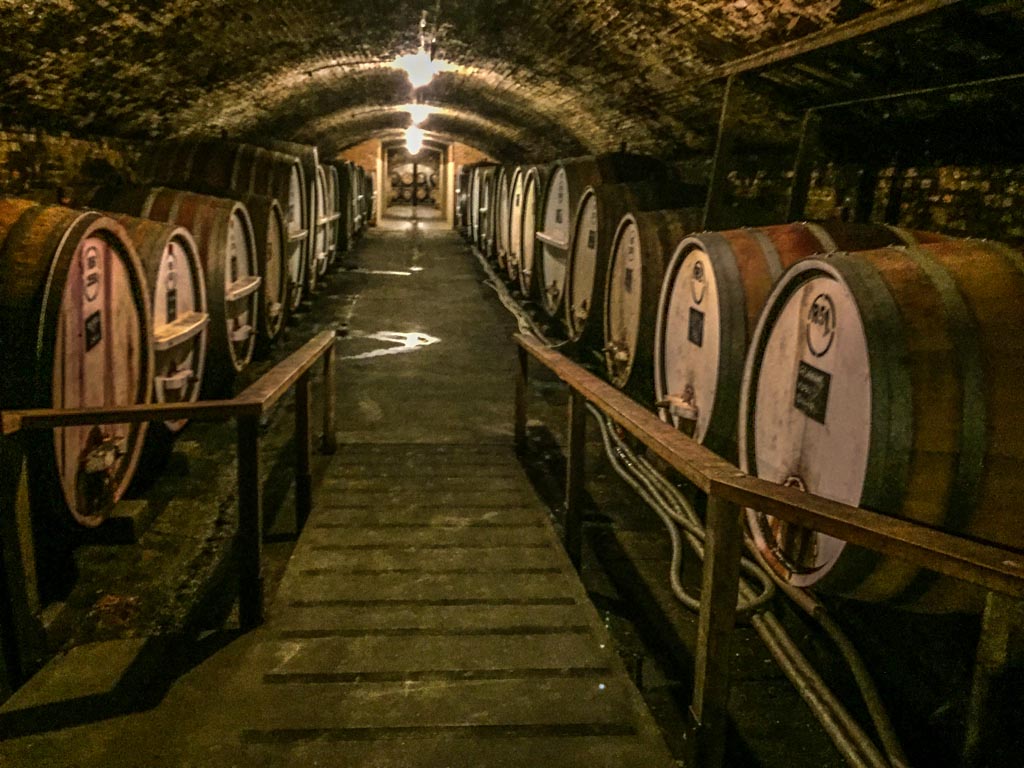
My Christmas trip this year is first travel to Khancoban for a week and then to Mathoura for a second week.  Nadine will be with me for the whole time, Cam and his boys will be with us for the first week, Mel and Cooper only for 2 days as Cooper has end of primary school functions to attend.  We stopped at Euroa for two nights on the way and visited Tahbilk Winery, tasted wines and had a light lunch at the cafe.  It was a very enjoyable visit with excellent wines, good food and lots to see.  The underground cellars seem just the same as when Marg and I visited in 1964.


On the way to euroa we visited Gooram Falls off the Merton-Euroa road.


The caravan park at Khancoban has large grassed sites and good amenities.  It is very quiet at the moment with few campers, so we were able to select 3 sites with good shade for which we were grateful as the temperature was 30+ on most days.  The view from the park was excellent and changed as the direction of the sun changed.  This photo is an evening shot with a storm building.
The main reason for being in Khancoban was to scatter some of Marg’s ashes in the Upper Murray as close to the source as we could get.  Marg loved the Murray and we have camped on it from the source springs at Cowombat Flat (access only for walkers now), to the mouth at Goolwah, and many places in between.  So on Tuesday December 18th we headed off to Tom Groggin, about 50 Km along the Alpins Way from Khancoban.  We had planned to cross Davies Plain to get close to the source, but the road had been damaged and closed on November 29th, bugger.

The road to Tom Groggin was very windy but picturesque, the view of Mt Thompson an example.

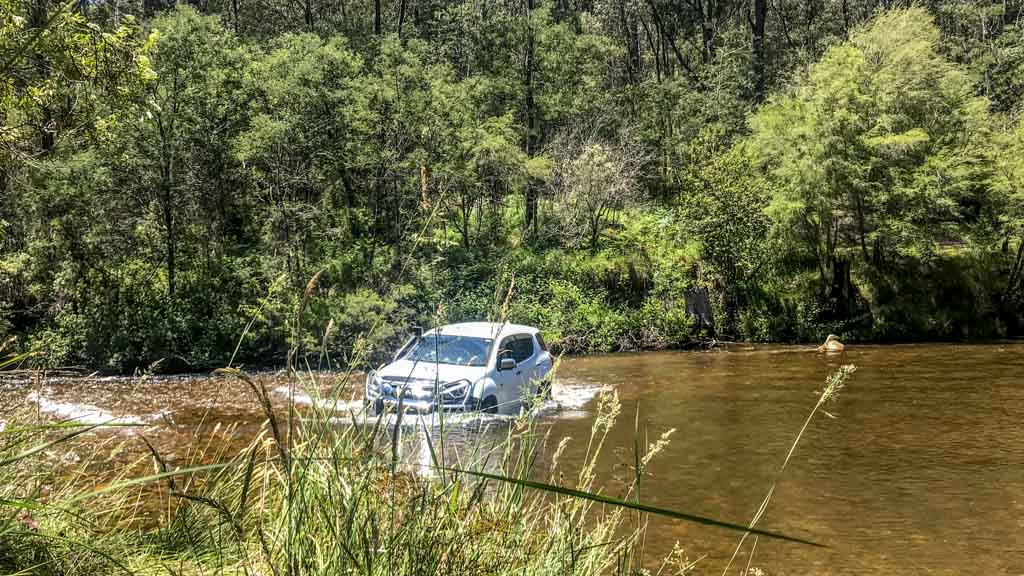
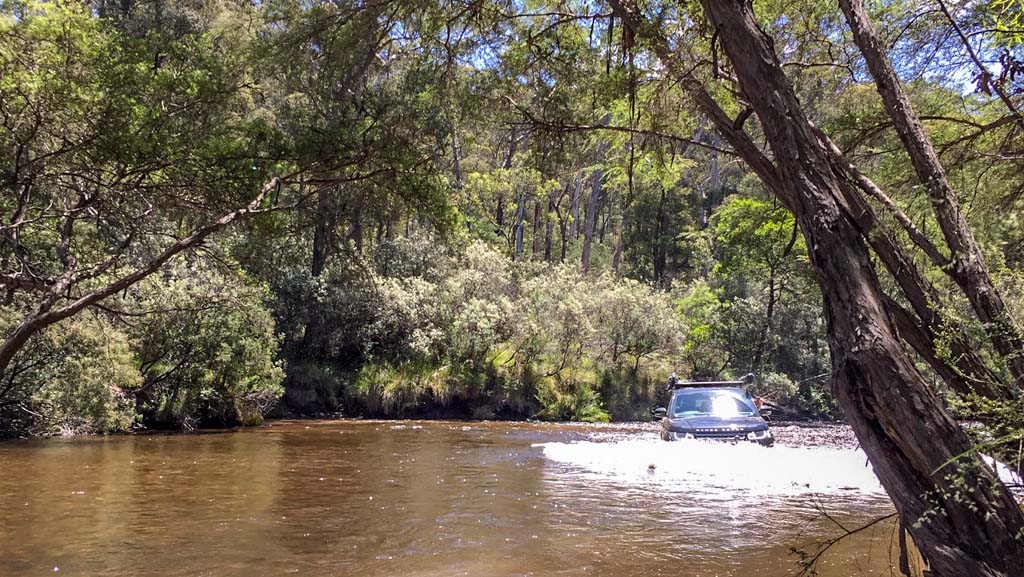
We lit a fire for cooking and had BBQ lunch on the Murray at Tom Groggin in the picnic area, a lovely spot but very hot.  After lunch we crossed the Murray to search for a spot to scatter the ashes.  It was fun crossing and both Heath and Deen got wet feet from the bow wave pushed up by the cars, they were close to the edge taking photos.


The lower photo is of Cam crossing, the other two show me on the approach and crossing.  You can see that the approach is excellent with a good depth of large rocks, much better than other times we crossed in the 1990s.  Then the approach had deep scoured out grooves and you had to drive carefully balanced on the top of the ridges.  We took a video of me crossing the river, it can be viewed on YouTube using this link: https://youtu.be/hJbzL3nDeO4.
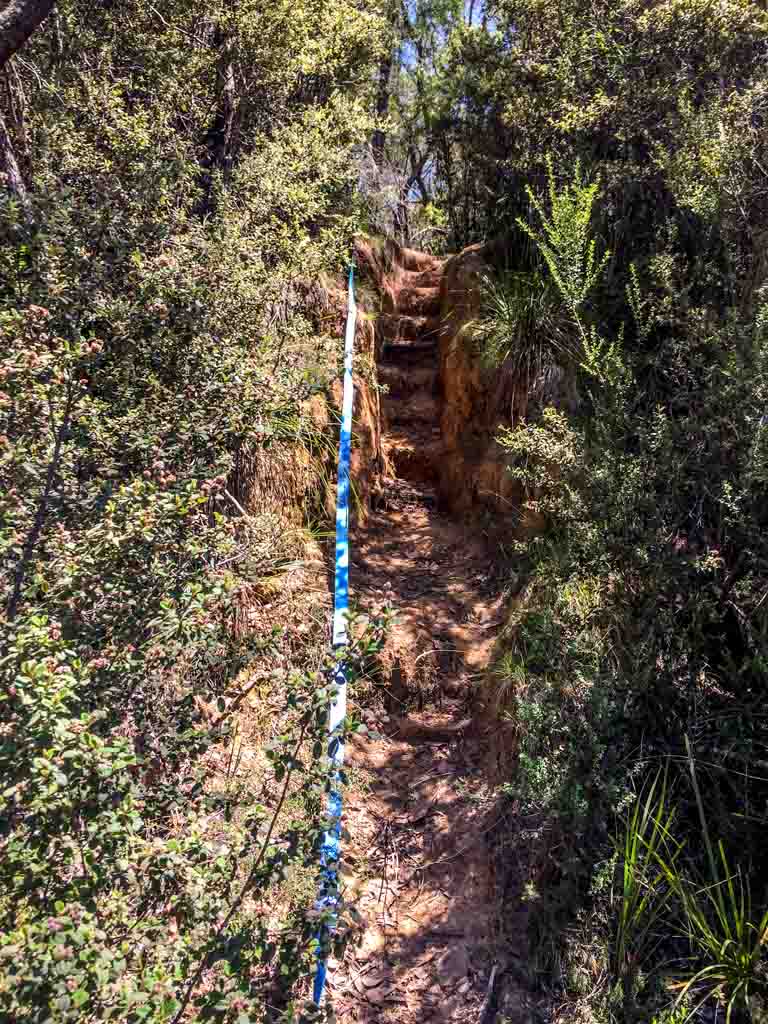
After crossing the river we followed the track for a few kilometres until it turned away from the river to go over Davies Plain.  So we turned around and went down a steep side track to the river, low range first stuff.  It was a beautiful spot so we decided this would be where we scattered the ashes.  Access was down some 20 feet of rough steps that someone had hewn in the bank.  We used a winch strap to assist us going up and down but only Nadine and I used it.


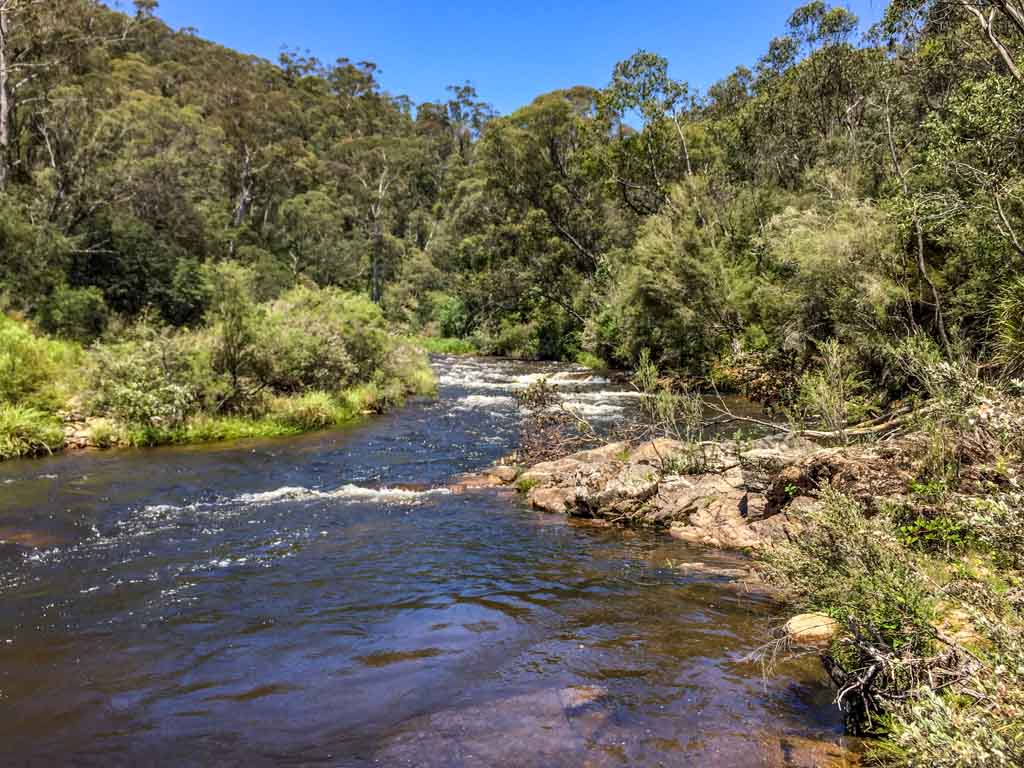
The Murray at this point was washing over rocks and through pools, it was just delightful and so appropriate.

This photo is the downstream shot, the upstream one below is just as pretty.


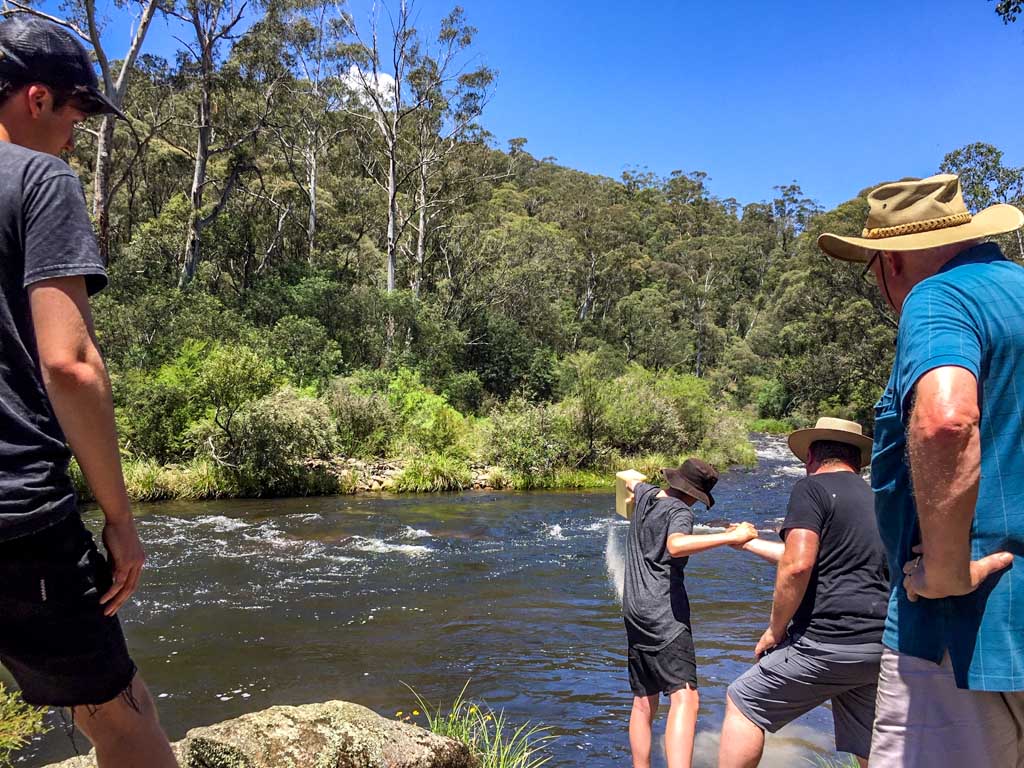
On the right is a photo of me preparing to scatter Margs’s ashes.  We all took turns at scattering, a very emotional and tearful party.  Heath finished the scattering.


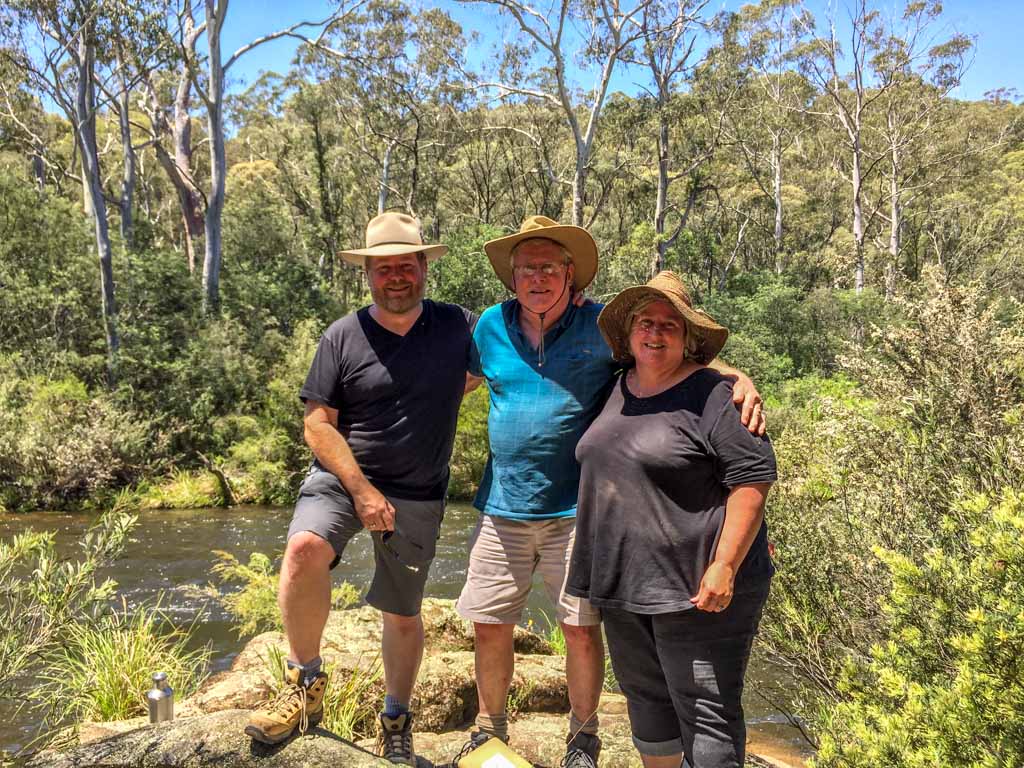
We took a few photos of each other and a couple of these are below.


It is good to think about Margs last journey being down the Murray passed all the places we have visited in a river she loved.  In the evening we sat around for hours sharing memories of our times with Margie, it was so good for us all to hear of others memories: and we were able to flesh out some memories that were not complete.  So it was a sad but very good time.

We have three more batches of ashes to scatter, one each for Cam and Deen and one more for me, which I will do at Memory Cove some time, a beautiful spot at the bottom of the Eyre Peninsula in Lincoln National Park.

I will be publishing another couple of blogs on this trip.


Posted in 2018 | 4 Comments

Kingston and Pinnaroo

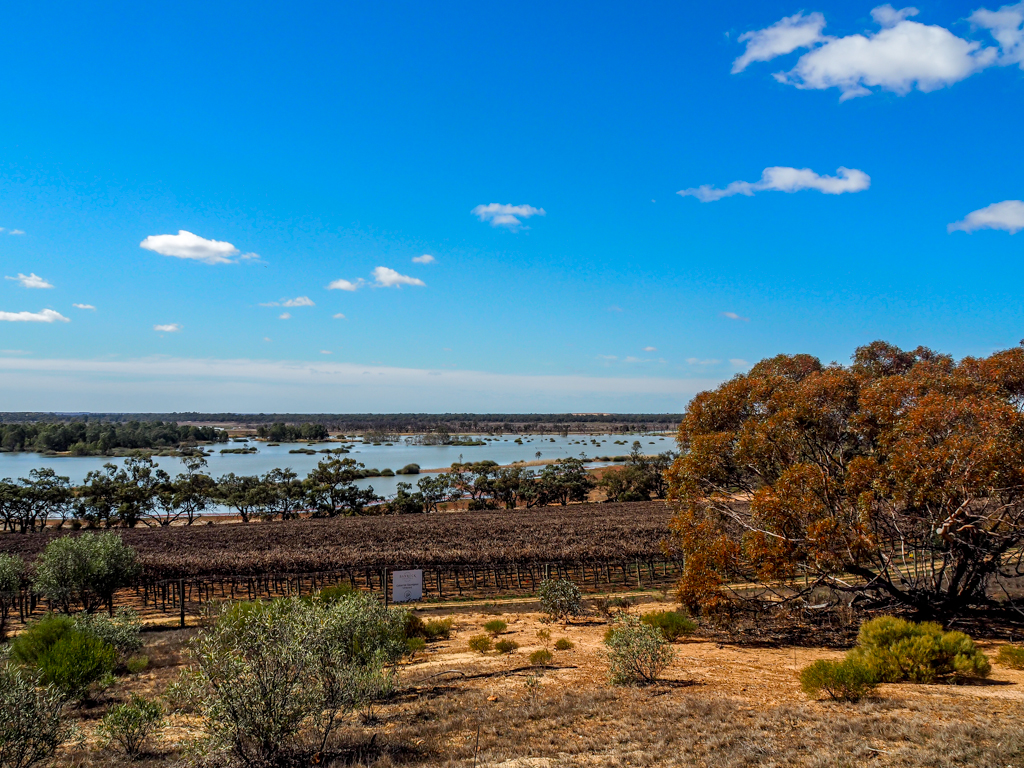
I am have enjoyed my stay in Kingston-on-Murray, the caravan park is right on the Murray and in an area of Australia that I haven’t stayed for more than an overnight stop.  It is also good to be in a place where you don’t have to sign your life away to buy a bottle of wine.  Just near where I stayed is Banrock Station Wine and Wetlands centre, a marvellous environmental initiative.  The company has been rehabilitating wetlands since 1993 and the progress they have made is amazing.  It is so positive to see a corporate entity so committed to environmental causes; they have spent $6M on environmental projects in 13 countries.  They have established several walks through the bush and wetlands that start at the cafe/wine tasting building.  The view from the building is wonderful.


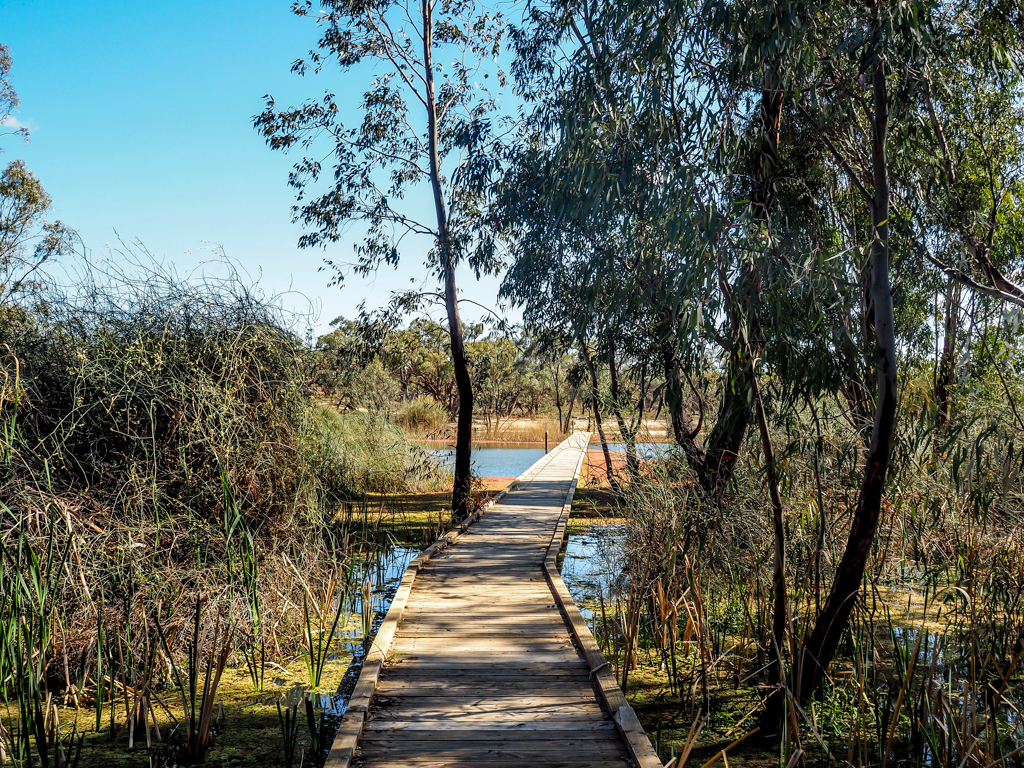
The walk I chose was 4.5 Km and it takes you through some Mallee bushland and then onto a boardwalk through the wetlands.  The track is gravelled and an easy walk.  Along the way there was a patch of Spiny Daisy that had been planted, part of a national project to protect the endangered plant.  It was interesting to me that the first specimen of this plant was collected by Dr Beckler, the scientific officer in the Burke and Wills team.


After about 1 Km you move onto the boardwalk which winds through open water, reeds and trees.  I also came on a small snake, about 3 feet long, which gave me a start so much that I forgot to take a photo, I Googled it and I think it was a tiger snake.  The snake moved away and then slid off the boardwalk into the water, phew!


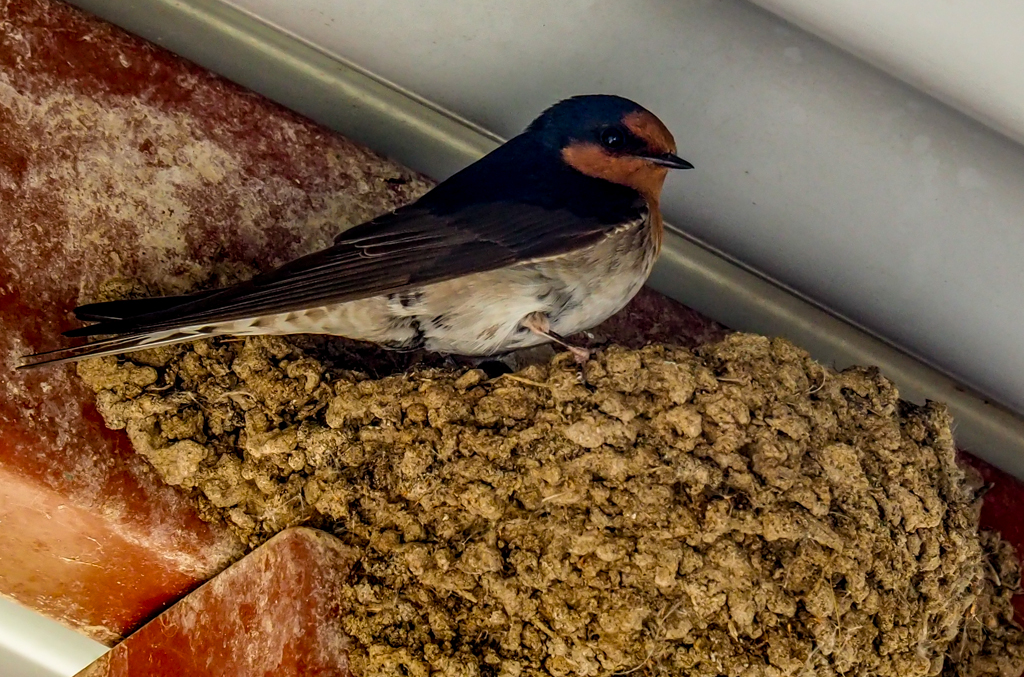
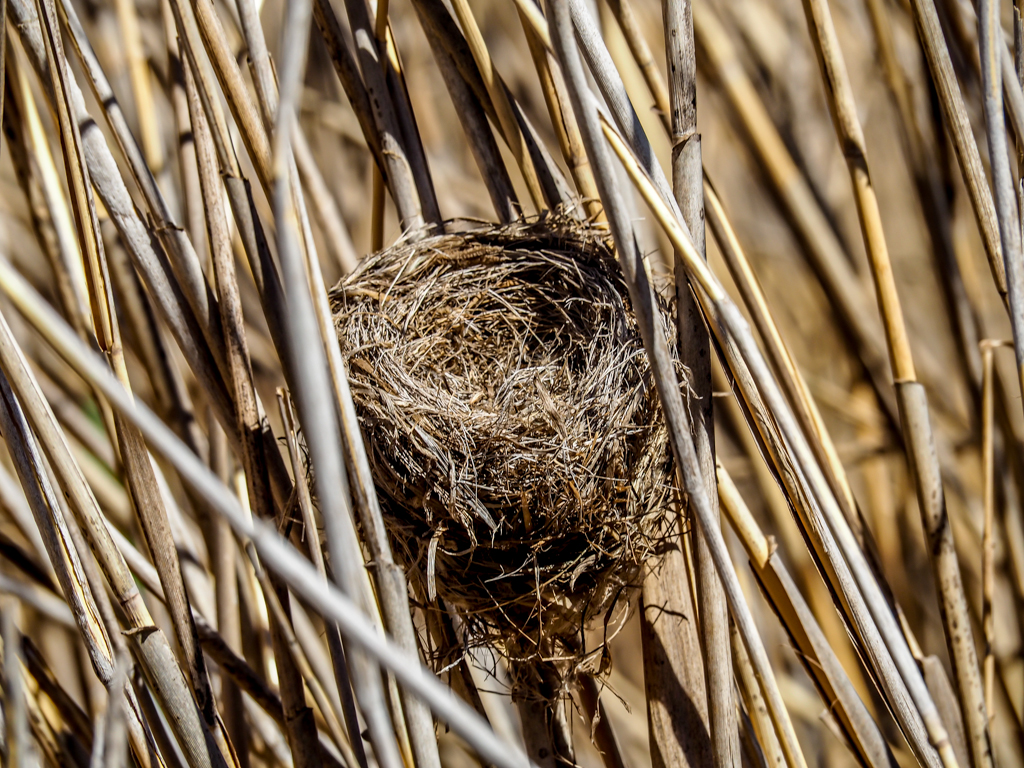
Along the way there was a shelter and fairy martins had built a nest on the steel structure, so I waited and waited and eventually was able to get a photo of one of the birds on the nest.  There was also a beautiful nest in the reeds by the boardwalk nearby, only about 5 cm across, so tiny.


There was some really interesting historical info presented along the way, this area was a lake – Lake Bungunnia – that extended to Menindee Lakes and Balranald in NSW from the coast of SA.  The lake was formed by a natural tectonic barrier close to the coast in SA, that collapsed 700,000 years ago draining the area.  Prior to that the area was under the sea until about 2 million years ago when the land was pushed up and the ocean level dropped.  The cliffs along the Murray have shellfish embedded from the time they were under the ocean.  The forerunner of the Murray started running about 3 million years ago.  We live in such an ancient and interesting country.

So off to Pinnaroo, a small town just over the border in SA at the same level (latitude) as Ouyen in Victoria.  After setting up I went to Ngarkat National Park which protects an area of remnant mallee vegetation.  It also provides habitat for an endangered Mallee Emu wren which has only a few populations in the wild; limited distribution that could be lost in a big bushfire.  However controlled burns are necessary as the wrens breed best in an area that has been burned within the last 16 years, as that maintains the spinifex at it optimum size and condition (they nest in the spinifex).


That is not my photo, but it is a lovely little wren.  The park is classic Mallee scrub, mallee gums, little bushes and sandy soil, but it is incredibly peaceful.  I walked through the bush and the only sound, apart from the sound of an occasional bird was my boots in the sand, when I stopped it was absolute silence.  It was a pity it has been so dry as last time Marg and I camped here we found some orchids, but none this time.  I really enjoyed the walk.


After the walk I had a picnic in the camping area, again very relaxing.  I used a boundary post to support the camera for this photo, it’s great having a camera that has a fold out screen.


Today I went out to Karte National Park that also protects remanent Mallee bushland and the Emu Scrub Wren.  We had camped here as well and looking at our campsite bought a lump to my throat and lots of good memories.


On the road to Karte there were many stumpy tail lizards crossing the road, their shape is distinctive so you have time to avoid them if you are careful.


There is one walk at Karte so I did that, not as peaceful as yesterday’s walk at Ngarkat because it was windy, but still enjoyable.  The track winds up a sandhill and then returns to the campground.


Tomorrow I will be off to Bendigo for a week or so and then home.  I have some tests to complete and Bendigo is the furthest that Melbourne Pathology operate;  (I got the specimen bottles from them before I left home so I have to use them now, both the bottles and Melbourne Pathology).

Posted in 2018 | 5 Comments