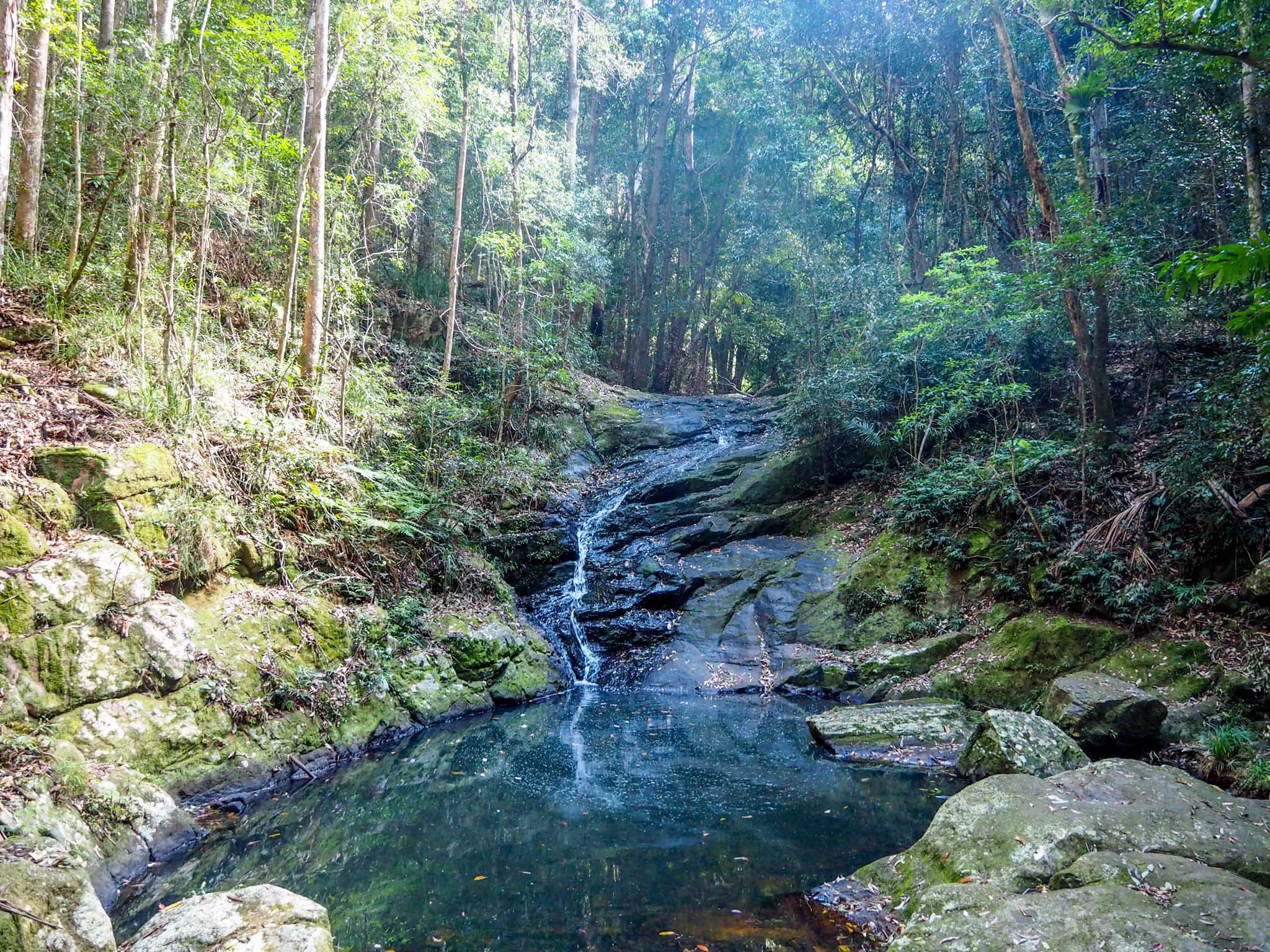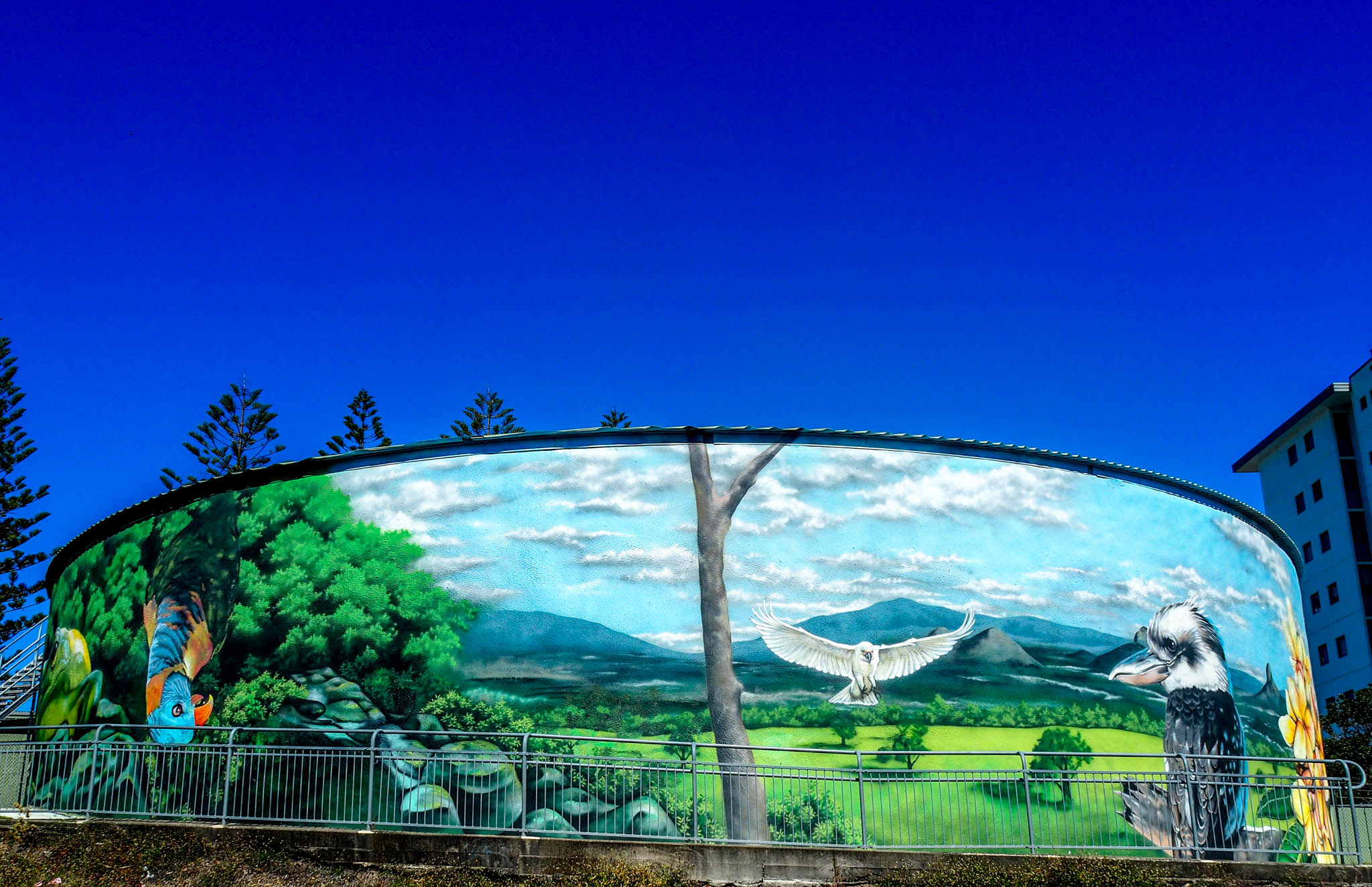
Brisbane

A short trip of 80 or so Km brings me to Brisbane, bit of a shock after a month mostly in the bush, but the roads are good and the GPS is a saviour.  I have a number of towers to visit so I decided to do them all on Sunday, hopefully with less traffic.  I am staying at Newmarket Gardens Caravan Park which is busy but well set out with reasonable size sites and a number of trees scattered through the park.  I am under one and the shade is very welcome (29° C).  If you need to camp in Brisbane I would recommend it and it’s not too far from the CBD.   The first tower I visited was at Kallangur 33 Km north of the CBD. The name Kallangur originates from the Aboriginal word kalangoor, meaning a goodly or satisfactory place. The artwork on the water tower was a forest scene with trees and grass trees, reminiscent of places I had visited along the way.  It was well very done but sun glare made it hard to get a really good photo.  But the artists have captured a Queensland forest very well.
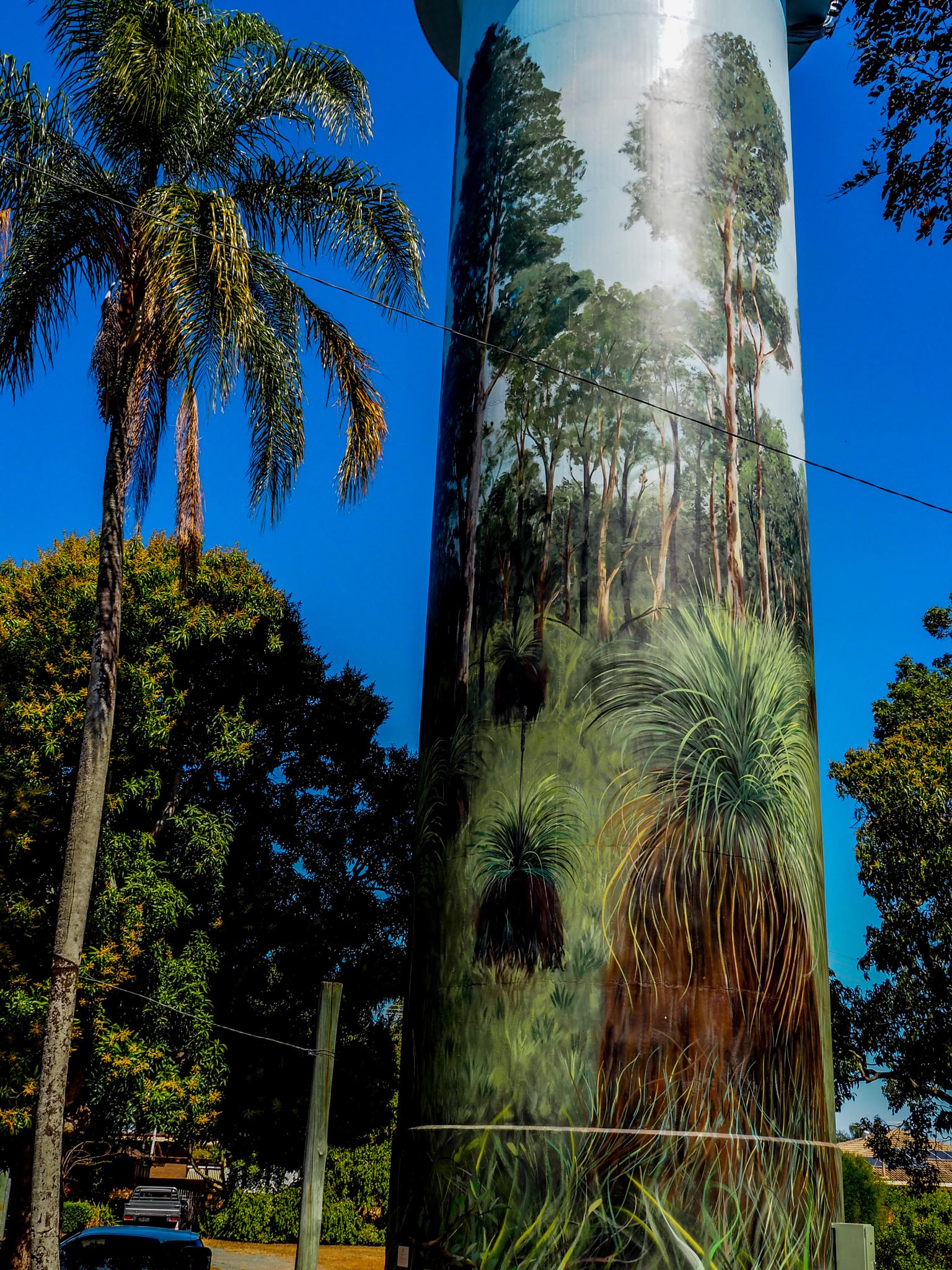
Kallangur Water Tower

There was a small memorial to Australian Defence Forces with statues of people dressed in clothing of all the different forces, there are several more statues that I couldn’t fit into the photo.

Kallangur Memorial Statues

From here it was off to Ferny Hills about 20 Km NW of the CBD.  Here the water tower is a squat one surrounded on two sides by houses and there were trees as well, so getting a full view into a photo was not possible on most sides.  The artwork was excellent and detailed.

Ferny Hills Water Tower

Here are some of the animals and birds on this tower.

Ferny Hills Water Tower Possum

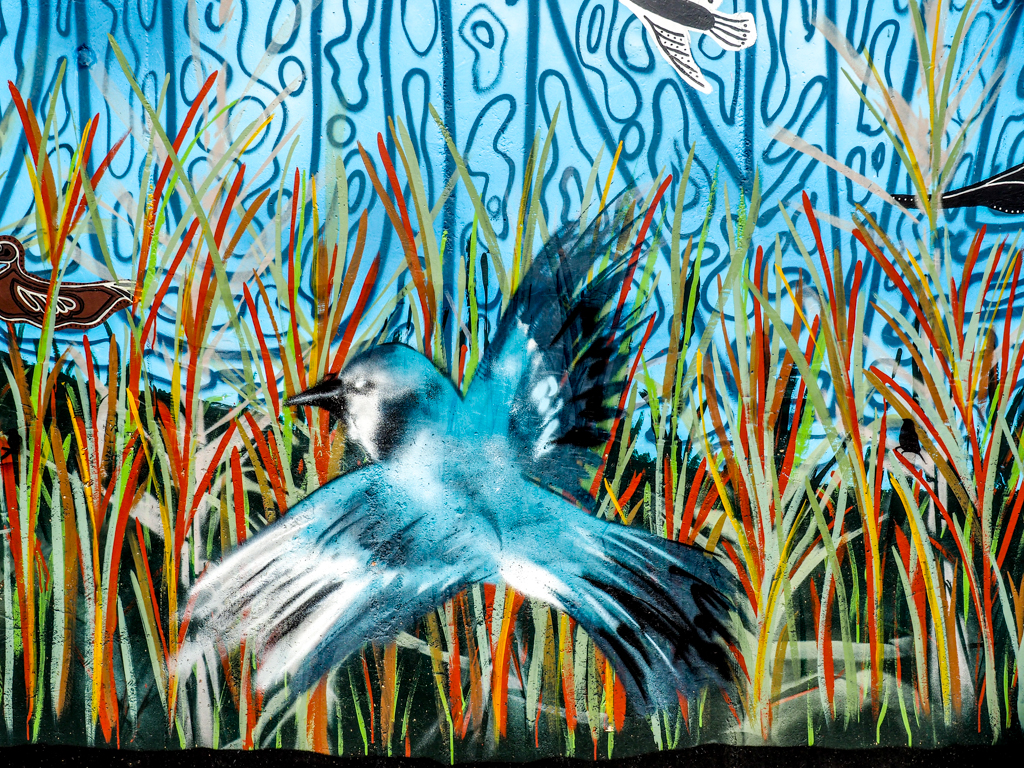
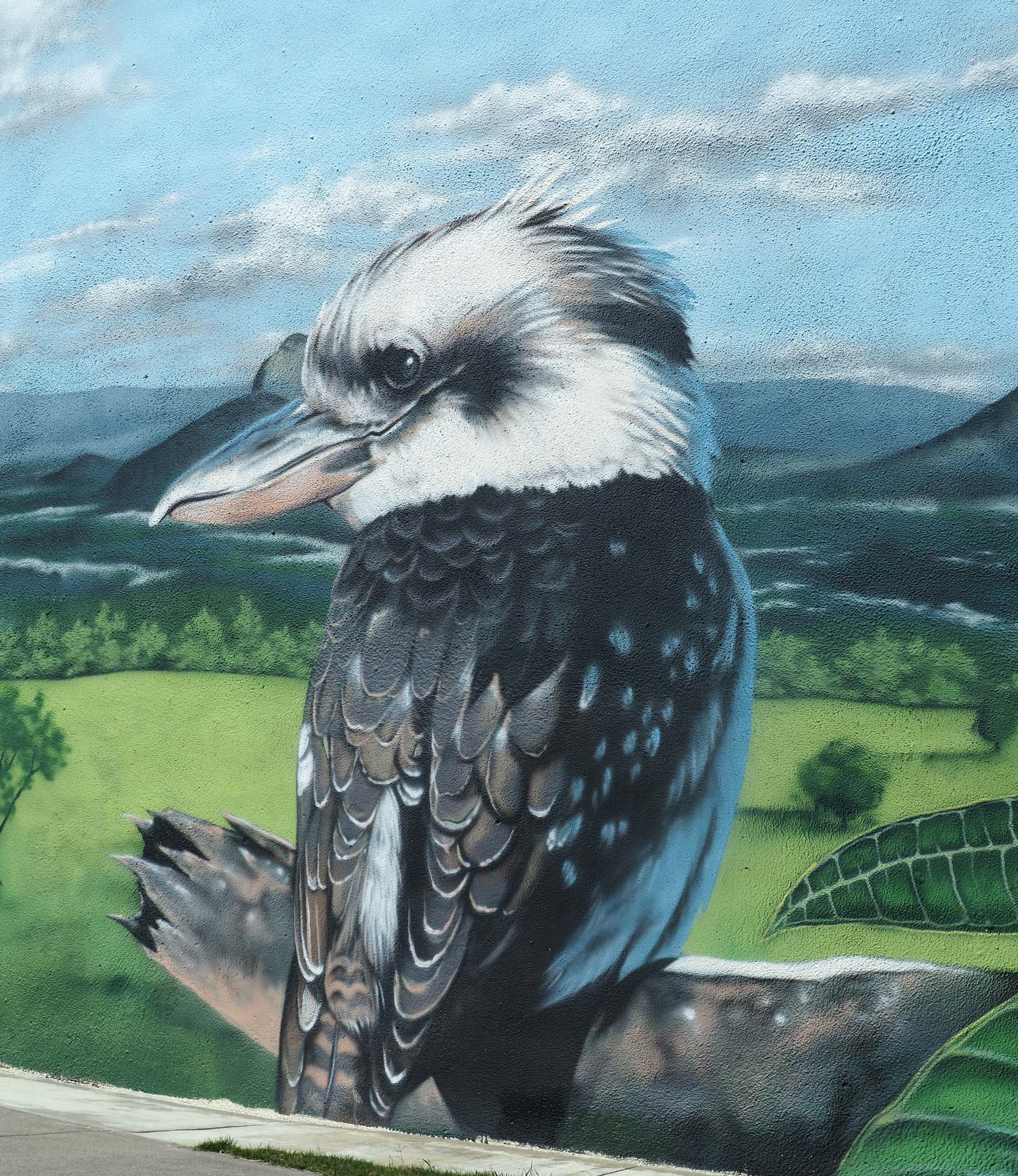
Ferny Hills Water Tower Butcher BirdThe Blue Winged Kookaburra is a bit blue, artistic licence I guess.

Ferny Hills Water Tower Blue Winged Kookaburra and Green Tree Frog

I can’t find a parrot to match this painting, the closest is a Musk Lorikeet, but it’s a good painting.

Ferny Hills Water Tower Parrot

Back at the caravan park I took some photos of the artwork on the toilet block.  The ones on the mens toilet looked like they wanted to scare men from going in.

Newmarket Gardens Caravan Park Spider
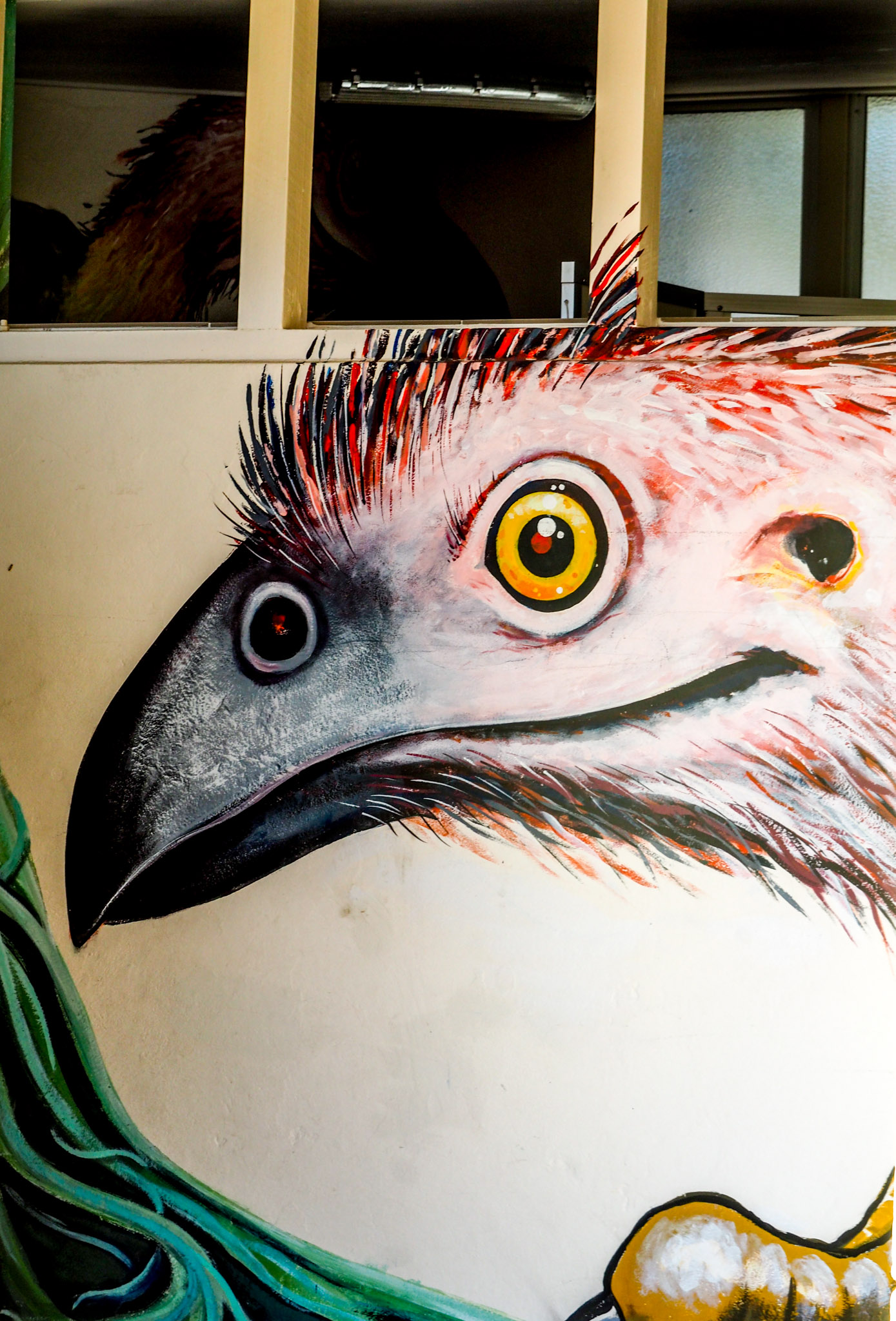
Newmarket Gardens Caravan Park Emu

In contrast the artwork on the ladies toilet is much more inviting.
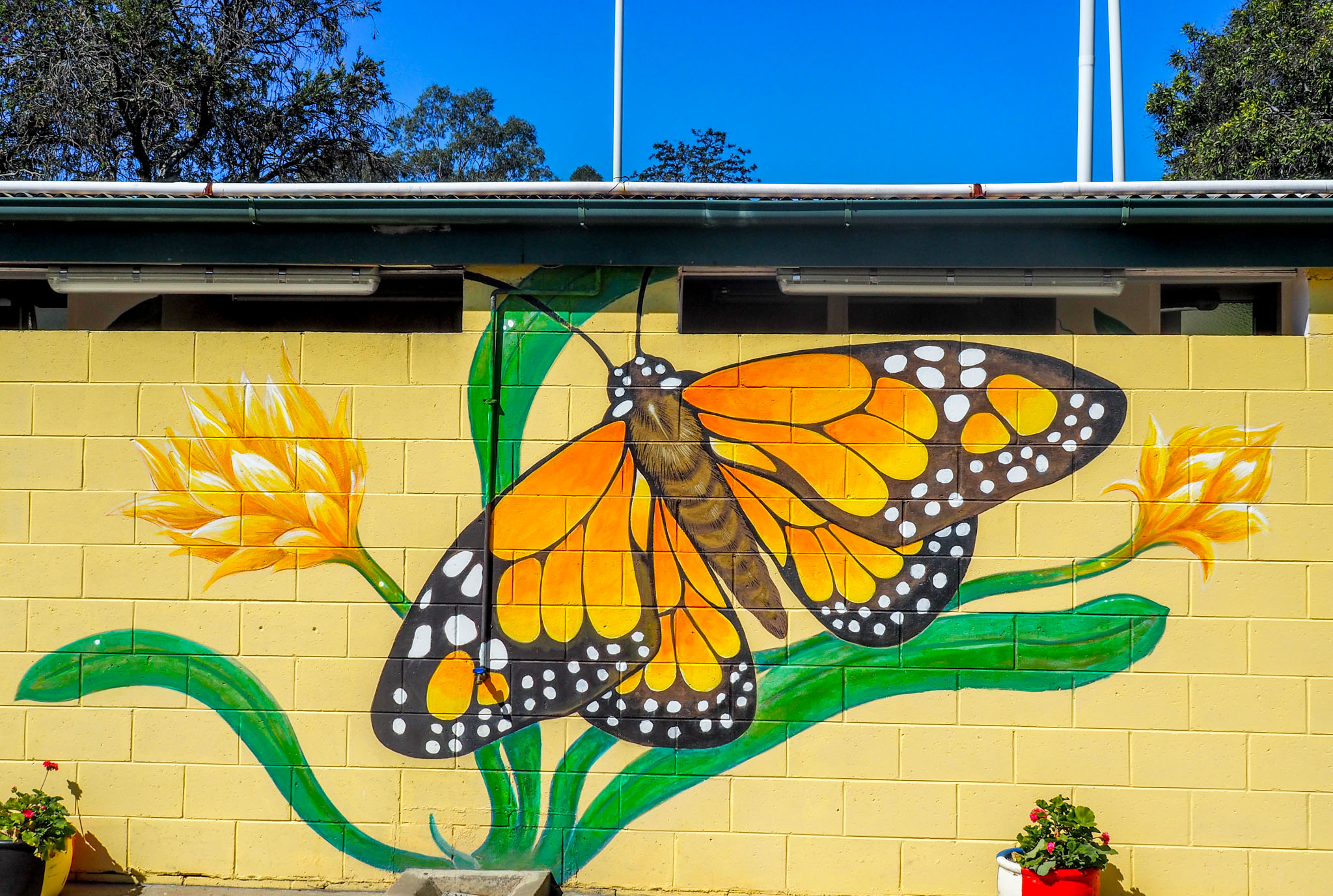
Newmarket Gardens Caravan Park Butterfly
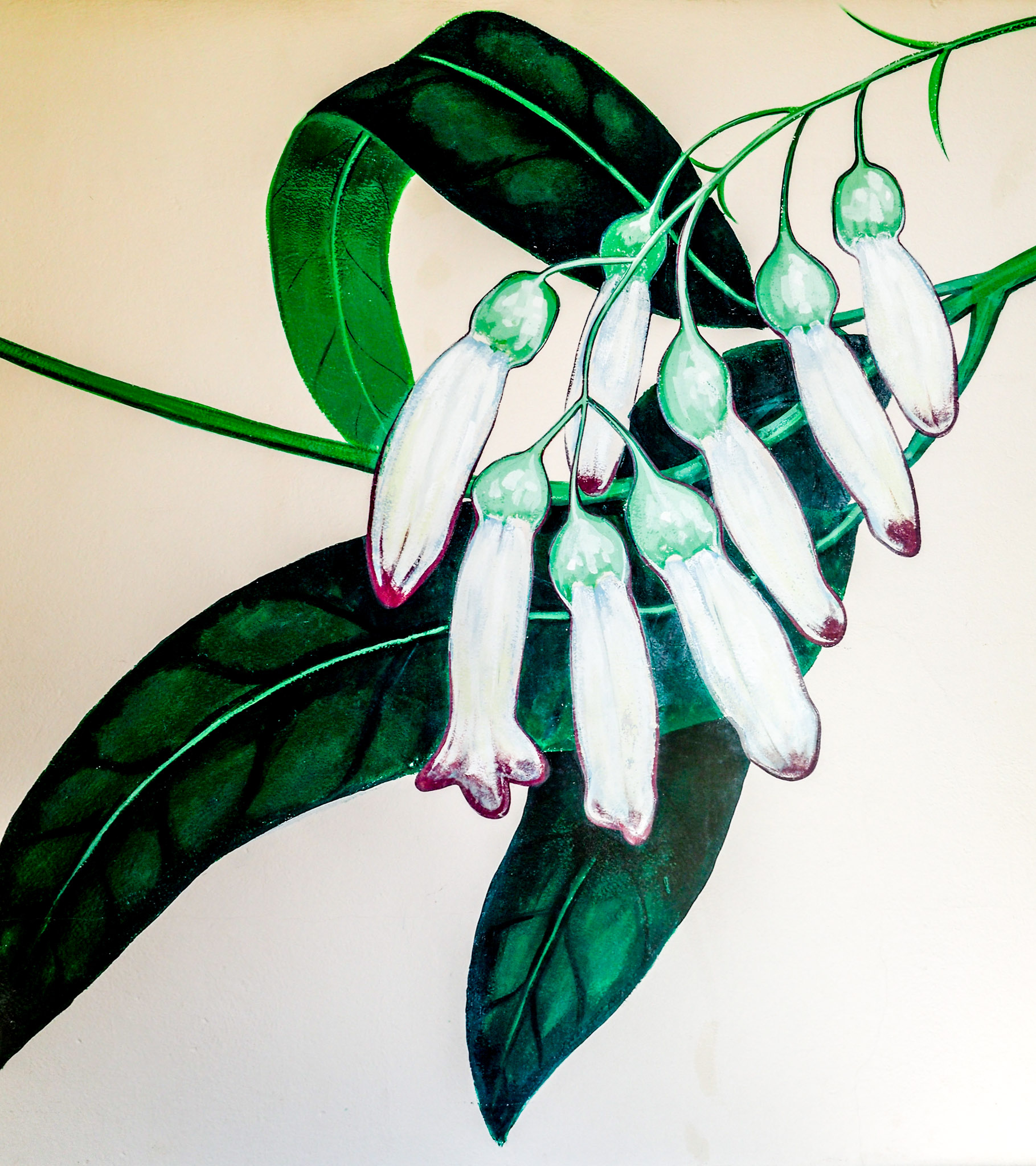
Newmarket Gardens Caravan Park Flowers – Ladies Side

Another couple from around the toilet block:

Newmarket Gardens Caravan Park Flowers – Ladies Side #2
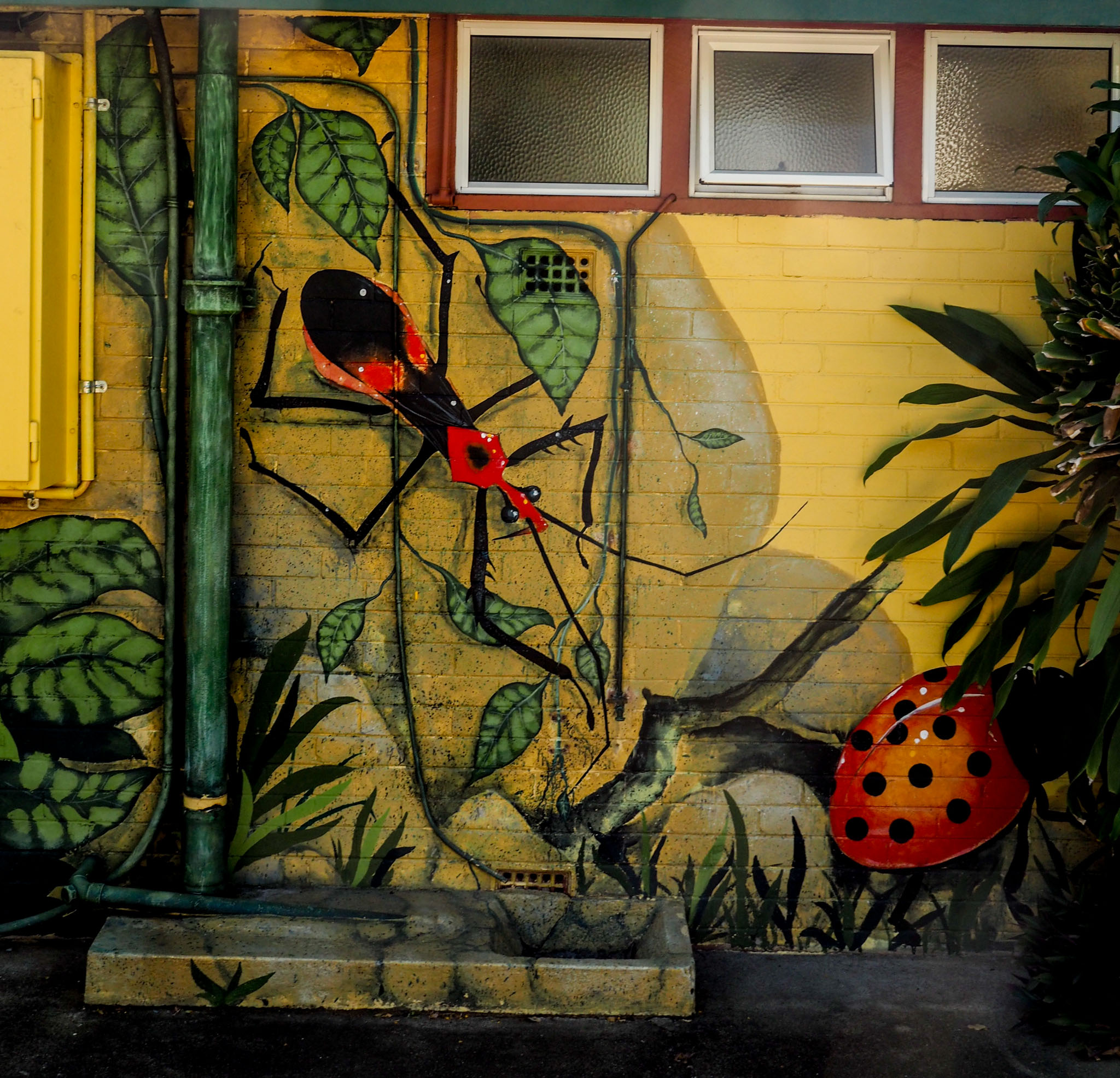
Newmarket Gardens Caravan Park Ant & Ladybird

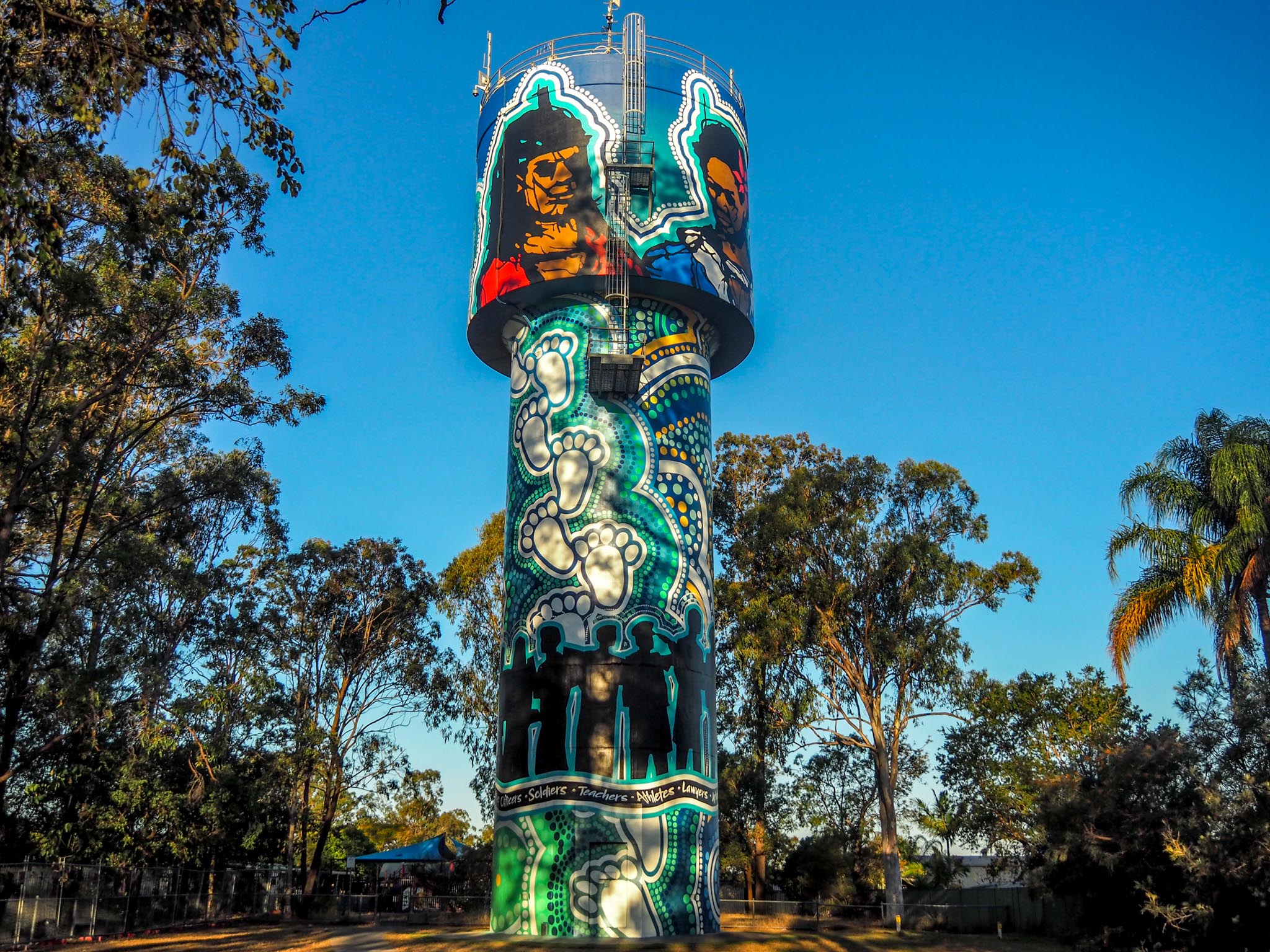
So later in the afternoon I headed off about 40 Km south to Logan to see a water tower decorated in aboriginal dot art style.  I had two GPS programmed but still managed to circle the CBD once and cross the river three times before I got to Logan.  There are a number of motorways that go right into the city but if you miss an on ramp you have to drive around a bit, but the motorways are good as are the arterial roads.  The tower was excellent but inside a temporary construction style fence, not sure why, and this with big trees made photography difficult.  There was also dappled shade on the tower.
Chester Park Water Tower

You can see the dappled shade on the tower in the photo.

Chester Park Water Tower Two Faces on The Top

The view from the back missed the shade and you can see how good the artwork looks without the shade.

Chester Park Water Tower Rear Face

Chester park Water Tower Side View

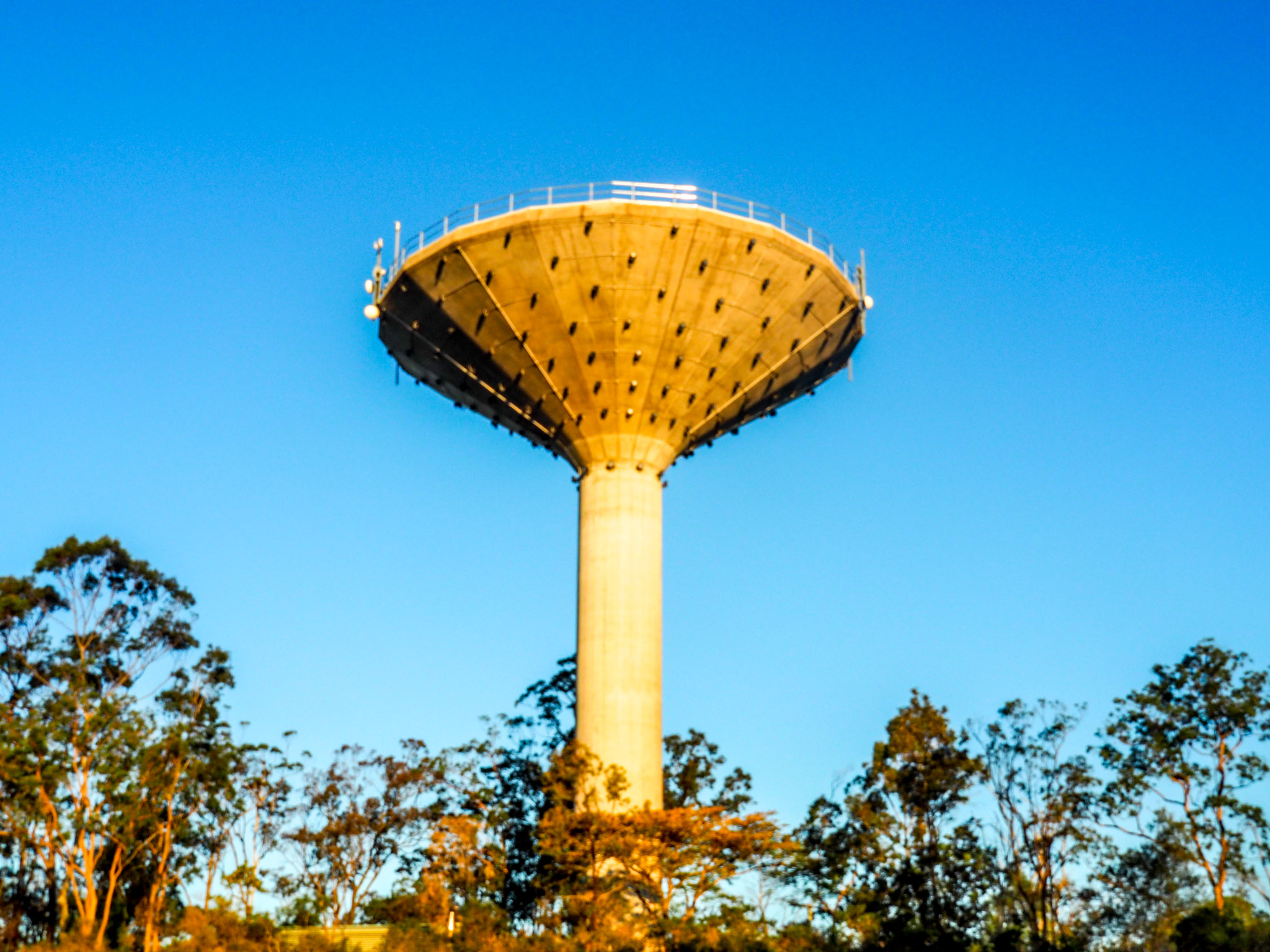
I think the Chester Park tower may be the one I have liked best so far.  From here I drove a couple of Km to wineglass water tower and got there as the sun was setting.  It is an amazing structure that holds a megalitre of water and weighs 400 tonnes.
Wineglass Water Tower at Sunset

The black dots on the tower are lights that come on every night.  Logan Council publish a webpage that gives the times the lights are on and the colour they will be.  They change colours to celebrate and event or sporting team in the council area.  They were to be green and gold on Sunday to celebrate Park Ridge Pirates Grand Final.  the lights operate from 5.30 until 10.30 and the tower can be seen on the top of the hill from many kilometres away.  I had to wait an hour until it was dark enough to see the lights well enough to photograph.  This meant a trip back through the city in the dark guided only by GPS, I was not looking forward to that, but it was worth seeing the tower.  Ever so often they switch back to the normal violet colour, which looks the best in my opinion.

Wineglass Water Tower Violet

On a normal night the violet tower would have violet lights on the flared section, not green and gold.

Wineglass Water Tower Green & Gold

Later in the night the green would cover the tower.  There were three power poles near the tower with artwork on them, two of birds and one of a Numbat, they were all well done.

Wineglass Water Tower Powerpole Robin

Wineglass Water Tower Powerpole LBB

For none birdwatchers LBB is an acronym for “Little Brown Bird”, often used when the LBBs are in the treetops and can’t be identified.

Wineglass Water Tower Powerpole Numbat

So at six I set off home, this time I paid close attention to the GPS instructions and all the road signs, as there are multiple off ramps and I had to use about half a dozen of them on the journey.  At one stage there was an interchange between two motorways that was different to both GPSs, so I just headed where I thought I should go with both GPSs off the road, but eventually the three of us were singing in unison.  The main issue is that the road signs refer to suburbs that I don’t know, for example, I am staying in Ashgrove, but the signs refer to Newmarket which I now know is the next suburb.  It was good to get home.

Tomorrow I’m off to Crows Nest near Toowoomba and will meet up with my cousin and his wife, Neville and Noreen, whom I haven’t seen for many, many years, so that will be good.  Then I start heading down to the NSW north coast.

Posted in 2019 | 2 Comments

Maleny Region #2

On Wednesday my friends Trish and Dave came out to the caravan park and we enjoyed several hours of conversation on a deck that overlooked the view from the park over the Sunshine Coast, it was great to catch up.

We planned some walks for Thursday and a lunch, but the day was wet so the walks were cancelled and we met up for lunch, and that was very enjoyable, lots of reminiscing and friendly banter.  I dropped Trish and Dave back into Maleny where they are staying at the showgrounds for the Maleny music festival that starts Friday.

So on Friday I set off to Kondalilla NP along a road the followed the ridge to Mapleton with wonderful views and big drops off the sides of the road.  Sadly most of the rainforest had been cleared and prescribed burns obscured the views.  The walk to the falls at Kondalilla NP was 3.4 Km return with over more than 300 steps and lots of declines and climbs, but it was through the rainforest and quite cool, so that was good.  There were lots of staghorn ferns in the trees that looked wonderful.

Staghorn Ferns at Kondalilla NP

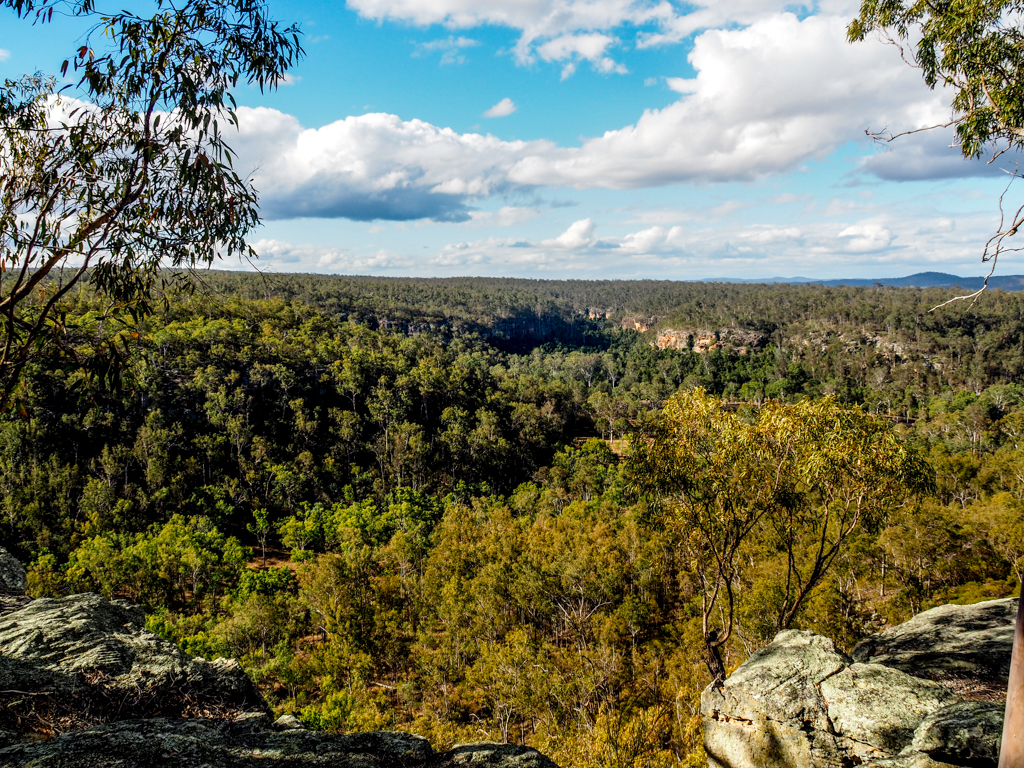
In the Kabi language Kondalilla means “rushing water”, not so rushing at the moment.  Views along the track were over valleys and forest and quite spectacular.

View from walk at Kondalilla NP

I crossed Picnic Creek where there was a small waterfall, especially small as the weather has been so dry, but it was still very pretty.

Picnic Creek Falls

The rainforest also hosted lots of big grass trees with leaves much thicker and bigger than those at Cania Gorge.

Grass Tree at Kondalilla NP

I eventually made it to the lookout over the falls on Skene Creek that drop 90 metres into rock pools, again, not much water going over.  Imagine them in flood.

Skene Creek Falls Kondalilla NP

From Kondalilla National Park I went to Mapleton Falls National Park, a very small park of only 26 hectares protecting remanent rainforest.  I didn’t walk far at this park, just to the lookout, which looks over the falls and the escarpment.  The viewing platform is about 200 metres above the creek and is a cantilever platform, so I had to take a big breath and tentatively walk to the edge to take photos.  The falls drop 120 metres and must be spectacular when it rains.

Mapleton Falls Mapleton Falls NP

In the bottom right corner you can see the rock face that the falls drop over, and the small flow of water.

On Saturday I went to Conondale National Park near Kenilworth about 40 Km from Ocean View Caravan Park.  It was a winding road through steep hilly country with the final section through a Mary river valley.  The road into the park became high clearance 4WD only, but I pushed on for a while, then stopped at a pretty picnic spot.  The signage there advised to tackle the road in one direction to not conflict with oncoming traffic, but didn’t say which way (to find that out you had to go to Kenilworth Forestry Office!   Also I was by myself and the road was quite rough and steep.  So I turned around and headed home.  I enjoyed the creek crossings though.

Creek Crossing Conondale National Park

As you can see the rainforest is quite dense, and it was good to hear lots of different bird songs.

The map below shows my journey from Mt Eliza to Coonamble in NSW.

Journey Day 1 to Day 10

I am now in my fifth week away and have driven 5,700 Km, set up and packed up camp fourteen times, visited and photographed thirty-three silos and water towers.  The journey since Coonamble is on the map below.

Map of Journey Day 11 to Day 34

Tomorrow I move onto Brisbane for a couple of days to visit several water towers around the city


Posted in 2019 | 2 Comments

Maleny Region

After eight very restful days at Noosa I moved onto Ocean View Caravan Park, a big trip of around 80 Km, and the park really does have a wonderful ocean view over the Sunshine Coast.  The photo below is what I see from my van.

View from Ocean View Caravan Park Panorama

Once set up, I went to Maleny to Mary Cairncross Scenic Reserve which protects about 50 hectares of remanent rainforest.  A 2 Km walk takes you through beautiful rainforest with massive trees, plams, ferns and lots of birds.  The walk is cool and flat and very enjoyable.
Walk at Mary Cairncross Scenic Reserve

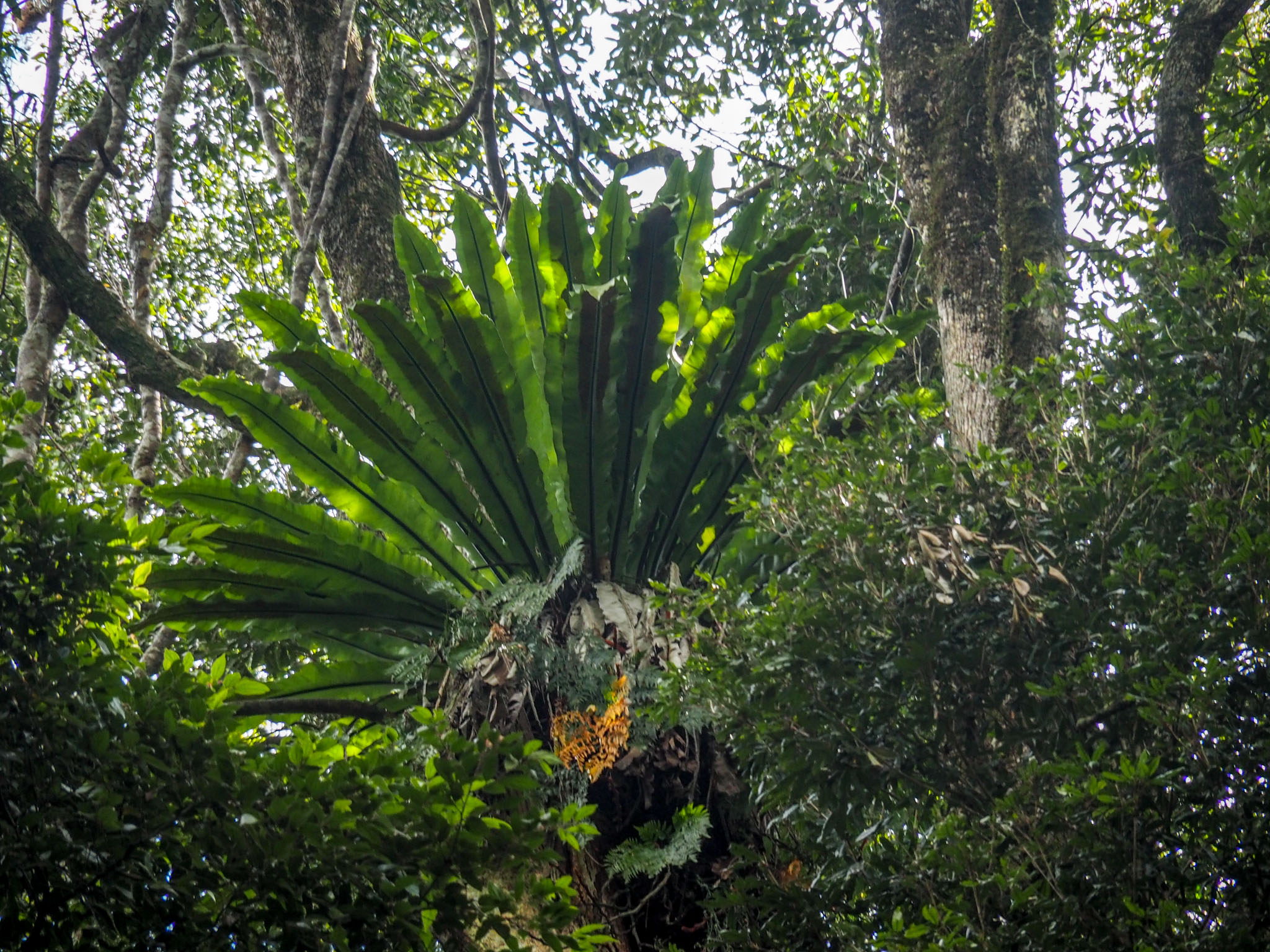
The tree that looks like it is in the centre of the path is a Watkins Fig, a variety of Strangler Fig, so called because it kills its host tree.  A seed dropped in the upper branches of the host tree sprouts, it then sends down thin roots that thicken over time to eventually cover the whole outside of the host tree, killing it.  But it’s not all bad, as the hollow left inside the fig, when the host tree rots away, becomes an important habitat for birds and animals.  High in the big trees grow massive birds nest ferns, probably 20 metre up the tree and higher,  just as well my camera has 10X zoom.

Birds Nest Fern in Mary Cairncross Scenic Reserve

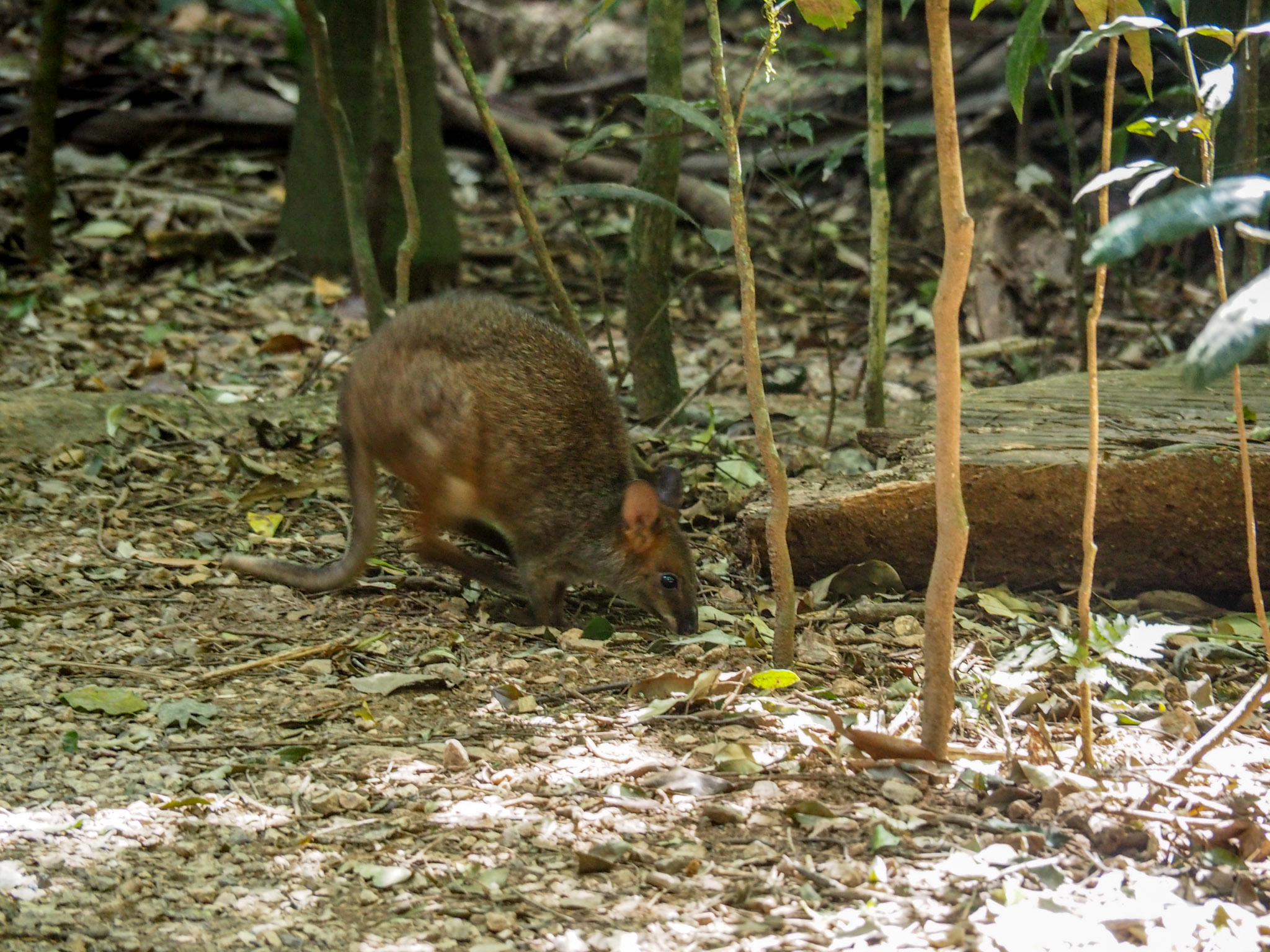
Along the way I passed a couple of Red Leg Pademelons, small wallabies, and this one was a baby only about 200 mm high.

Pademelon at Mary Cairncross Scenic Reserve

While walking around the reserve I heard a number of birds that sound like a cat meow or a babies cry.  I checked with a ranger and it was a Green Catbird.  You can hear it by pasting this link into your browser: https://www.youtube.com/watch?v=uhtXtJYW3uA and listening to the video.

Green Catbird in Mary Cairncross Scenic Reserve

I had to be careful to not drop my camera while I climbed a tree to take the photo.  Only joking, the only timber involved was the floor of the information centre!  The view over the glasshouse mountains from the reserve was fantastic and I loved the cloud formation.

Glasshouse Mountains from Mary Cairncross Scenic Reserve

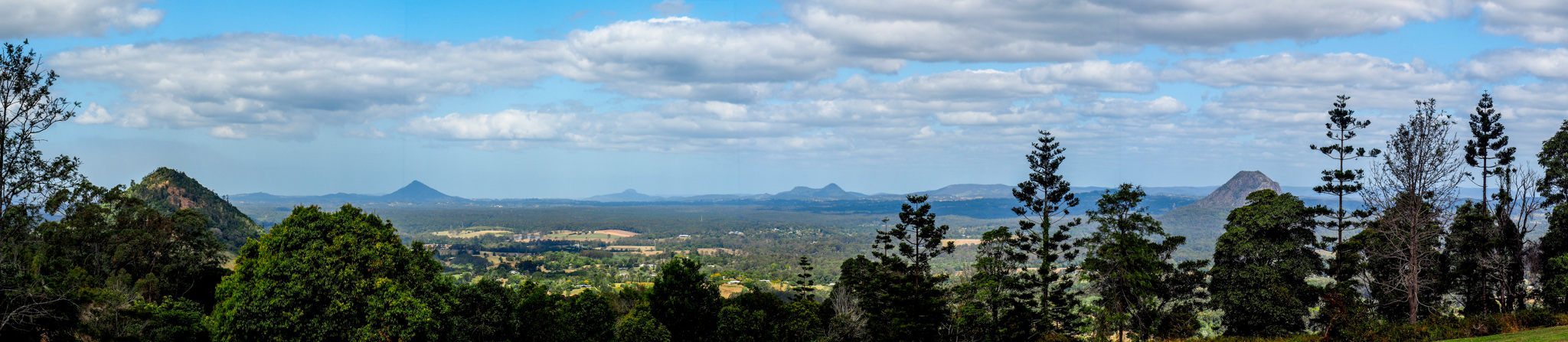
Captain Cook named these mountains and today I found out why he gave that name.  I could never work out why they got their name because they don’t look like glass houses, but they do look like the glass making kilns in his native Yorkshire, where they are called English Glass Houses, so mystery solved.  The mountains were formed in the same way as Mt Walsh near Biggenden I visited earlier.  Magma was pushed up into crevices and voids under the earth’s surface and originally the magma would have been 300-400 metres under the surface at the time.  Erosion of the softer sandstone over the eons eventually exposed these mountains as they are today.  For good measure I also took a panorama.

Glasshouse Mountains Panorama

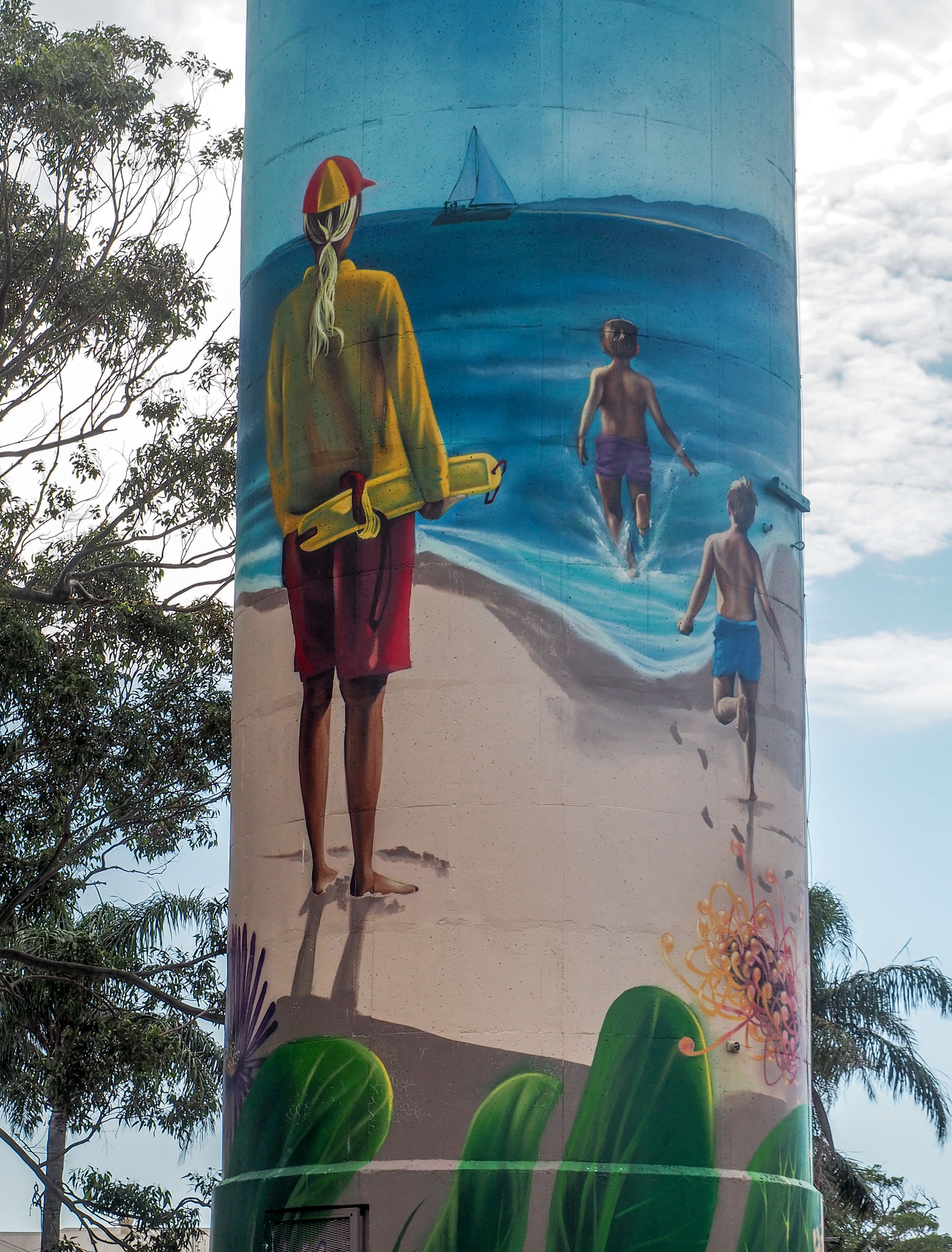
Today is Wednesday, I need to keep track of the days otherwise I would lose track and I have to be back in Melbourne to see the Lions win the flag!  So it was off to Bribie Island to view a couple of water towers.  The first was at Woorim on the far east side of the island.  It was excellent, with surfers on one face and a New Holland honeyeater on the other.

Woorim Water Tower Bribie Island

The honeyeater detail was excellent and I especially liked how well the grevillea flower was depicted.

New Holland Honeyeater on Woorim W/T


Surfers on Woorim Water Tower

On the top section of the Woorim tower they have painted a gull in flight, you can see part of it on left top of the photo of the whole tower.

Gull on Woorim Water Tower

I then headed for Bongaree water tower on the other side of the island, only about 5 KM away, it’s not a big island.  In fact the northern end of the island is a very long narrow spit of sand and it is feared that this will be breached soon as water levels rise, exposing Golden Beach to the ocean and possible erosion issues.  The tower is well done but lacks the fine detail of the Woorim tower.  It is also behind a cyclone fence so I had to go into the RSL carpark on one side and a caravan park on the other to be able to take photos.

Bongaree W/T Bribie Island


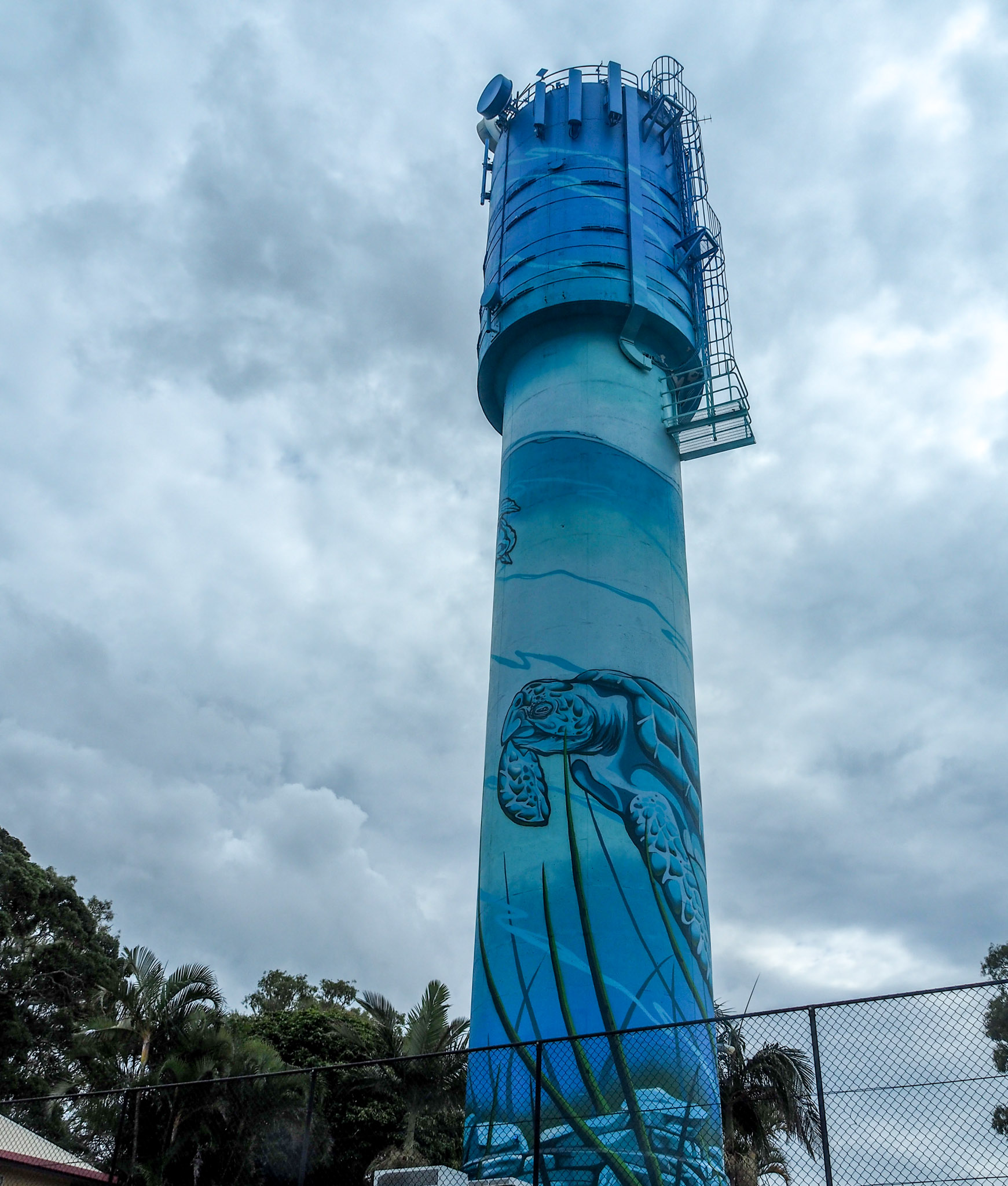
Large Turtle Bongaree W/T Bribie Island

Near the top of the tower is a smaller turtle.

Small Turtle Bongaree W/T Bribie Island

My friends of very long standing, Trish and Dave, arrive in Maleny today so we will share some good times together, and probably visit a few more places around the Blackall Ranges.


Posted in 2019 | 2 Comments

Noosa Region #2

It’s Saturday and after nearly four weeks away and 5,500 Km I am still enjoying the journey.  I decided to check out a couple of National Parks so headed off for Tewantin National Park and up Mt Tinbeerwah where there is 1 Km walk to the summit.  Great views at the top, and there was a group of people learning how to abseil off the mountain, must be mad.

View South over Glasshouse Mountains from Mt Tinbeerwah

On the way up on the walk you get a good view over Lake Cootharaba and my camp is on the shores of Lake Cootharaba.  If you use your imagination you can see a teddy bear in the cloud, maybe close 1-1/2 eyes.

View over Lake Cootharaba from Mt Tinbeerwah

From here I went to Woondum National Park and had lunch at Rock Pools picnic area, a picturesque spot to have lunch.

Rock Pool at Woondum NP

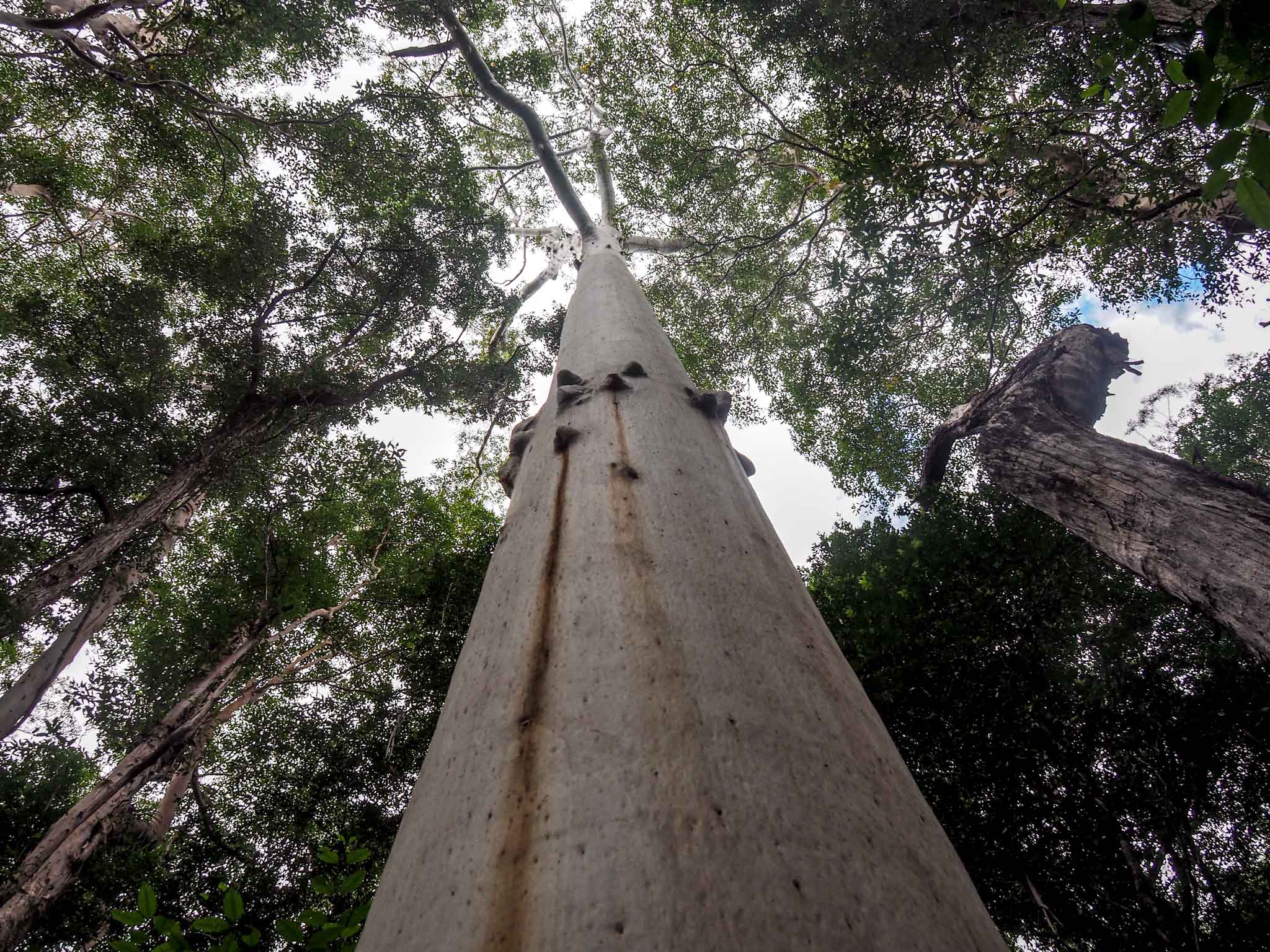
Only a trickle of water down the rock cascade.  There is a short walk through the rainforest where there are very tall Turpentine trees.  These trees were extensively harvested as the timber is close grained and resistant to decay and marine borers.

Tree at Woondum NP

I tried to take a photo that illustrated the height of the trees.  While having lunch I chatted with a trail bike rider, Alex, and I asked him if the road was a through road.  It was and he said he would show me the way.  It was a 4WD only track with a few rough bits but he waited for me if I got too far back.  If there was an embankment he would ride up it in a big loop, fearless.  We ended up at a lookout where there was a wedding going on, but I was able to walk through and see the view.

View from Woondum NP

On Saturday night I met my neighbours Cheryl and Henry and enjoyed good conversation, so much so that they invited me to join them for a roast dinner, which was excellent and well enjoyed.  The conversation continued next morning, so very convivial and relaxing.

On sunday I met up with Lisa and Billy McCann for lunch, Lisa was 4 year old when Marg was first introduced into her life and Margie was a constant childminder and companion for Lisa and her sister Giselle even though Margie was only just a teenager.  Their very close friendship continued from that time, it was a very special relationship.  To my knowledge, Giselle and Lisa are the only people who called Margie, Margie, apart from me, even though they spelt it Margi.  It was a great reunion with much reminiscing, sorry no photos, too busy talking.

On Monday I set off for a walk in Noosa National Park, but a complete failure.  No parking within 2 Km and hoards of people, so I beat a fast retreat, maybe next time.  So lunch at the cafe at the campground, a quiet afternoon, and a couple of wines with my neighbours Bob and Margaret, completed my stay at Habitat Noosa.  Tomorrow off the Landsborough and meeting up with Trish and Dave, friends forever.


Posted in 2019 | 6 Comments

Noosa Region

Well you can’t win them all.  I called in at Gympie to see the water tower art there and it was a construction site.  Fenced off with 4 or 5 construction machines, a work shed and lots of other stuff.  I managed to sneak through the gate and get one clear photo.  The artwork is very well done and appears to be of a magic forest.
Gympie Water Tower

From Gympie I headed for Noosa, it was a good journey winding through green hills and rainforest, so good to be surrounded by green countryside after 3 weeks of brown desolation.  I then set up camp at Habitat Noosa which is about 25 Km north west of Noosa, it is a small enclave surrounded on three sides by National Park and Lake Cootharaba on the fourth.  Very peaceful, big sites, a cafe and micro brewery positioned on the edge of the lake, thanks Trish for the heads up.

Camp at Habitat Noosa

The water tower at Peregian Beach was on my list so I headed off and did some shopping on the way.  Struck out for a second time in a row, very disappointing.  The artwork is basic, there is nowhere to get back to take a decent photo and it is surrounded by a cyclone fence.

Peregian Water Tower

In the afternoon I went on a 2.5 Km walk from the campground to Mill Point, the site of a timber mill set up in 1870, less than 100 years since the first fleet arrived in Botany Bay, shows how quickly the Europeans moved out across the country.  They harvested Kauri, Red Cedar, Beech and Hoop Pine, all wonderful furniture timbers.  The 25 hectare mill site is now all regrowth rainforest, but there is an old boiler standing like a sentry in the bush as guarding remnants an earlier era.

Elana Mill Boiler

The mill was equipped to saw logs up to 4 ft 6 in in diameter and processed 3-1/2 million superfeet of timber a year, a massive output, equal to 8,250 cubic metres of timber.  Because the mill was surrounded by swamp, a 5 Km tramway was built to bring the timber into the mill with horses pulling the logs.  The last part of the walk is along the low embankment built to carry the tramway through the swamp.

Walk to Mill Point

A nearby cemetery held the graves of 5 women, 10 men and 30 children illustrating how tough life here must have been in dirt-floored slab huts, cold in winter hot in summer, and they had to cope with things like these that attacked me on the walk.

What are These Things

Wednesday saw me heading for Caloundra to see the water tower there, it was great, lots of detail and very well painted.  I approached the tower from the north and this was my first view.

Caloundra Water Tower North Side

I crossed the road to see the east side, which was just as good.

Caloundra Water Tower East Side

The rear of the tank was not accessible, not sure if it was painted or not.  I thought the Kookaburra was excellent.

Caloundra Water Tower Kookaburra

I also liked the frangipani flowers, Margie had frangipani flowers as the central focus of her wedding bouquet.

Caloundra Water Tower Frangipani Flowers

Next to the frangipani flowers behind a fence there was a seascape with a surfer in the centre.

Caloundra Water Tower Surfer

The urbanisation of the Sunshine Coast matches the Gold Coast, it is not longer a quiet holiday destination, the traffic is very heavy and shopping centres abound.

From Caloundra, I headed for Mooloolaba and Point Cartwright where there is another water tower.  There is a small park at the end of the road where the tower and a lighthouse are located, and very little parking, but I was lucky to get a spot as before I was out of the car the other two spots were filled.  The view south was great, the smoke is from a bushfire in Bribie Island where a controlled burn was not!

View South from Point Cartwright Mooloolaba

The artwork on the water tower was very good but lots of trees so it was hard to get good shots.  The tower was painted in 2016 by three artists and designed to capture the tranquility of looking out to sea.

Mooloolaba Water Tower

Mooloolaba W/T Square Tailed Kite

The square Tailed Kite was a frequent visitor to the site while it was being painted, maybe to make sure the artists got it right.  I liked the butterfly on the back of the tower, it was a Richmond Birdwing Butterfly that is a threatened species but the council is doing work at Point Cartwright to assist its survival.  I was lucky there was just enough gap between trees to get a reasonable photo

Richmond Birdwing Butterfly

On one side there was a humpback whale but to many trees to get a reasonable photo.   The sea turtle which frequents the area was part of the artwork.

Mooloolaba W/T Sea Turtle

Back at camp a Black Bittern visited me.

Black Bittern

No more water towers until I move on from Habitat Noosa, I might visit a information centre to check out what things I could do.  Nothing tomorrow (Thursday) as my car is being serviced.  Weather is still perfect with mid 20s during the day, nights get a bit chilly at around 10 °C but the heater covers that.


Posted in 2019 | 5 Comments

Cania Gorge to Biggenden

On Saturday I set off for Biggenden and visited the water tanks at Monto on the way.  There are two tanks painted with artwork, one looks quite old and is a depiction of Three Moon Creek Farm.  The story is that the farmer went to the creek to get a billy of water when the full moon was up and he saw the moon, its reflection in the creek, and a reflection in the billy, hence Three Moon Creek.

Monto Water Tank #1

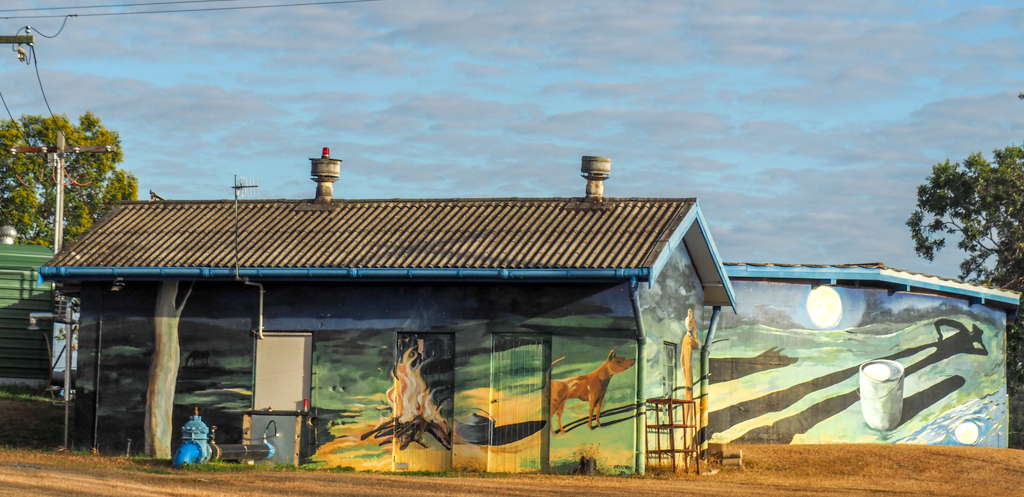
The second newer tank is close to a pump shed and the artist has painted a man with his dog on the shed and their shadows are projected onto the water tank for a very good effect.

Monto Water Tank #2 and Pump Shed

This is the Monto pump shed.

Monto Pump Shed

The Monto tanks are surrounded by a cyclone wire fence making taking clear photos difficult, for one photo I reached up over the top of the fence and for another I squeezed the camera through a gap in a gate.

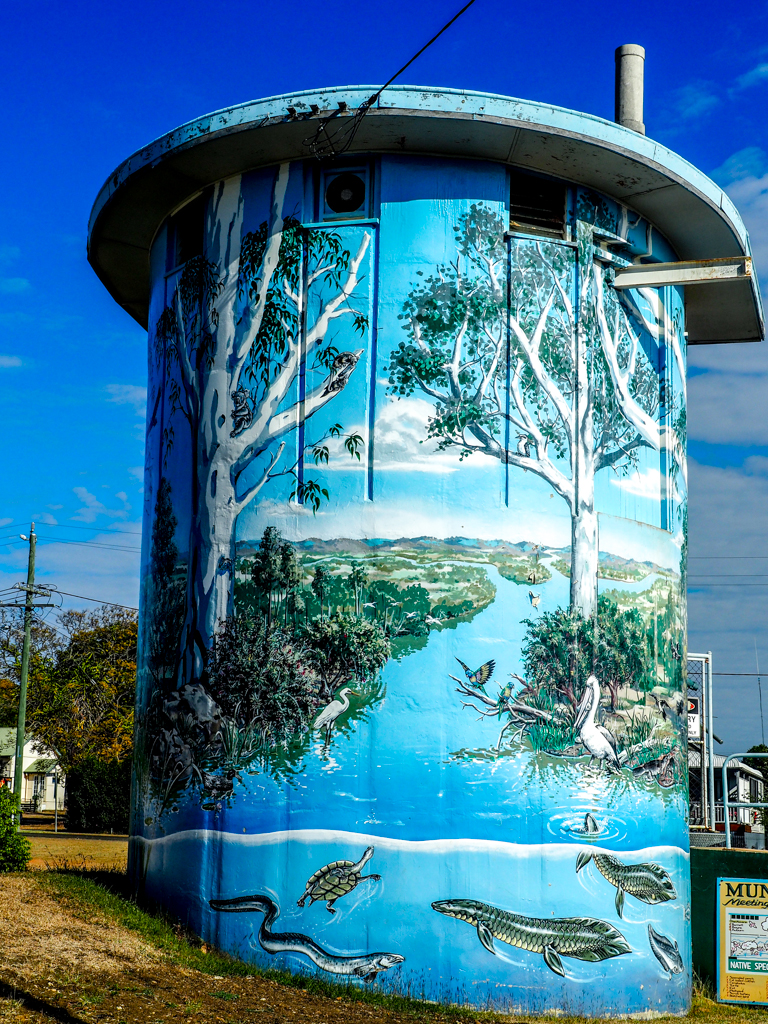
From Monto I drove to Mundubbera where there is a small tower servicing a pump shed.  The artwork was very good representing the geography, the flora and fauna of the area.  In this view you can see a mountain range in the distance known as the Seven Sisters and the Burnett river .

Mundubbera Water Tank South Side

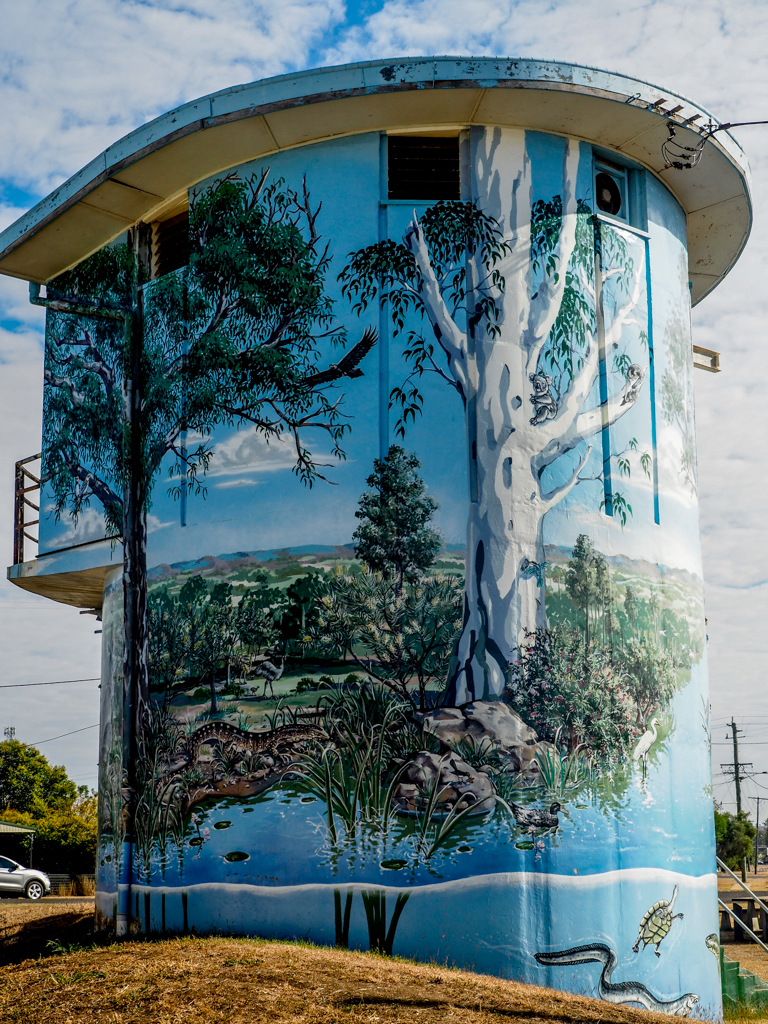
In this shot you can see the staircase that winds up the tower.

Mundubbera Water Tank North Side

Mundubbera Tower West Side

On Sunday I visited two National Parks close to Biggenden, Mt Woowoonga and Mt Walsh.  Both mountains are the result of vocalic activity 220 million years ago.  A massive eruption created a giant caldera, like a meteor crater.  Then pulses of magma pushed up but did not break the surface and then solidified into granite.  Erosion over the millions of years ground away the soft rock leaving the mountains.  Mt Woowoonga is covered in vegetation while the top of Mt Walsh is exposed granite with vegetation on the lower slopes.

Mt Walsh Panorama

I had made a wrap before I left camp and had that at the picnic ground at the base of Mt Walsh.  It was very peaceful and relaxing.  I got a bit of a boost from a young woman setting off to climb the mountain (2-1/2 hour climb and descent).  I asked her if she was going to climb it and she responded “Yes, I did it when I was 15, are you going to do it?” I replied “Do I look like I could” and she said “Yes you do”, made my day!

At Mt Woowoonga there are lots of Hoop Pine trees that tower over the rainforest.  It’s hard to estimate the height but my guess would be 100-125 feet, they grow to a maximum of around 200 feet and live for up to 450 years.  Hoop Pine gets its common name from the outer layer of bark which forms scale-like horizontal hoops.  I took a vertical panorama to try and capture their height.  To give you an idea of the height, it took four frames to capture this panorama


Mt Woowoonga Hoop Pines

Although these National Parks are small, around 2,500 hectares, about 450,000 hectares of former state forest in Queensland and around these parks is managed by the National Parks Service as conservation areas, implemented in 1999.

The rainforest at Mt Woowoonga was very dry just like most of this area of Queensland.  On my travels I pass areas of irrigation and it seems that Queensland has sufficient irrigation water, unlike NSW.

I enjoyed the walk at Mt Woowoonga and in places you catch glimpses of the hoop pine towering above the forest, this would have made it easy for the timber getters to find them to cut down.

Hoop Pine above the Rainforest

These hoop pine are relatively young so as the age they will emerge to a much greater height.

Tomorrow I am off to Noosa Habitat a small camping area next to the Great Sandy National Park – Cooloola Recreation Area and I will be there for 8 days, i’m looking forward to that stop.


Posted in 2019 | Leave a comment

Cania Gorge

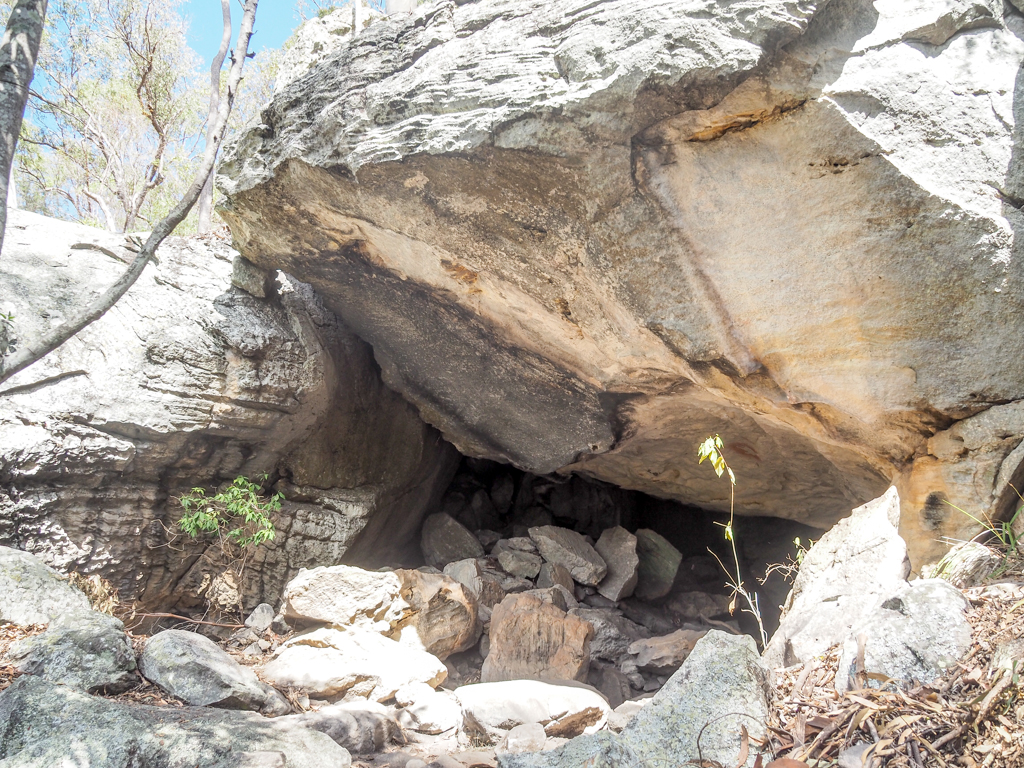
Not  far from the camp there was a rock overhang known as Bigfoot for obvious reasons.  It is a bit hard to see but there is another Staghorn on the top centre of the rock, it is amazing they survive in such harsh positions.

Cania Gorge Bigfoot

I took a short walk (1.3 Km) to Two Storey Cave, no idea how it got the name because you would have to crawl to get to the end of it.  However the walk was enjoyable up the escarpment then across to the cave and down again.  It was a sunny day, but there were clouds and dappled shade to keep me cool.  Along the way you passed massive boulders and walked between two on the track that formed a tall cave.

Cania Gorge Rock Formation

I then got to Two Storey Cave which was about a 1/2 storey.

Two Storey Cave

After that it was downhill return, but I got a bit of a shock when I came across a Lesser Grey Tree Python.

Lesser Grey Tree Python

After the walk I drove into Monto for some shopping and lunch, but the restaurant I wanted to go to was closed so I had a counter lunch instead, which was very good.

Tonight I got the OzPig out and lit a fire, the first campfire I have had alone since Margie died.  It was an emotional time bringing back lots of memories, but what was amazing was that there was a full moon and puffy white clouds in the sky.  The night I first met Marg and when our relationship started was exactly a night like this and at that time I said how beautiful the sky looked.  Until I said that Margie had been non-committal because she fancied someone else, but she later told me that she then thought that this guy could be sensitive and alright.  When we got to the coffee lounge we were holding hands and the relationship was sealed, Marg was 15 and I was 18.

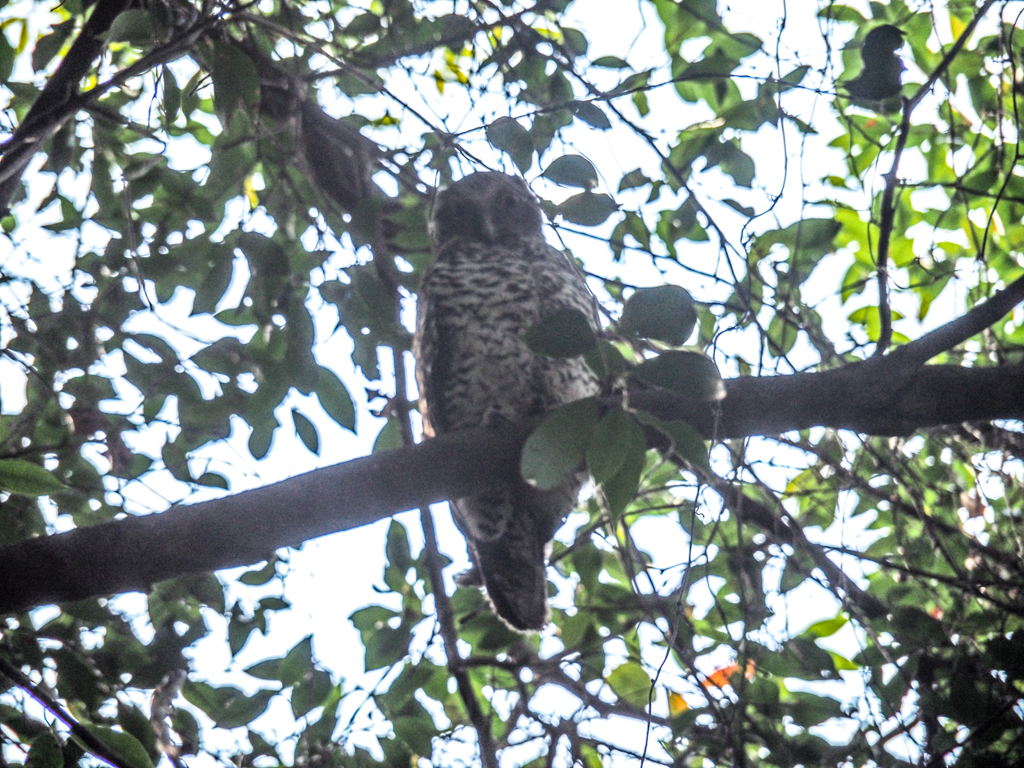
On my last day at Cania Gorge, Friday, I walked along the gorge to a dripping rock and a rock overhang.  It was a rough and rocky walk, maybe that’s a book opening in there, like “it was dark and stormy night”!  But it was and up and down 346 rough rock steps, I counted them on the return walk which was 3.2 Km return.  I was lucky along the way to see a Southern Boobook Owl about 6 metres up a tree.  It was hard to get a photo with the bright sky in the background but here he/she is:

Southern Boobook Owl at Cania Gorge

Or as it looked from the ground using ten times zoom.

Southern Boobook at Cania Gorge

The walk travelled along one side of the gorge through a dry rainforest, may sound like an oxymoron but that is what it is called, and at times you see the sandstone cliff from the path through the trees.

Cania Gorge from Dripping Rock Walk

Surprisingly the dripping rock was still dripping even after a prolonged dry spell, but the drips were about one every second from 3 or 4 different spots.  If you look carefully at the photo you can see them.

Cania Gorge Dripping Rock

Only joking!  After that you walk another 600 metres to get to a big rock overhang at the start of a short valley.  A very peaceful, quiet spot with a few ferns and noticeably cooler than along the walk.

Cania Gorge Rock Overhang

All in all it was a delightful walk with dappled shade most of the way.

Tonight I joined a few fellow campers around a fire and had a very enjoyable evening, the park sold homemade pizzas, which we ate around the fire and washed down with some red wine, a good way to end a very enjoyable stop.

My stay at Cania Gorge was a good one, but tomorrow, Saturday, I move on the Biggenden and then to a stop near Noosa.


Posted in 2019 | 4 Comments

Moura to Cania Gorge

Today, Tuesday, I headed off to Moura and Biloela, the most north that I will travel, and then onto Cania Gorge.  I will stay at Cania Gorge for 4 days and it will be good to have a break from packing up and driving most days.  I have to say most of the roads in Queensland have been crap, I thought Victoria’s rural roads were bad but Queensland’s are worse.  They have the same system of putting up signs “rough road” rather than fixing them, as is done in Victoria, but the roughness is worse and there are massive undulations that have the car and the caravan bucking wildly.  Hopefully the journey back down the coast will be better.

On the positive side I bought a punnet of Queensland strawberries today and they were great, red right through, the first time in years that I have eaten strawberries that are not white in the centre, delicious.

I woke up about six after going to bed early and I was on the road by 7.15, my fingers got a bit cold packing up in 3 °C, but the day has been perfect, clear skies and sunny at 19 °C.

The water tower at Moura was very well done, but the main feature was facing a green shed, not sure why they did that.  You can just see the corner of the shed roof on the left in this photo which is why the tower is off centre.

Moura Water Tower

The detail on this tower is excellent and the colours are vibrant.

Moura Water Tower Galah

The back of the tower is just as vibrant but with less detail.

Moura Water Tower from the Back

On the journey to Moura I passed several massive coal mines and a train of coal wagons about one Km long.  The country was very dry with little grass and the dams were mostly dry.  The next town was Biloela where the town has created artwork on a water tank.  The painting is very colourful with lots of detail and is very well executed.  It shows the development of the area on three panels of the water tank.  The first panel is of the Jurassic period.

Biloela Water Tank Jurassic Period

The next panel is of the period that aborigines dominated the area, the Jurassic period panel is on the left.

Biloela Water Tank Aboriginal Period Panorama

The last panel detailed the European settlement of the area which faces the road.

Biloela Water Tank European Settlement Panorama

This photo shows the whole tank with the aboriginal panel on the left and the last part of the European settlement illustration on the right.  The only way I could get it in one photo was to do a panorama on the camera.

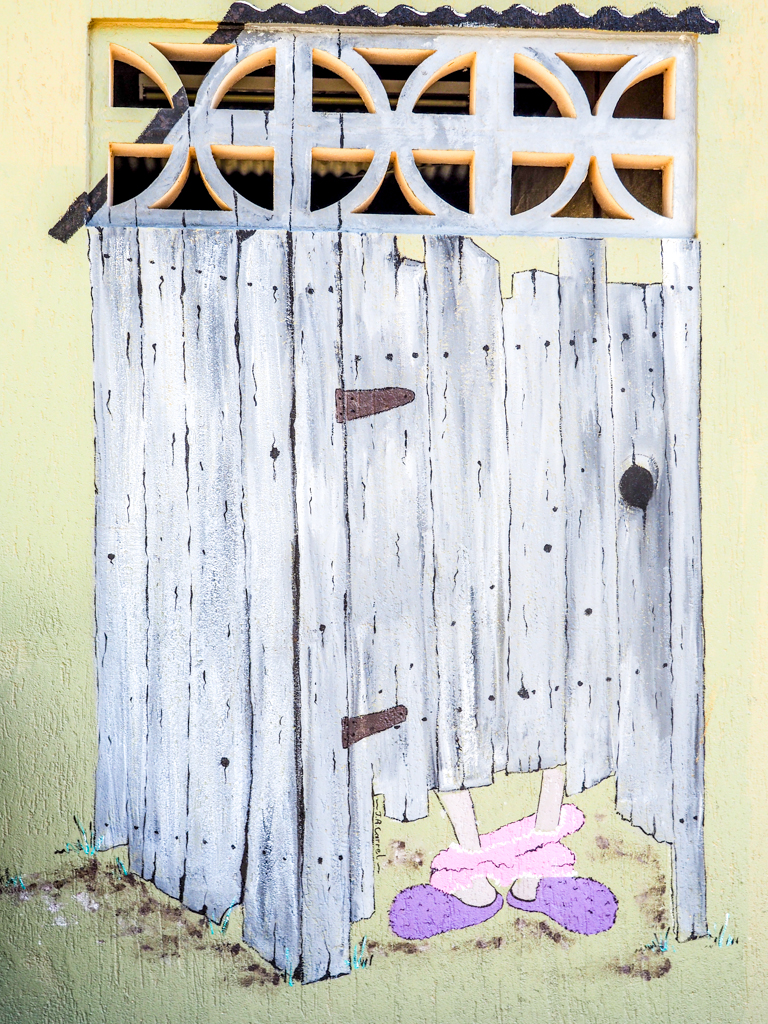
So on to Cania Gorge which looks just the same as when Marg and I were here, I have good memories of our stay here.  Given that I have been following a public art trail it was a surprise to see lots of art on the cabins and toilets in the caravan park.  The toilet mens and ladies signs were good.

Mens Toilet

Ladies Toilet


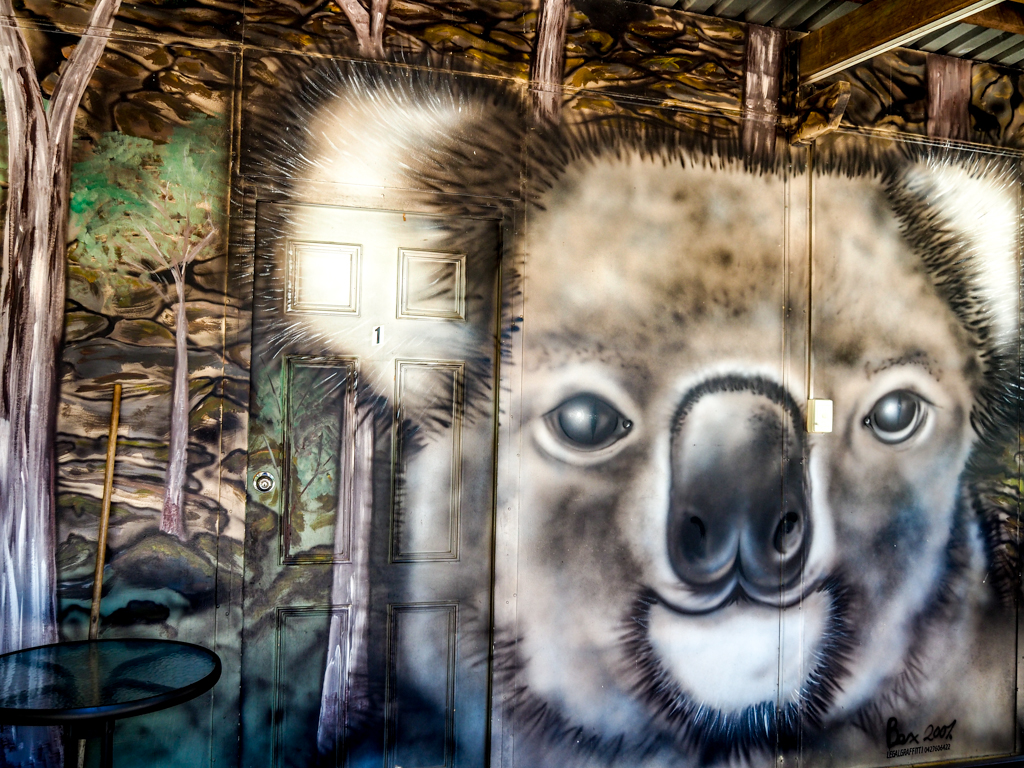
The cabins in the park are all named after Australian birds or animals and are painted with artwork that matches the name.

Kookaburra on Kookaburra Cabin

Koala on Koala Cabin


On Wednesday I had a bit of a lazy day, spent a couple of hours talking with my neighbours and then went on a walk to Giants Chair Lookout.  It was a steep 900 metre climb with about 400 steps the forest I walked through was delightful with hundreds of grass trees dotting the landscape.

Grass Trees at Cania Gorge

The gorge is about 100 metres deep and runs for about 10 km.  The view from the top is good but not spectacular.


Cania Gorge from Giants Chair Lookout Panorama

Another view of the gorge.

Cania Gorge from Giants Chair Lookout

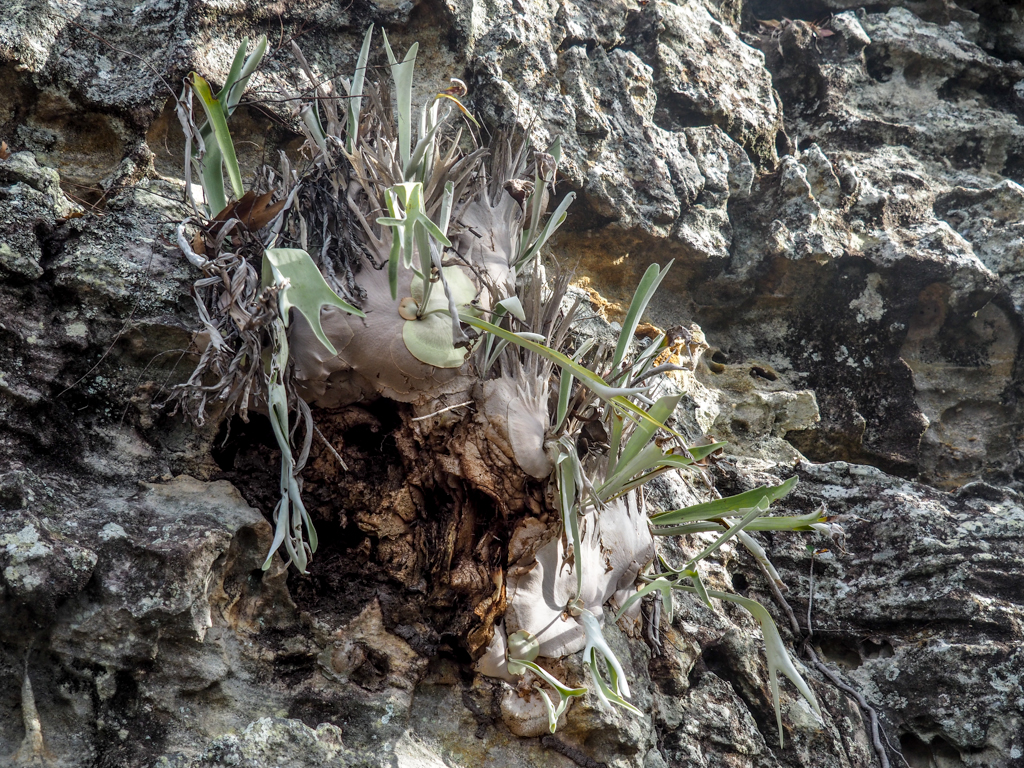
On one of the rock faces there was a staghorn fern growing that looked to me to be 30-40 years old.

Cania Gorge Staghorn Fern

Tomorrow I will drive into Monto, the nearest town and have lunch at a cafe, Marg and I did that on our last visit here and maybe another walk in the afternoon.  It may be a few days until I have enough material for the next blog.

Posted in 2019 | 6 Comments

Goondiwindi to Theodore

My daughter Nadine let me know that Banjo Paterson wrote a poem on the town I passed the other day, “Come by Chance”, and the poem is worth a read.  You can read it at:  https://www.poetrylibrary.edu.au/poets/paterson-a-b-banjo/come-by-chance-0001046

On Saturday I set off from Yelarbon to go to Possum Park 20 Km north of Miles which is 250 KM inland from Noosa.  The camp is set in bushland but the camping area is bare gravel with no trees, but the outlook is OK.  I put the drone up in a howling gale and was able to take some photos between gusts.  Went the wind blew the drone would tip over a bit as the wind was too strong but it levelled out between gusts.  The camp was a RAAF ammunition store during WW2 servicing and airbase in Miles.  There are 30 bunkers around the camp and some have been turned into accommodation.

Camp at Possum Park

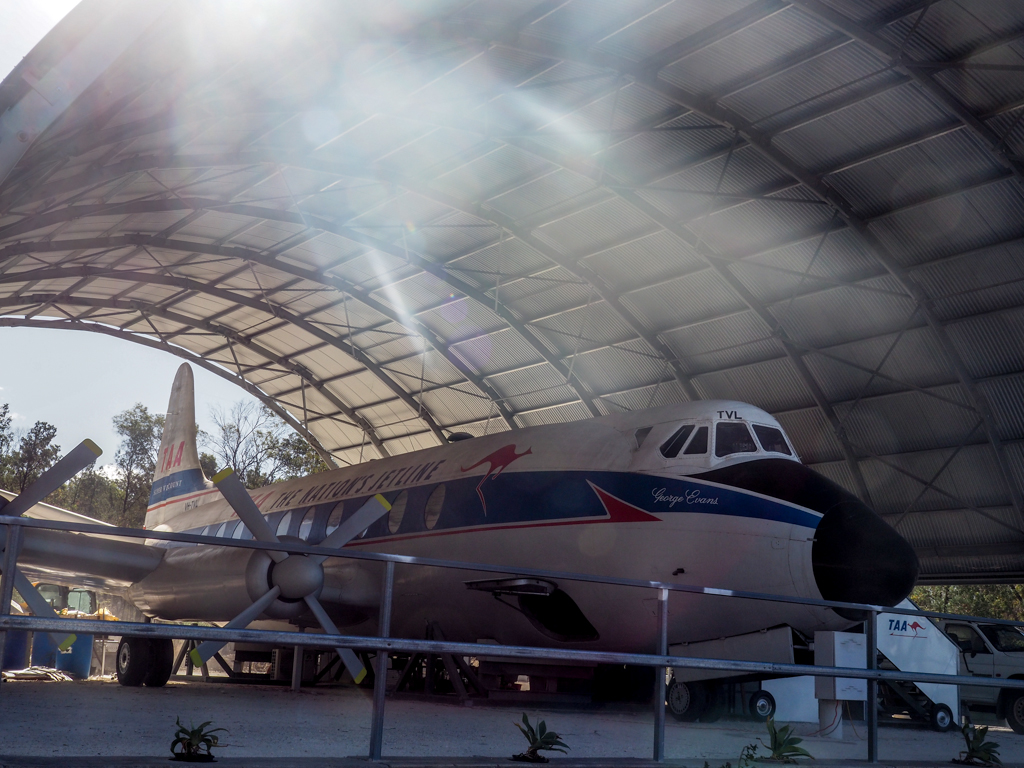
The owners of the park have bought TAA Viscount, which they plan to turn into accommodation.  When the park was an RAAF store a railway line that joined the line to Brisbane was laid and there are some railway cars retained in the park that are now accommodation.

TAA Viscount at Possum Park

Railway Car Accommodation at Possum Park

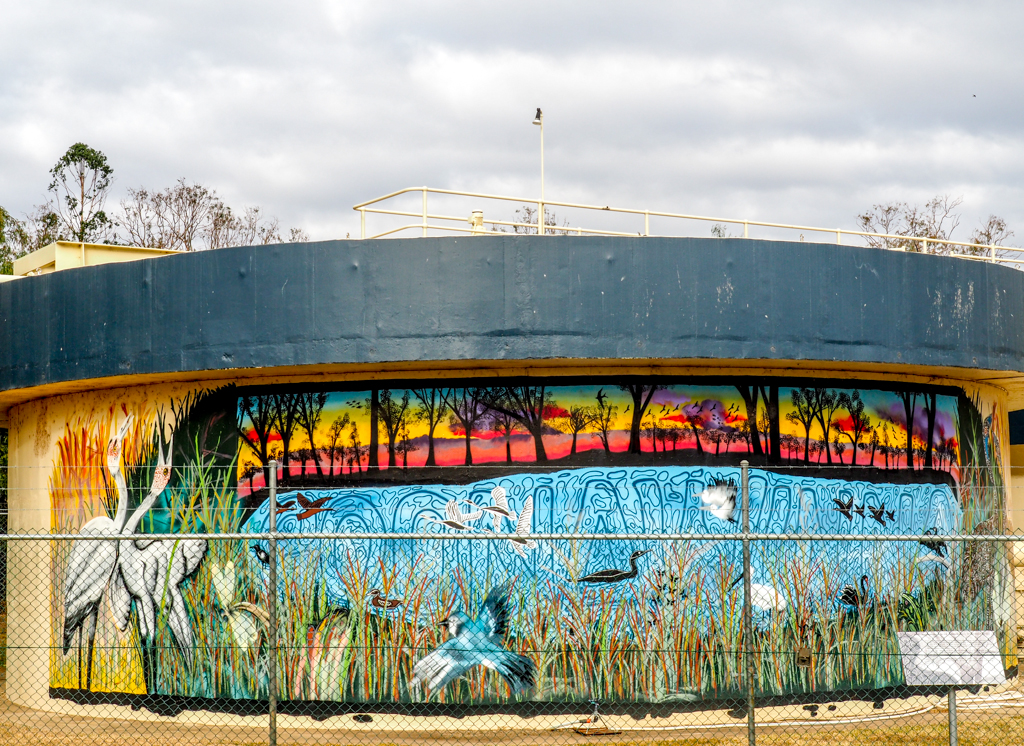
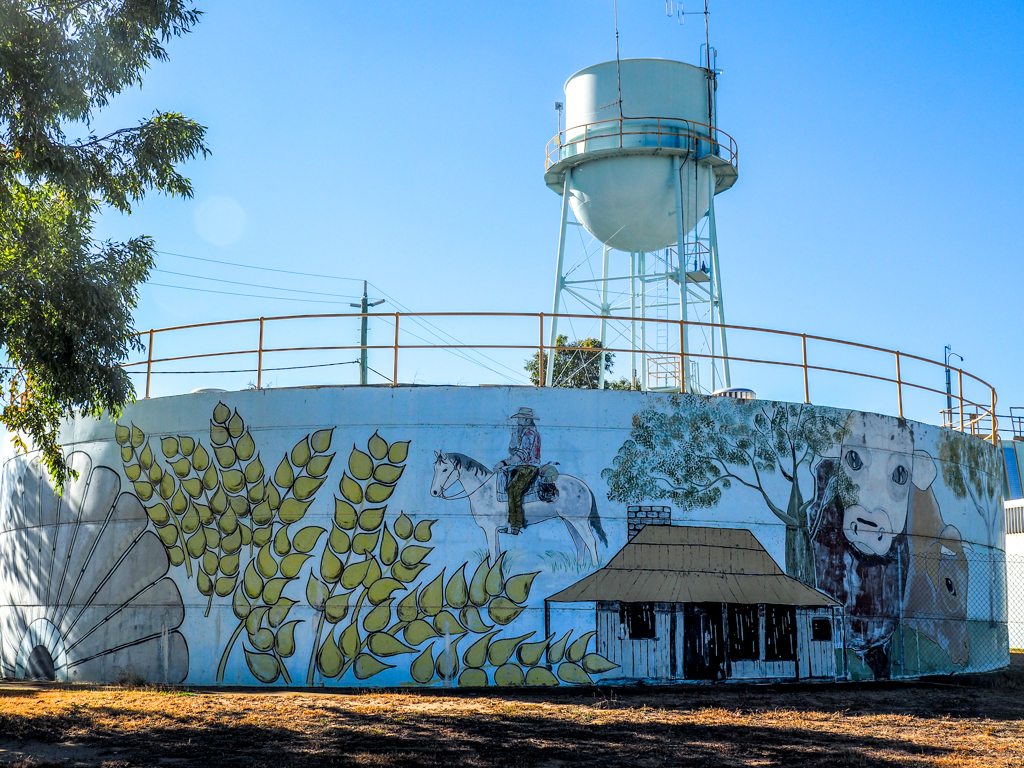
On the way here I visited Goondiwindi and the water tower art in the town.  It was a small water tower but the artwork was good.   There is no info available on the artist or the theme but it does look like the artwork is about the sun, land, water and water birds.

Goondiwindi Water Tank

Goondiwindi Water Tank

The next water tank I visited was at Wandoan on the way from Miles to Theodore.  Painted by members of the Wandoan Progress Association in the 1990s.  A member of the community Trish Rowen won a competition to decide the design, another local donated the paint, a real community effort.  They painted it at night using an overhead projector to project the image off a sheet of paper.  A local visited the painters and picked up the paper image to have a look and copped some abuse, but he did it again twice, the blistered paint had to be scraped off and repainted!  The tank still looks good but is faded.

Wandoan Water Tank

You can tell how much the art has faded on the truck and the flag.

Wandoan Water Tank West Side

I am staying a couple of nights in the Theodore showgrounds and tomorrow will visit Isla Gorge National Park.  Theodore is a small town on the Dawson river.  The map below shows my last five days travel to Theodore.

Journey Day 11 to Day 15

On Monday I visited Isla Gorge National Park.  It is one of the twenty five separate mountain ranges in Queensland that branch off the Great Dividing Range.  From Isla gorge the range extends to Robinson Gorge, Mt Moffat and Carnarvon Gorge.  The range is sandstone that was laid down under the sea in the Jurassic period 190 million years ago.  Uplifts and erosion have made the gorges.  In some places volcanic basalt caps the ranges.  Three creeks flow in the gorge eventually flowing into the Dawson River which rises in Carnarvon Gorge and flows into the Fitzroy river to the coast near Rockhampton.

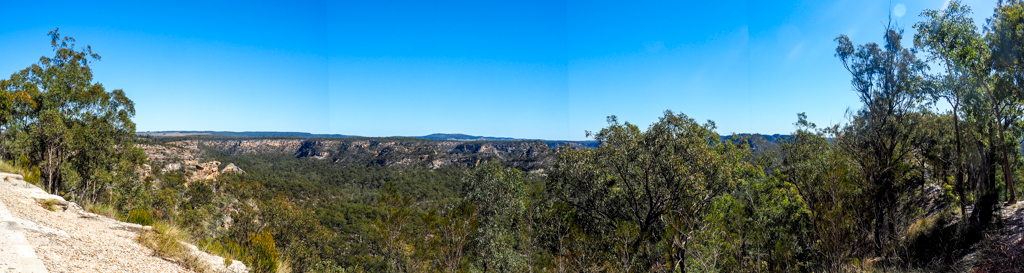
The gorge looks just like Carnarvon gorge except you can only see it from the top, at Carnarvon you walk along the base of the gorge.  But the views are great and from the car park you look over towering sandstone cliffs that photos do not do justice.  There is a short walk to other viewing points but trees seem to be in the way at every turn.  I set up the camera and took a couple of panoramas.

Isla Gorge from the car park


Isla Gorge view from the walk

These are the views you see when you step out of your car.

Car Park View West

Car Park view East

While at Isla Gorge I had lunch, I made a wrap using a hamburger I cooked last night plus avocado, tomato, lettuce, cucumber, capsicum and dressing, it was yummy.  I sat on the other side of the table for lunch so I could enjoy the view you see in the photo.

Lunch at Isla Gorge

Tomorrow I am off to Carnia Gorge where Marg and I enjoyed a great stay twelve years ago, I may even have a campfire in her memory.


Posted in 2019 | 1 Comment

St George to Yelarbon

I drove 430 Km from Coonamble to St George in southern Queensland on Wednesday.  It was sad to see bare red earth, little vegetation, and trees dying or dead, the country is crying out for rain.  Strangely there were a few paddocks with crops going OK, but others with crops barely out of the ground and browning off already.  On the news this morning they reported that Stanthorpe (Qld) and Gunnedah (NSW) have only ten days water remaining, no doubt there are other towns as bad or worse.  On the way I passed a signpost to a town “Come by Chance”, I guess that says it all about the size of the town.  I did consider going to see it but I was worried I may miss it!

The big industry for the St George Shire is cotton and the roadsides are scattered with little puffs of white.  I don’t like the massive water dams on every property when I think of all the problems the NSW farmers are facing and the state of the Darling river.  Exporting cotton and rice is like exporting water from the driest continent.  Surely we can grow dry land crops of crops that need much less water.  What makes it worst is that a lot of the biggest farms are overseas controlled.  Cubbie Station is 51% owned by a chinese company, it is the biggest cotton grower in the southern hemisphere.  Profits go overseas with our water.

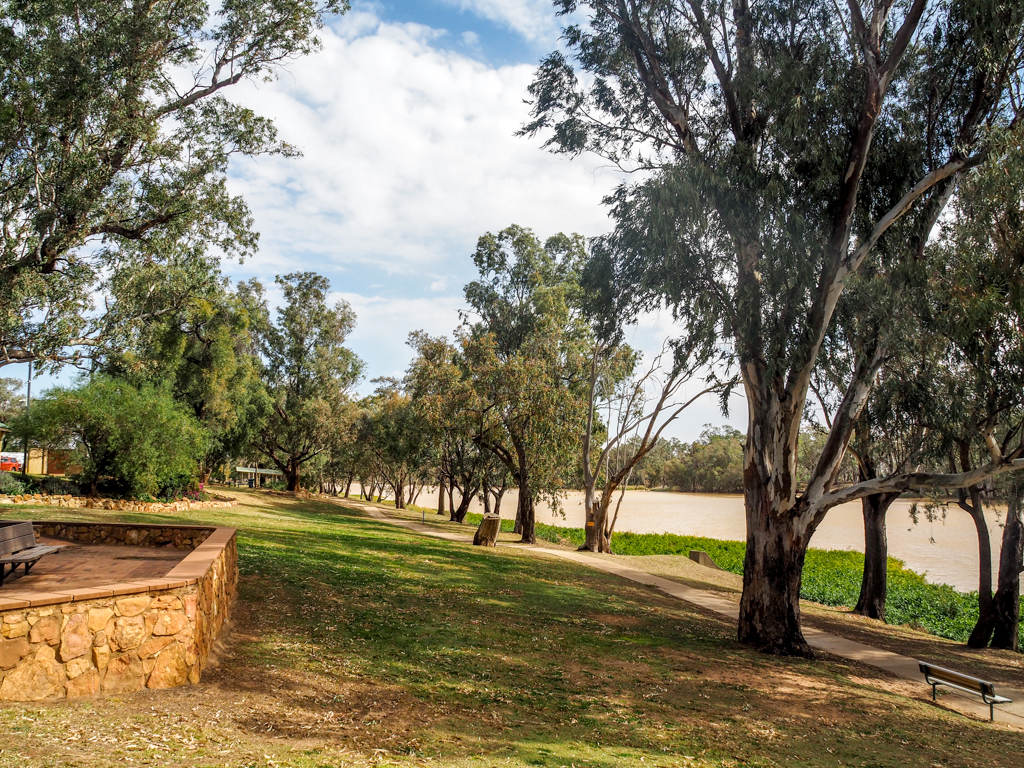
St George is a small town on the Balonne river which has a weir about 7 Km south of the town so it is quite full but not flowing.  I am camped at at Kapunda Fishing Camp right on the river 9 Km north of St George.  It has basic facilities plus power but little need for that as last night dropped to only 11 °C and today it will be 24 °C.  Only four other camps here so it is very quiet.   After I set up I went to a winery near the town, Riversands, which makes a range of white and red wines and a vintage port, which was what attracted me to visit the winery  Their Chardonnay and Shiraz were good but the port was more like a tawny, but I still bought a couple of bottles, I doubt they will make it back home!  The photo below is of my camp at St George.


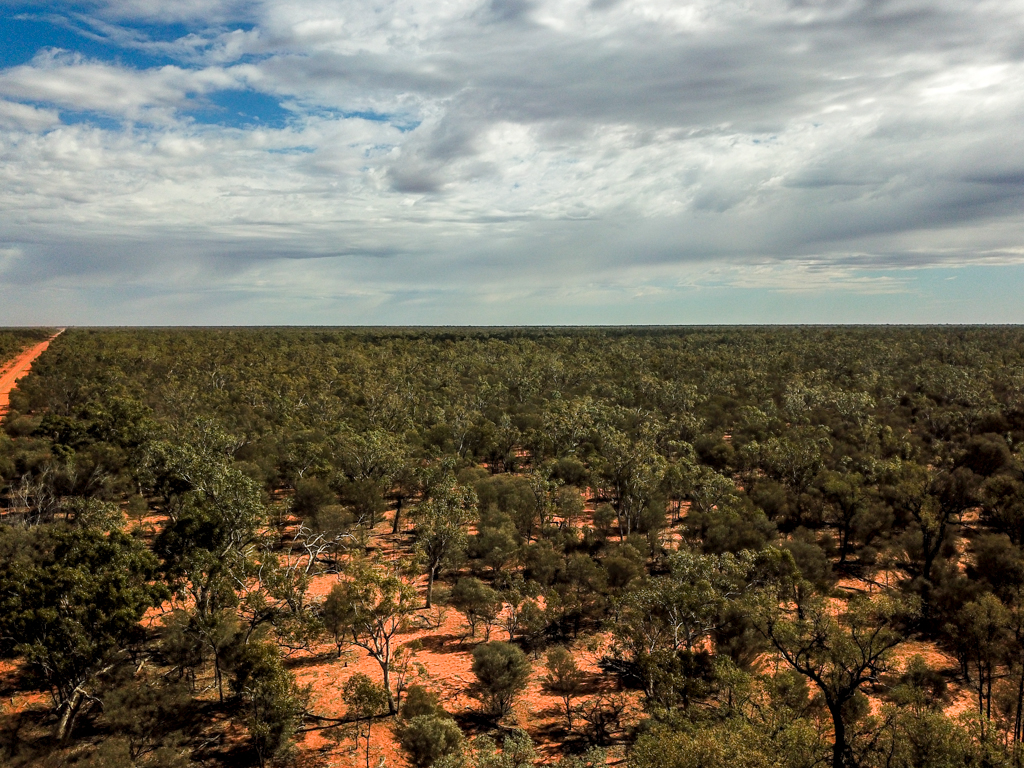
Today I drove to Thurston National Park, a 220 Km round trip, it is an undeveloped park renowned for its birdlife.  Sadly when I was there I didn’t hear a bird so it was not a successful trip.  Maybe I should have guessed that with the drought the birds would have moved out.  But I put the drone up in very gusty winds and took the first drone photos of the trip.  The 20 Km drive off the highway is on a fair dirt road, but the seven gates each way got a bit tiring.


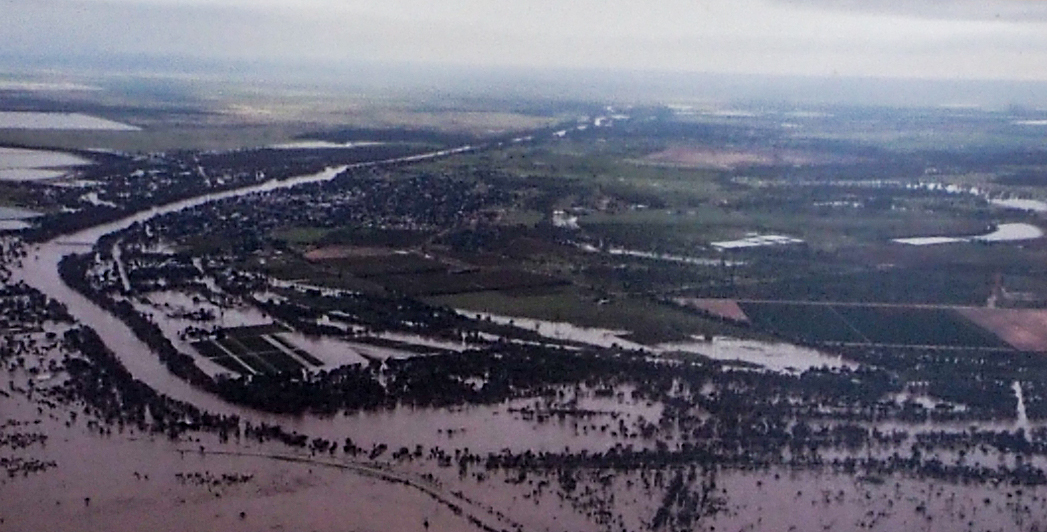
Back in St George I visited their riverside picnic area and it was good to see some green grass.  Very well maintained area with lots of tables and a free BBQ.  There was also a flood marker showing the height of the floods over the years.  The biggest was in 2012 at 13.95 metres and the river flow at that time was 328,000 megalitres per day an incredible volume, about two thirds of a Sydney Harbour per day!  The top of the flood marker was about five metres above my head.  The bottom marker is the height of the bridge which would have been four metres under water at the flood peak.  Most of the town had to be evacuated to Dalby until the river subsided.  Old timers say the 1890 flood was higher, but the flood marker was washed away so it is only conjecture.


The photo below is of St George in the the 2012 flood (I did pack my time machine for this trip).


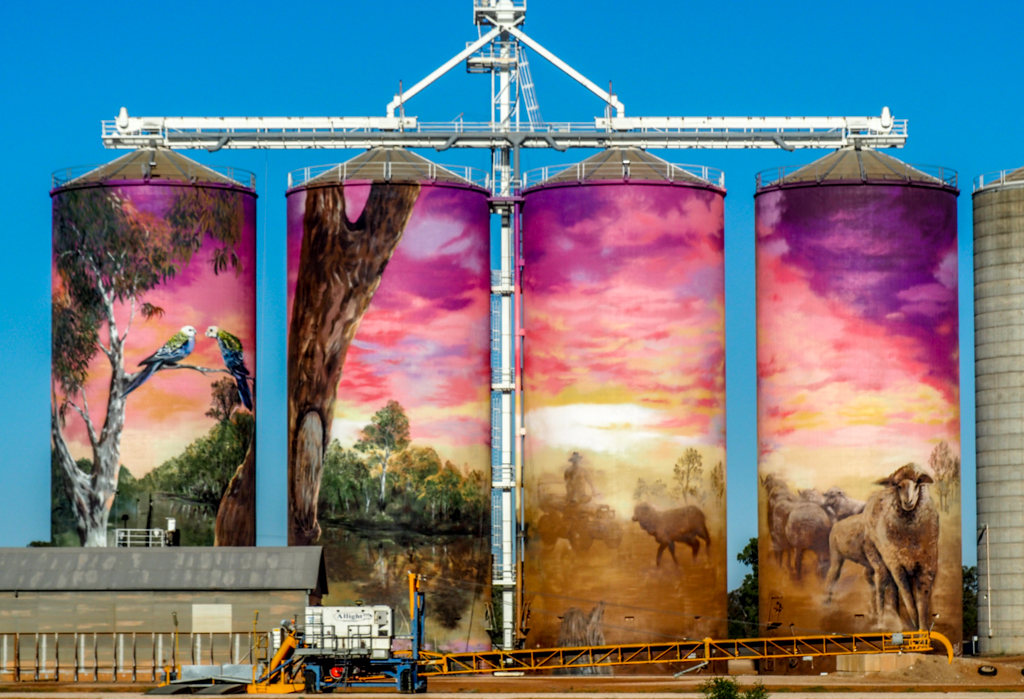
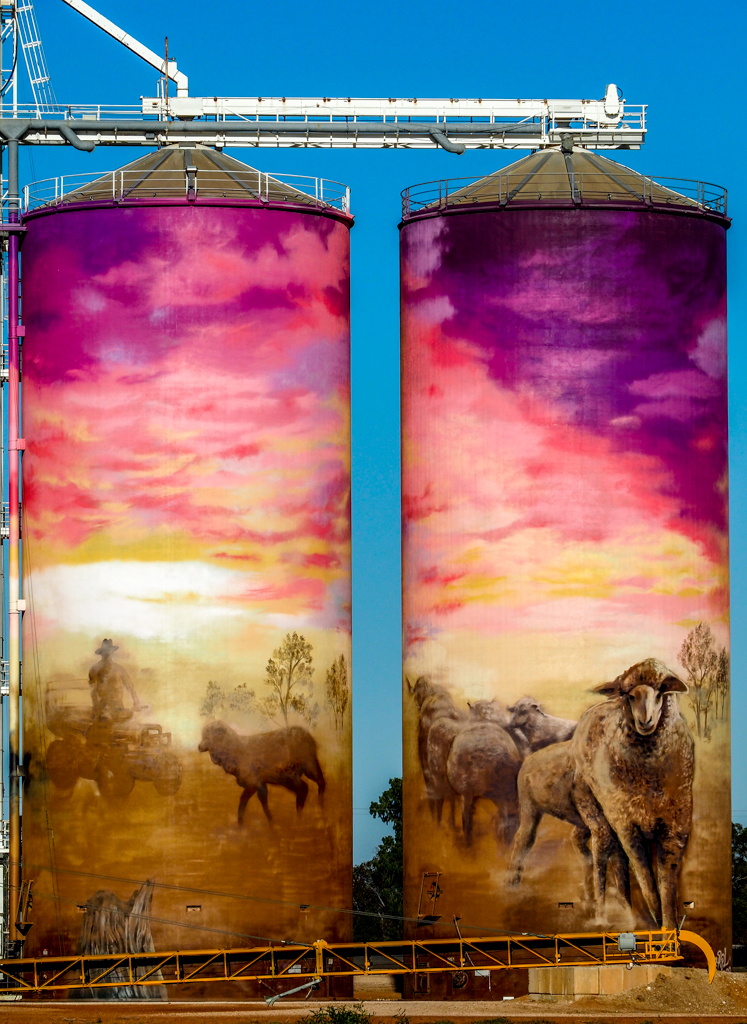
Today, Friday, I set out to Thallon about 80 Km south-east of St George.  The silos there are called “the waterhole” and depict the Moonie river, wildlife, trees and sheep, with a sunset in the background.  The painters are two Brisbane-based artists, Travis Vinson and Joel Fergie.  The silos look great as you approach the town from the distance.


A couple of closer views:


On the way I called in to Ninidigully to see the historic hotel, established in 1864 it is the oldest continuously licensed pub in Queensland and is on the banks of the Moonie river.


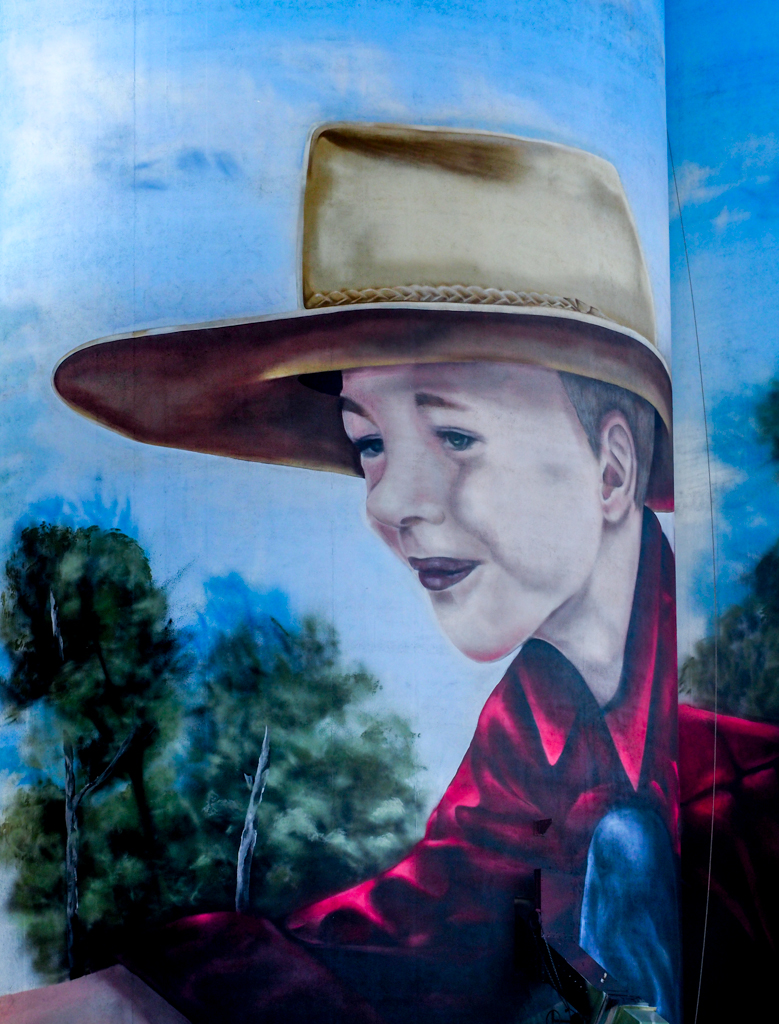
From Thallon I travelled from through Goondiwindi to Yelarbon where I will stop for the night at the recreation ground – $15 a night with power and water, clean but small amenities.  The silos here depict a boy playing in the Yelarbon lagoon “when the rain comes” and floating a boat he has made out of a newspaper.  Four silos have been painted with another three having been cleaned and painted white ready for more artwork.


The boy is painted across two silos.


Tomorrow is Saturday and I am heading off on a two day trip to Theodore from where I will visit Isla Gorge National Park, a park I have wanted to visit for a while but on that never quite fitted into our various journeys.  So no blogs for a couple of days and only one silo on the way at Wandoan.


Posted in 2019 | 2 Comments