Ceduna to Esperance

We seem to have been in the car the an eternity but in all, the kilos have totalled 3100 in seven days. We are now in Esperance, by the ocean, but only for the night, because tomorrow we have a short trip to Cape Arid National Park, which sounds fabulous.

Now, about the Nullabour. Nullus Arbor, meaning ‘no tree’, but the aboriginal word for the plain is Oondiri, meaning ‘the waterless’. The plain has an average rainfall of only 20cm a year.

The only arduous or boring part of the trip was the straight (and I mean straight) road. We both thought the vegetation beside the road was fantastic, with the Hampton Tableland to the north of us, stretched all the way along from Eucla until we climbed up on to the top of it at Madura. After this we travelled on the longest straight stretch of road in Australia, 146.6 Km without a bend!

We stopped several times and took photos of the Great Australian Bight, believed to be the longest line of sea cliffs in the world, starting from Cape Pasely in the west to Cape Carnot, near Port Lincoln, a distance of 1600kms!

We stopped several times and took photos of the Great Australian Bight, believed to be the longest line of sea cliffs in the world, starting from Cape Pasely in the west to Cape Carnot, near Port Lincoln, a distance of 1600kms!

Posted in 2008 | Tagged , , | 2 Comments

The Big Trek Across the Plains to WA

Sunset and the fire at Kimba

We left the Barossa Valley, passing the distinctive stone houses of this area, through, what looks like, country that has received its share of rain. No barren areas, as was our experience last time we went to the Flinders Ranges – brown land and animal skeletons all the way along.

Headed for Burra, at my request, to once again, buy the now famous ‘salt bush hogget’. Maggie Beer has been praising its qualities for some time now. We cooked the Merino cutlets on a wood fire BBQ the same night and they had an excellent flavour and were extremely tender. YUM

While in Burra, we had to sample the Cornish Pastie, also famous for this area, where mining for copper was the livelihood of he town in the mid 1800s.

Rhys and Heath – can you sot the Magnet Men on this huge eucalypt that we saw?

We stopped at Kimba for the night – very run down for a Top Tourist Park, but we were allowed to have that fire BBQ.

Another cold morning, another early start and arrived at Ceduna at 12noon. Lovely site, with views of the bay, the jetty, guys fishing. Quite a large town – bought supplies and oysters from Denial Bay. Ceduna claims to be “The Oyster Capital of Australia”!  Temperatures have ranged from 5-15 degrees.

The road from Kimba to Ceduna was far more interesting than I expected, with with the classic Russell Drysdale depictions of magnificent Mallees – multi-trunked and loads of spindly branches, with clumps of foliage on the ends of the branches, similar to umbrellas! I’d never tire of that scene. Healthy looking crops, the entire distance too!


At Ceduna the magnet men got a bit excited and tried to climb over the fence of the caravan park to get to the playground as soon as we stopped!

The only down side has been the continuing comment about the dire state of the mouth of the Murray River and the Coorong and lower lakes. Scientific opinion is that unless good rains come before October, native fish will be non existent and these areas will die. Frightening.

Posted in 2008 | Tagged , | Leave a comment

Hamiliton to Nuriootpa

Started off at 8am and had quite an easy drive through very scenic country. No sign of the drought, with green hills and pastures all the way. Loads of cows and sheep, some of the sheep with twins and triplets.

Visited Mt Monster Conservation Park (approx. 10kms before Keith), for a picnic lunch. A beautiful setting of Ozzie bush, on a granite outcrop, dating back millions of years, when it was once covered in the sea. When the sea receded, sediment was the only thing remaining, covering Mt Monster and today, millions of years later and after sediment has been washed away, the granite outcrops are the feature. A perfect setting for a rest and lunch, though rather cold.

Amongst eucalypts, banksias, correas, we spotted these grass trees with ‘attitude’! Rhys and Heath, can you spot the magnet men on the grass trees?

Posted in 2008 | Tagged , , | 1 Comment

Start at Portsea

Magnet Men Ready for the JourneyWe had a very relaxing start to our holiday, using the Portsea ferry to take us to Queenscliff, cutting out the peak hour rush and tolls. The magnet men were so excited that they wanted to ride on the bonnet of the car!

Russ had a trip down memory lane, as we headed for Wallacedale, where his paternal grandmother, Susan Jaffray lived, over to Russ.

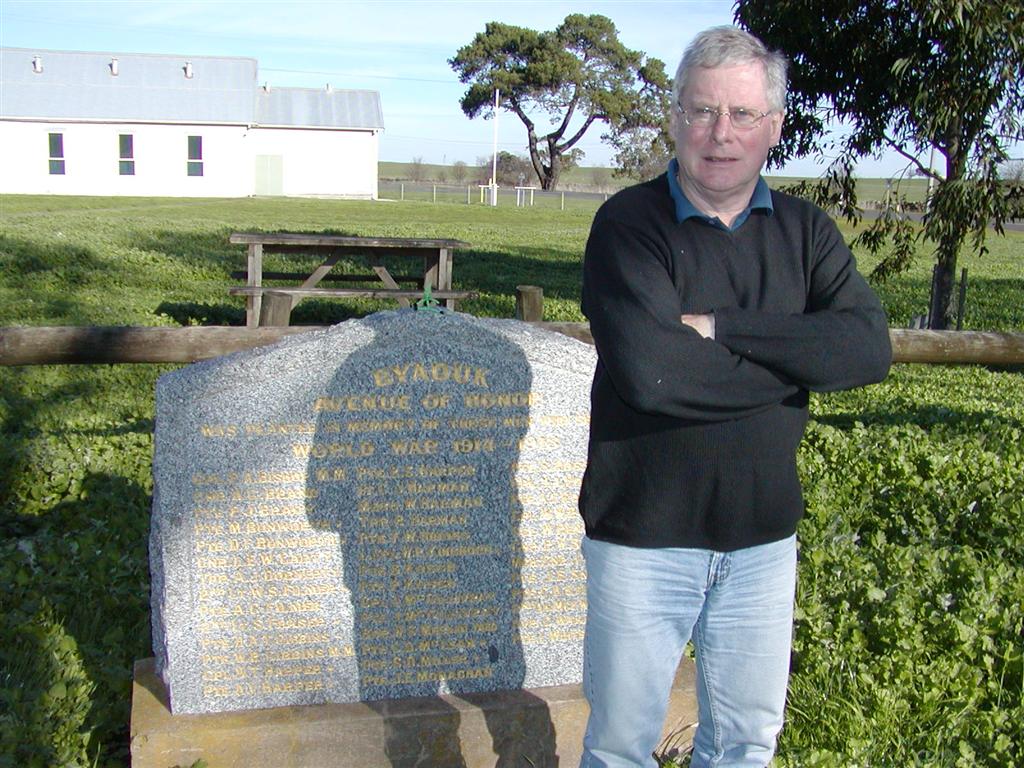
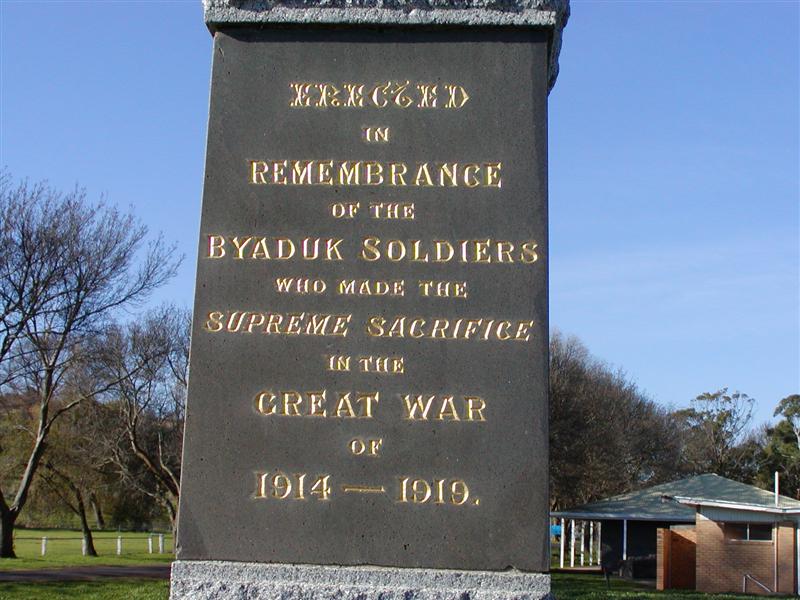
We turned off the Hamilton highway at Penshurst and headed to Byaduk where Aunty Reb and Aunty Lou lived (Grandma Incoll’s sisters). Reb was married to Vert Kinghorn and in the village of Byaduk (footy ground and hall only) was a memorial to a Corporal Walter Kinghorn, who was killed in the first world war.

There was also a memorial to a Private Frank Suttee who was the first Australian soldier killed in the Boar War. Grandma Incoll’s sister (I think Mary) was married to John Suttee and no doubt they are related as they lived near the Kinghorns in Byaduk.

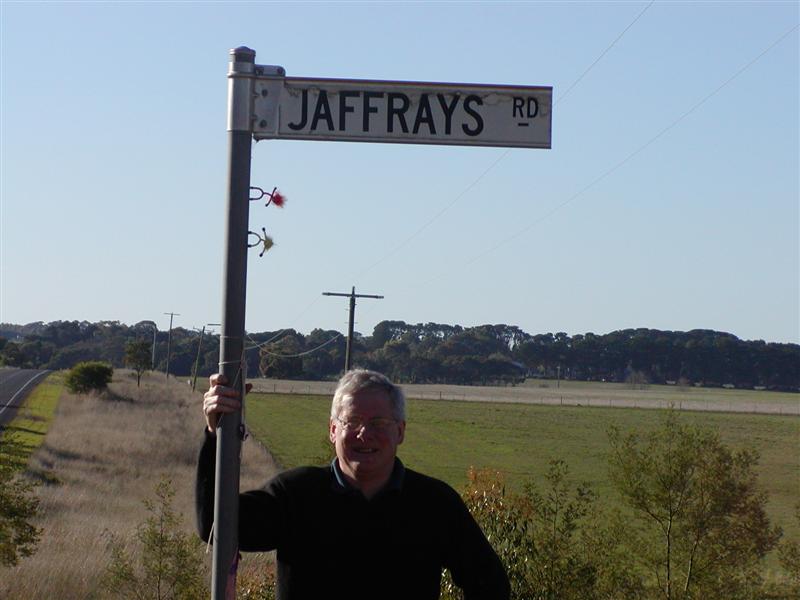
We then went to the Jaffray family farm at Wallacedale, sadly little remains except for some old iron and the roof of the scullery intact but on the ground. Even the giant peppercorn tree between the house and the stables was no longer. The farm is on the corner of Jaffrays Rd and Nixons Rd (Swamp Rd is now Nixons Rd). The distance from house site to the main drain seems much longer, but the road at one car wide seems much narrower. I didn’t feel like taking a photo of the farm, so we took one of the Jaffrays Rd sign on the corner of the Hamilton – Portland Rd), and the magnet men could not be kept out of another photo opportunity!

Now at Hamilton for overnight stop and got some exercise with the magnet men on the monkey bars – no comments on the big monkey please!

Posted in 2008 | Tagged , | 1 Comment

Almost On the Road!

This is just a test run.

Posted in 2008 | 1 Comment

TRILBY TO HILLSTON TO DENILIQUIN

We left Trilby and travelled nearly 400kms, in red bulldust again, until we arrived at a very small town, having a much welcome caravan park. The temperatures are cooler still and we have jumpers on for the first time since leaving central NSW on the way up.

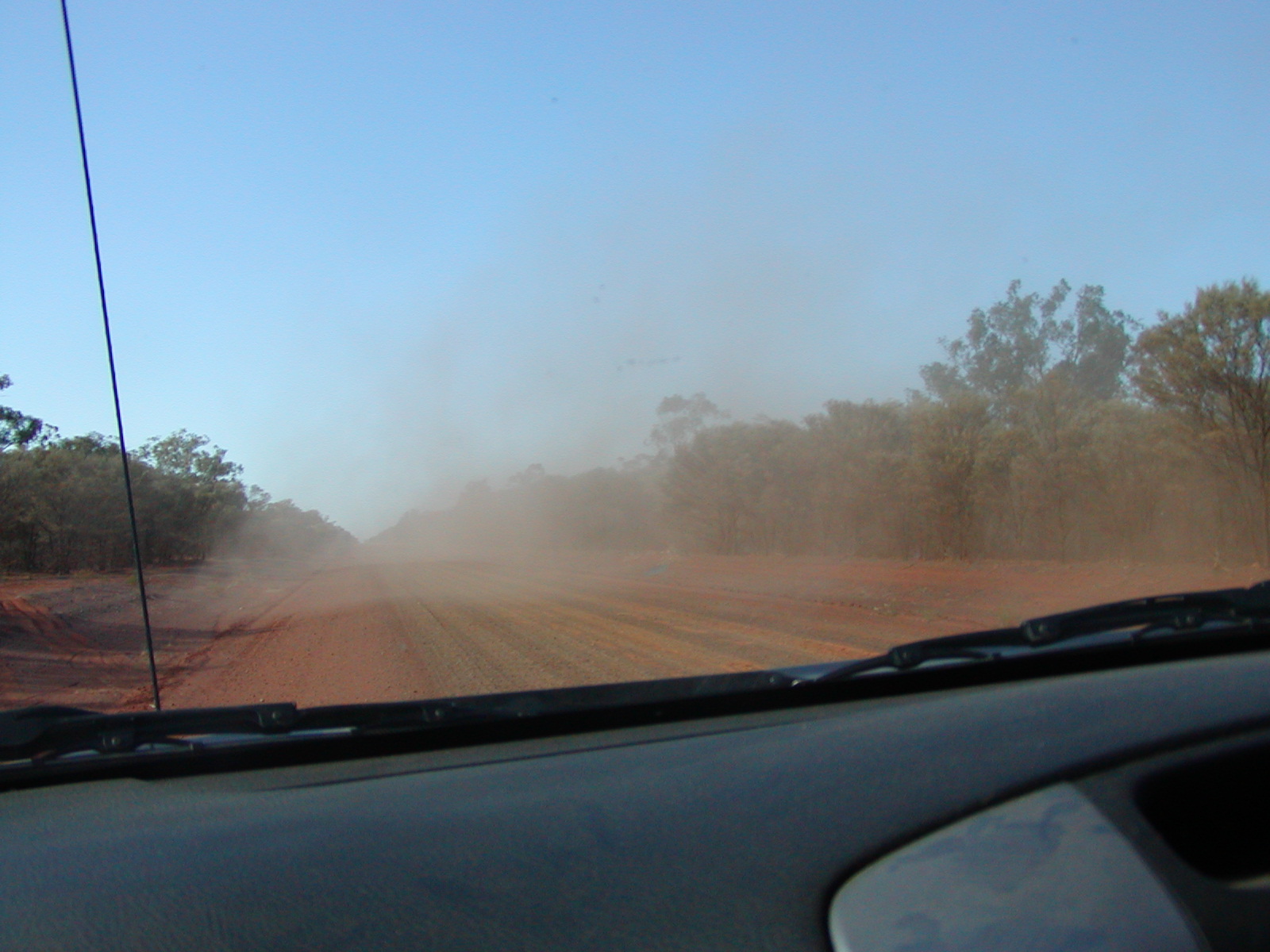
On the road again the next day, finding the distances between towns much smaller than in Queensland. Another 100kms on red dust, where I photographed an oncoming road train, although the photo doesn’t really represent the foreboding giant approaching and the overpowering dust that follows.

stop-wait-for-dust-to-settlevery-close-roadtrain

Happily, the next 350kms or so were on bitumen – I think we are both thoroughly over red dust roads. Our supposedly “dust proof” caravan is covered in red dust internally and we are leaving every skerrick there to show the dealer, who will have his work cut out to make sure the caravan lives up to its guarantee of being dustproof! We take it back next Monday, on our way home.

Our destination today was Echuca, but we saw a sign to Four Post Camp, just south of Deniliquin. Advertised as being on the Edward River, we thought it was worth a look. It turned out to be a great diversion, although the river is a shadow of its former self. We found out that the Edward River is an anabranch of the mighty Murray River, and when it’s in flood, it actually carries more water than the Murray!

clean-up-time

Fires are allowed here and we had the caretakers and two other campers as company. The caretakers are volunteers here, and the whole camp was originally set up as a recreational site for children. Schools, aboriginal groups, children with special needs are a few of the beneficiaries, and the camp is open to groups for conferences, as well as people like us – just needing a powered site for a couple of nights. It’s like a massive Mahaika (?), with a children’s activity area, a large hall, a new bunk house, with very good accommodation, BBQs, etc. Funding has come from the Federal Government, as well as the local Lions and Apex Clubs.

DID YOU KNOW!!

We have just clocked up 10,000kms, at a cost of $2,000 for fuel.

Broken Hill has more trucks and sets of traffic lights underground on mining roads than it does on the surface.

Broken Hill is also further from its own state capital Sydney, than Melbourne or Adelaide.

Hillston, Willandra and the surrounding region contain a system of Pleistocene lakes, formed over the last two million years. Ancient fossils, burial and cremation sites have been discovered in Willandra Lakes, dating back 40,000 years.

Tibooburra is bordered by the Sturt National Park, named after explorer Charles Sturt, who passed through the area as he searched for an inland sea in 1884-85.

It is claimed the cash flow at Lightning Ridge’s Commonwealth Bank is the largest in Australia.

Wentworth’s prime position at the meeting place of the Murray and Darling Rivers saw it short listed to become Australia’s capital.

Sturt described the point at which Wentworth now lays as the ‘confluence’ – the merging of two streams.

Did you also know that this is our last blog (sob, sob), as tomorrow we go to Kyneton, meet up with Barry and Cas, have lunch on Sunday in Woodend and see Samantha’s new house, then the dealer on Monday and HOME. Look forward to catching up with you all!!

Thank you for reading – hope there haven’t been too many mistakes!!!

Posted in 2007 | Leave a comment

TRIBLY STATION

For the next two nights, we are staying on a 200,000 acre sheep station (with a recent additional purchase of land), 132kms out of Bourke, on the Darling River. Our campsite is on the river bank, but we can’t see the trickle of the Darling, unless we stand on the edge of at least a 30 metre high bank.

camp-at-trilby-station

We were greeted by a large flock of red-tailed cockatoos and some beautiful parrots (yet to find out what they are).

The owners, Gary & Liz Murray, are fifth generation “Murrays”. The first generation settled here in 1860. Initially, Trilby was part of Dunlop Station, which was the first station to introduce mechanical shearing and despite a shearer’s strike and protest, ended up shearing 276,300 sheep in 1894, 235,000 in 1895, and from 1900-1910 there was never more than 100,000 shorn, because of drought (90,000 died in 1896). In the early 1950s, Dunlop was divided 5 different ways – all to the Murray children, except one – a woman, who was married! Today, on Trilby, they only manage to run 6,000 sheep, all hand fed at the moment! Gary has to regularly check the entire property, making sure all troughs have water, which takes 11 hours by vehicle, but if he flies (they have two planes and a helicopter!), it’s only one and a half hours.

There is a schoolhouse on the property, which their ten year old son attends with his governess, using School of the Air, now with satellite coverage, meaning Wil can see his teacher. On arrival we were loaned two bound books, one with a complete history of their family, the property, lifestyle etc. and the other contained mud maps of trips over their property.

In the afternoon of Day one we did Mud Map 1, taking us to the Old Dunlop Farm, where the remains of their first steam engine (which was used to drive a thrashing machine or chaff cutter), and many demolished buildings – deliberately dismantled so the material could be used to build the shearer’s shed, garage and old shearer’s huts at Trilby.

Day 2

Very cold this morning (10 degrees), so Russ lit a fire and we had jaffles. (We are noticing the differences in temperature as we are heading south – from high thirties in Far North Queensland, to thirty in Windorah and Quilpie, to high twenties in Bourke and, after the sun gets over the trees, low twenties here!). A nice warm shower as well, made lunch to take with us and set off on Mud Map 2, a much longer drive.

trilby-station-from-iron-range

Just over 50kms in all, on 4WD tracks (mainly for clearance), we saw strong, steel holding yards, different fencing requirements – lighter fencing for the ewes, stronger for the rams (which only have six weeks with the ewes, the rest of the time they try to get out to be with them! They also housed goats, which needed stronger and higher fencing still, but were worth rounding up, because of the export market, where they were trucked to the abattoir, blessed, slaughtered and then exported overseas to mainly SE Asia. Goat is the most universally eaten meat.

Over the trip we were informed about the useful plants for cattle and sheep, the weeds and shrubs that only goats will eat, all the tanks, bores, dams and were given an extremely good insight into the hard work that farmers have to do, all done in such barren conditions.

We came across the old homestead, New Chum House, abandoned in 1965, with everything left “as was”, in case someone needed to shelter from flood, or whatever.

We saw the remains of two cars, once belonging to two fencers, who lived in an old bus, another relic. The roof of the bus is wiped off, as the story goes, because “they loved a drink or two and didn’t judge the bridge”.

fencers-bus

As we have passed through these properties from the north, we have often asked “why” and “how” they live where they do and now we know the hard slog people have out here. If it’s not a flood, then its years of drought. Speaking to Liz, who’s been here for more than 26 years, she absolutely loves her life and the property, despite being hemmed in for 3 months due to flood.

We have collected a ram’s skull, as well has some goat’s horns, for Rhys and Heath to take to school for “show and tell”

Posted in 2007 | 1 Comment

Currawinya – Bourke – Quilpie

marg-watching-quilpie-street-party moon-eclipse-quilpie quilpie-street-party
Begrudgingly left Currawinya, on what we thought would be a romp in to the next stop – only 290kms. Started off at 8.10am, and traversed possibly the worst road to date! Approximately 240kms of bulldust, corrugations etc. etc. – heard it all before? The bush was interesting, quite a lot more vegetation, healthy looking trees and shrubs, but so much concentration on the road prevents enjoyment of the surroundings.

Our past memories of Bourke were not the best, as we chose a caravan park in the middle of Bourke, and we were kept awake by dogs, of which we think there must have been four to every one human. This time we chose the Kidman Camp Caravan Park, in North Bourke, and it has green grass, is extremely well designed, with a pool, spa and attractive homestead-looking cabins. Tonight there is a bush poet and a meal for $15 a head. We have seen several bush poets on the way, all have been entertaining.

Day 2

Last night’s bush poet was excellent, definitely the best to date. He was a real actor and although had not written any of the poetry himself, recited The Man From Ironbark and Mulga Bill splendidly. In addition, he cooked sausages, vegetables, spuds, billy tea, then entertained us with more old yarns and poems. He owns Digger, the draft horse, who pulls the wagon that takes people down to the paddle steamer, that tours up and down the beautiful Darling River twice a day. The man driving the wagon in the photo is the poet.

Bourke is proving to be a very interesting place, which we will make sure we come back to. The locals have really thought about tourism and we have been given some very informative newsletters and brochures on what to do and camps to move on to. There are three Stations mentioned that provide camp stays, fishing, etc. so tomorrow we’ll head for one of those.

The photos at the top are of the street party at Quilpie and the lunar eclipse, the same night.

Posted in 2007 | 2 Comments

CURRAWINYA NATIONAL PARK

30 August

We decided to stay another night in Quilpie, not knowing that there was a Street Party on in town that night. Everyone arrived in the afternoon, as they did yesterday (on their trek to Birdsville, even though the race aren’t happening), to take part in the local celebrations. The local kids must think it is like their version of the Melbourne Show. A minute scale, admittedly, but after their purchases of ‘show bags’, and light sticks (a copy of the light sabres), mad hats and wheeley bin races, a great time was had by all. There is a beautifully renovated pub in town, where we lunched the day before, got to know the owner, so we arrived in town at about 7pm, bought a glass of wine, collected a couple of chairs and took them outside and had a great view. It was also the night of the lunar eclipse, which made the evening complete. We both came away liking Quilpie very much.

People follow activities similar to this, all the way to Birdsville, eg. Yabbie races at Windorah!

Time to leave, so, on the road again, visiting Eulo on the way to Currawinya N.P. A General Store, Pub, a Curio shop, a school and that’s about it! Bought sandwiches at the pub (taking 30 minutes to be made), and headed for our destination, about one and half hours away.

My commentary must becoming boring with “another stunning place”, “this is spectacular”, but here I go again.
camp-at-currawinya-np

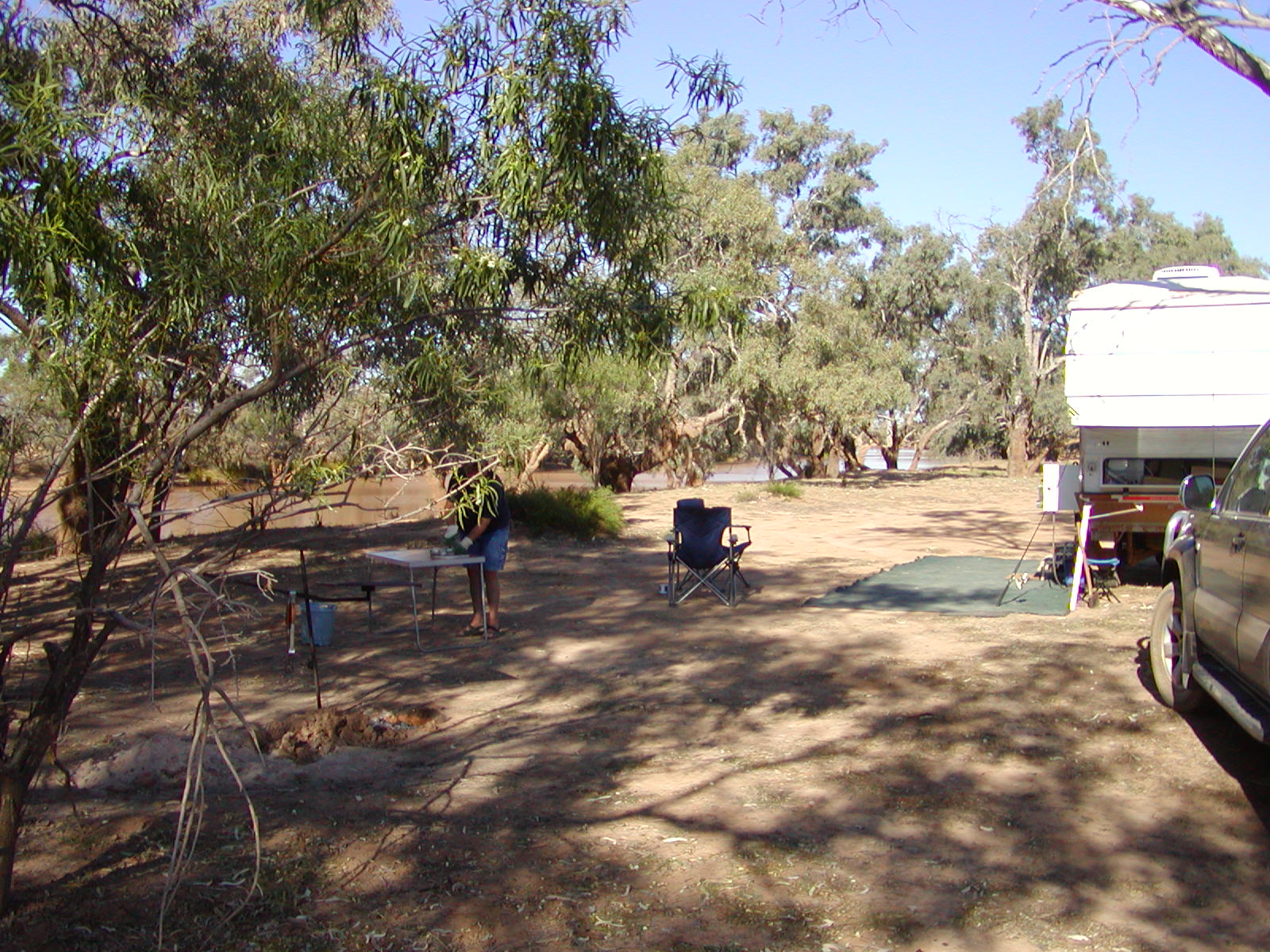
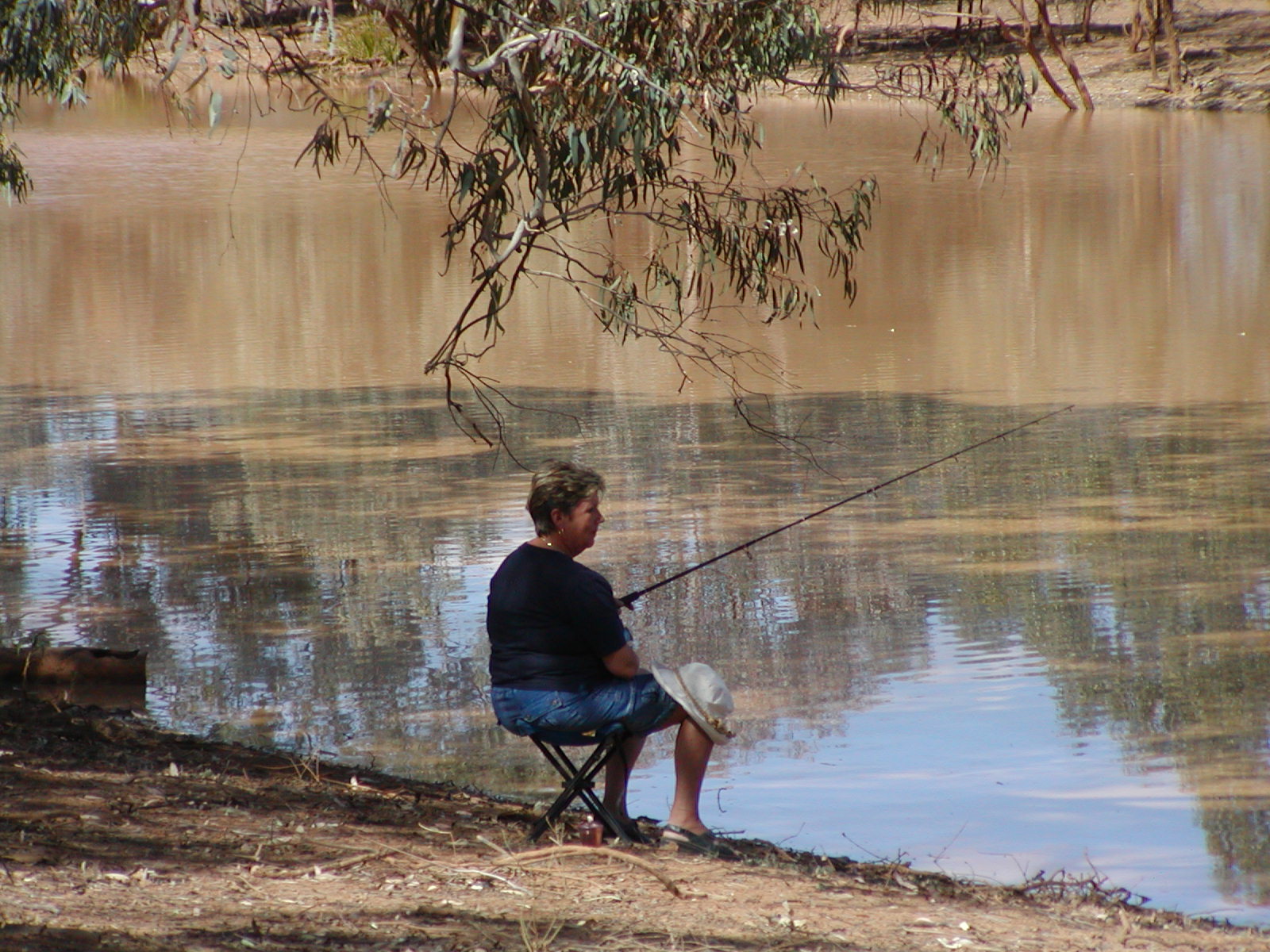
The terrain was more interesting, the dirt road quite good, and decided to camp on the Paroo River campground. Majestic Pelicans and ducks gracefully glide up and down the river like small battleships and galahs use the overhanging branches of riverside trees, to get a drink. Gnarly old Coolabahs, Acacias, a river, approximately 25 metres wide and I’ve got a craypot in and a line in also, trying to get a Yellow Belly.

Day 2

Caught a small catfish in the craypot, along with 2 shrimp, so before breakfast, I had a line in with the catfish as bait and almost immediately I was snagged AGAIN! Patience is required and a cup of tea!

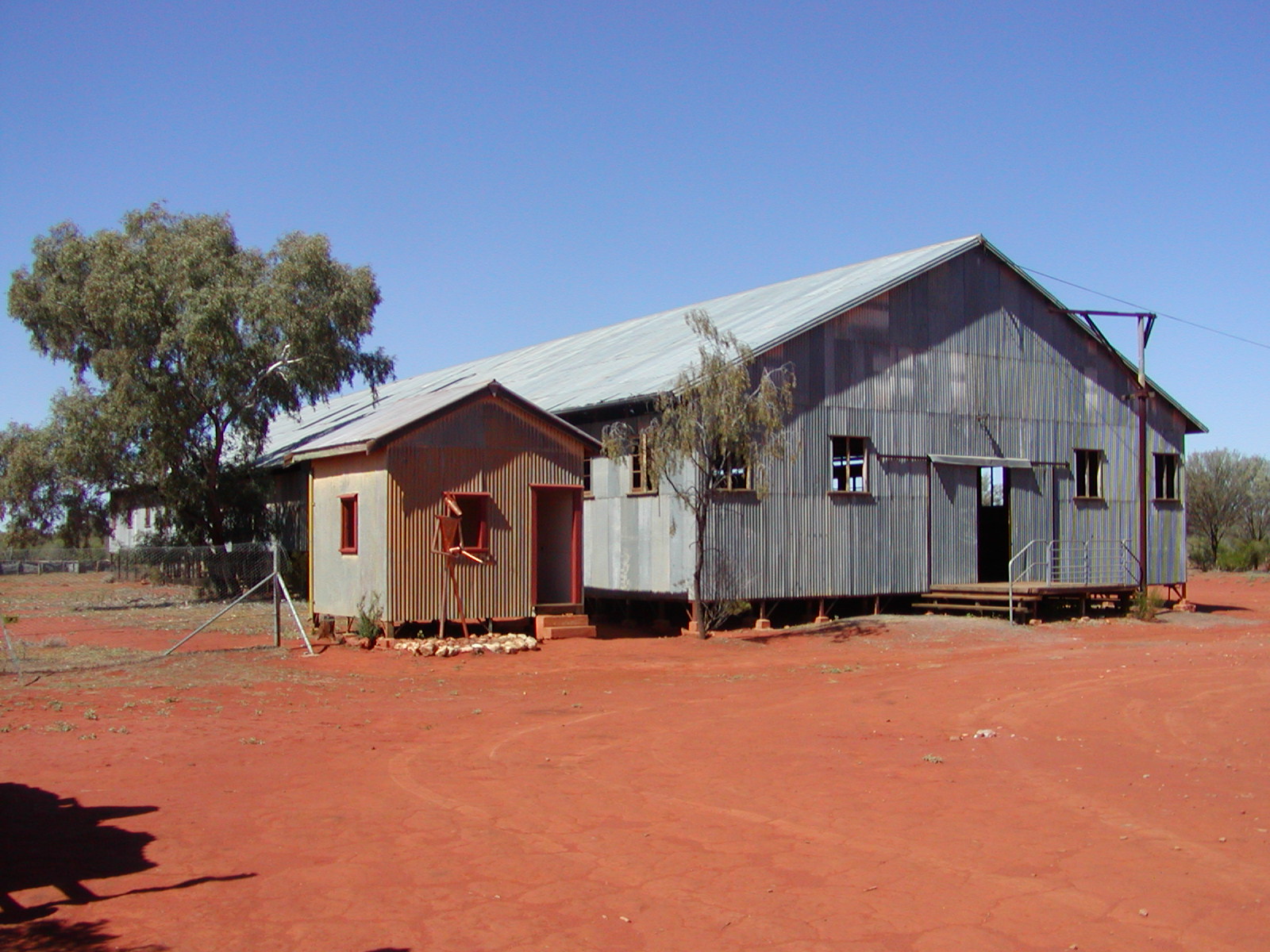
Set the line again, and the craypot, both of us had breaky and a shower, made lunch and set off to see the rest of the park. Firstly we saw the Ruins of the old Caiwarro Homesead, then travelled to the Caiwarro Waterhole. Then quite a long drive, down a wide red dirt roadway, until the turnoff to Currawinya Woolshed. A very large, solid building, still intact. This and three other shearing sheds were assembled from materials taken from a one hundred and ten stand shearing shed (shearing positions).
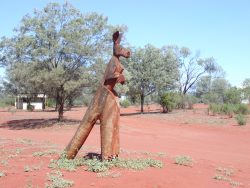
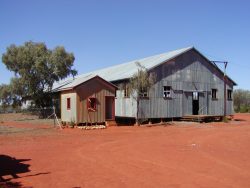
currawinya-kangaroo currawinya-woolshed

[Talking of shearing sheds, in Quilpie we met the World Champion female shearer, who is now running the Offshears Bakery. We looked through an album, photographing her achievements, one where she met the Queen in Geelong. She is quite an amazing young woman. She remains the World Champion to date!]

We lunched nearby at the Ourimperee Waterhole, where camping is allowed. This area had more shade, smaller trees and would be a lovely campsite in the future.

On the drive in we saw flocks of budgerigars and a pair of blue-winged parrots.

Later in the afternoon, after repairing and setting many fishing lines from snags, I asked Russ to pull in the line. To our surprise, there was a great sized Silver Perch on the end. How’s that for justice – I do all the work and Russ reels it in!! Cooked it in foil, with a sprinkling of onion, salt, pepper, lemon juice and tomato. Delicious.

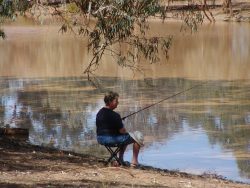
qld-trip-2007-10-028 marg-fishing-at-currawinya

Day 3

On rising, down to the craypot, collect the seven shrimps I’ll use for bait today and set the line, then breakfast. Within thirty minutes, a large silver perch was on the line and I was enthusiastic to continue. Every time I put a live shrimp on the line I had a result! We ended up with 2 good sized fish, put three little ones back and also put a shrimp back. Loads of excitement, exercise and a great tea ahead.

Late morning, we walked to the ruins of Caiwarro Homestead – probably 4kms, but as the crow flies – through bush. We found it to be rather hot, but very interesting. Part of the area we traversed is a protected aboriginals site and we could see signs of the past camps and many, fairly modern, artefacts. We thought that they may have been employed by the Station, and we were walking through their camp site.

To finish off a great day was a classic comment from Russ while sitting around the fire – “we haven’t seen a block of fudgerigars today”!!! We nearly fell off our chairs!!!

On leaving, we went back to the ruins, to photograph a Straited Pardelote, which had built its nest in the clay structure of the homestead fireplace. Unfortunately, the bird wasn’t there today, but the holes in the clay are the burrows to his nest, which, yesterday he protected fiercely.
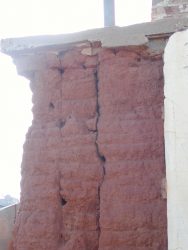
pardelote-nesting-holes-in-old-chimney

Posted in 2007 | Leave a comment

WINDORAH TO WELFORD NATIONAL PARK

Only a short distance to travel today, about 90kms, across the mighty Coopers Creek. What an amazing waterway! Down a one-lane bitumen road, with wide sides to access if road trains come the other way, but all we encountered were lots of cars, caravans etc. heading to Birdsville for the races next week.
Welford was a barren, desolate park, with poor signage, but eventually got to the Little Boomerang Camping Ground, on the Barcoo River.
We set up next to the river, near a River Red Gum on red earth, with a track leading to a real outback dunny. Not the greatest camp, but home for a night, nevertheless.
Onto Quilpie tomorrow.

camp-at-welford-on-barcoo-river coopers-creek-windorah

The photo on the right is of Coopers Creek near Windorah
The previous two publications were out of order – sorry about that!

Posted in 2007 | Leave a comment